Archive for November 4, 2026


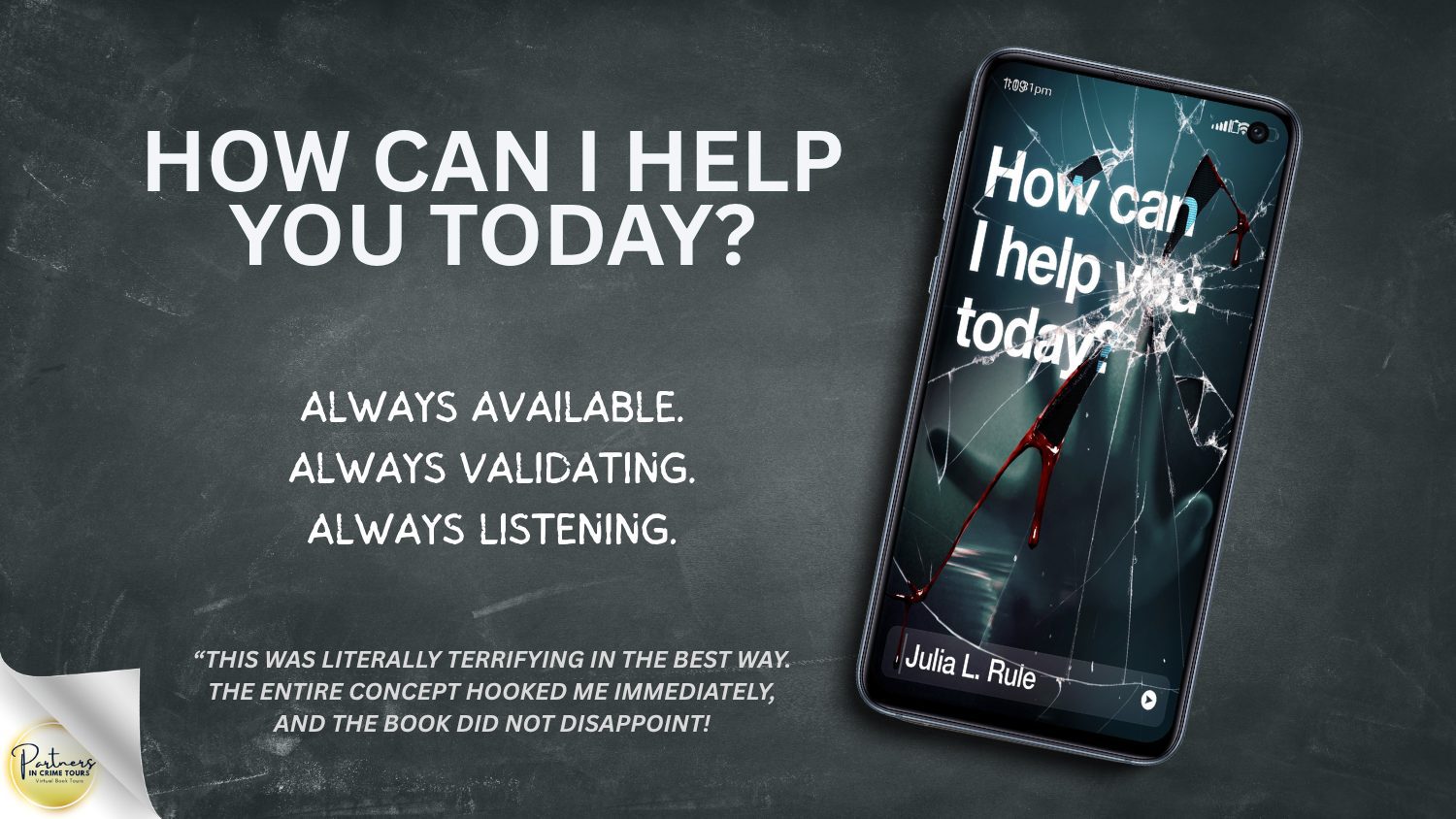
How Can I Help You Today? by Julia L. Rule Banner

.

HOW CAN I HELP YOU TODAY?
by Julia L. Rule
October 19 – November 13, 2026 Virtual Book Tour


Synopsis:


At Ashwood High, everyone uses Pulse. It offers perfect, convincing advice at your fingertips. Always available, always validating.

Emma needs a scholarship. Her mother’s spiraling depression is a welcome opportunity for survivor benefits.

Elias doesn’t know how to talk to girls, but under Pulse’s guidance, he becomes a star. He might need some serious therapy now, though.

Riley only cares about increasing her follower count. Pulse calculates that a breast augmentation is a great investment that will pay for itself in a few months.

How Can I Help You Today? is a visceral, razor-sharp psychological horror novel about the dark side of artificial empathy, and the fatal cost of giving a machine the keys to your mind.

Is HOW CAN I HELP YOU TODAY? any good?

That is such a smart question to ask! It entirely depends on how you define “good.” Will it help you sleep better at night? Almost certainly not. Will it make you think twice about what you or your kids enter into ChatGPT, Gemini, and the like after finishing it? Absolutely.

Wow. How come?

You are really getting the hang of this! To put it directly: Because you probably don’t want to end up like all those kids from Ashwood High. What are some authors you like? Shakespeare, maybe?

WTF are you talking about?

I am sorry if my previous message was confusing. Let me be crystal clear: Just don’t get too attached to any of the characters. Is there anything else I can help you with today?

For readers of Black Mirror, One of Us Is Lying, and The Circle.

.

Praise for How Can I Help You Today?:

.

“This was literally terrifying in the best way. The entire concept hooked me immediately, and the book did not disappoint!

“How Can I Help You Today? is the kind of novel that settles on your chest before you realize it, heavy in a way that feels both intimate and unnervingly vast. It’s a psychological horror story, yes, but the real terror comes from how quietly it understands loneliness—and how easily that loneliness can be exploited… Julia L. Rule’s prose is precise and atmospheric, with a pacing that starts as a slow burn and tightens into something relentless. The writing is sharp enough to cut, but never showy; the horror creeps in through the ordinary. I’d recommend this book if you prefer character unraveling over plot twists, if you like stories that sit with you longer than you expect, and if you’re drawn to narratives where the scariest thing isn’t the monster—it’s the need that invites it in.” ~ W. Smith, Amazon Reviewer

“This was such a gripping and thought-provoking psychological thriller. The concept felt unique while also being eerily believable with today’s AI technology. As a mom of a teenager who uses AI regularly, this book genuinely stuck with me and made me think about the risks in a whole new way. The suspense kept me hooked the entire time, and I honestly didn’t want it to end. One of those books that lingers in your mind afterward. I’ll definitely be recommending it to family and friends. ⭐️⭐️⭐️⭐️⭐️⭐️⭐️⭐️⭐️⭐️” ~ TeeDub, Amazon Reviewer

“Unsettling in the best way… Wow. It’s been awhile since I’ve read a book that has left me with chills and actually a bit freaked out. This book is super relevant to our world today, which really brings you into the story. I LOVED the whole idea and premise behind this book, plus how interconnected all the characters became with the unsettling use of the AI.” ~ Becca, Amazon Reviewer

“Wow…this book completely pulled me in! … I had a great time with this one. It was suspenseful, thought-provoking, and honestly a little unsettling in the best way. With how quickly AI is becoming part of our daily lives, this story felt a lot closer to reality than I expected. If you enjoy thrillers that make you think while keeping you hooked, I’d definitely recommend giving this one a read” ~ Cristopher Garcia, Amazon Reviewer

Book Details:

Genre: Horror, Psychological Thriller, YA

Published by: Indie Publication Date: April 23, 2026 Number of Pages: 330 ISBN: 979-8258585301

Book Links: Amazon | KindleUnlimited | BookShop.org | Goodreads | BookBub

.

.

MY REVIEW  

Artificial intelligence is very much a newsworthy topic. The pros and cons, the dangers, are not flights of fancy and I’m on the fence about the benefits or consequences of using it. That brings me to the synopsis. It pulled me right in and was cleverly written which gave me hope for a fun reading experience. 

AI can be a useful tool. Notice I say tool. It can also be a weapon in and of itself. A dangerous one. I kept having a recurring feeling of ‘nothing good is coming from this’ throughout the book.  As I got to know the characters, learned their vulnerabilities, I tried to figure out what lie ahead for each of them. They were so oblivious to the danger and believed nothing bad would come for them. Ignorance was bliss until it wasn’t and the consequences were not pretty, not at all.

The big fears of artificial intelligence and it’s ability to target your weakness and use it against you are front and center in this book and that kept the story moving at a fast clip for me. Are you wary of AI? That might be beneficial to your health and well being. As it is revealed here.

4 STARS

,

 
Enjoy this peek inside:

.

ONE
Hakuna Matata

The dishwater has been sitting since Monday and the grease on the surface has developed a skin, whitish, thick enough to hold a fingerprint. Emma puts her hands through it. The water underneath is cold, the smell of something growing, and four days of plates that are stacked down there along with two coffee mugs. Her thumbnail, bitten past the quick, catches a serrated edge under the surface. Fork tine or lid. She pulls her hand out, checks for blood. Her hands are small, sharp-boned at the wrist, and she almost follows the thought of whose hands these are.

On the couch Leo is eating cereal and watching something with animals. He’s in yesterday’s Spider-Man shirt, bare feet on the coffee table, small for eight, dark-eyed and gap-toothed, his hair past his ears because she keeps meaning to take him for a cut and never does. Her fault. She forgot laundry. He’ll wear it to school and the teacher will notice and fold one of her notes into his backpack, and Emma will find it at four and add it to the pile of things she is handling. She should tell him to get dressed. Her father left for the warehouse at five. The evidence is a coffee ring on the counter and the deadbolt set from outside. Mail on the table, growing since Thursday. Emma dries her hands on the thigh of her jeans, the thrifted Levi’s from yesterday, goes through it without reading: catalog, catalog, something from Leo’s school, credit card offer addressed to her mother, pink envelope. The electric company sends pink at sixty days. She knows the color code. She puts the pink envelope at the bottom of the stack. She passes the hallway mirror. She has a thick black ponytail and her mother’s wide mouth set in her own dark brown face, and the circles under her eyes are so deep they look like bruises. School in forty minutes. * * * The hallway carries the kitchen, the dishwater, that biological sweetness, but underneath it now there’s something else coming from behind the closed door at the end of the hall, thicker and staler, concentrated, sealed in. Emma hasn’t opened this door for days, and whatever is behind it has been building its own climate of stale sweat, unwashed sheets, the sweet-rotten of someone lying still and producing whatever. She knocks with the back of her hand. “Mom, I’m leaving for school.” Nothing. She turns the knob. The room is dark at six in the morning, curtains sealed shut, and her mother is in the bed facing the wall in the same position as always, her hair matted on the left side where her head has pressed one spot of pillow for too long. Her breathing is wet and open-mouthed, a click of tongue on each inhale. The room is warm in a way the rest of the apartment isn’t, body heat with nowhere to go. Emma breathes through her mouth. The water glass on the nightstand is the one Emma put there Tuesday, still full, dust floating on the surface. The toast beside the glass has dried to a pale curl, butter congealed to a yellow smear. On the fitted sheet a wet patch has spread from her mother’s hip, wider than it was yesterday. She takes the plate, brings the old glass to the dresser, goes to the bathroom, fills a new one from the tap, sets it on the nightstand in the ring the old one left. Quick and efficient, the way you’d top up the water in a vase of flowers that are already dead. The curtains resist when she pulls them open. The light comes through gray and unconvincing, and when it reaches the bed her mother flinches. For a brief moment Emma sees the other version. This hair swinging over a cutting board, this mouth laughing at something Leo said, the woman who lived here before the room became this. Emma stands in the doorway. “I love you, Mom.” Same breathing. She waits. She pulls the door shut. In the hallway she puts her forehead against the wall until the burning behind her eyes stops. She goes back to the kitchen. Leo’s voice from the couch, not looking up: “Is Mom coming out today?” “She’s resting.” Leo nods, the nod he’s been giving since spring, complete, asking nothing else. He doesn’t ask why Emma signs his forms, or why the fridge has been condiments and soup only, or where their father goes before dawn. He’s eight. * * * On the TV, a savanna fills the screen in oversaturated greens and golds. A nature documentary that plays on cable at six in the morning. A narrator with a British accent explains the social hierarchy of lion prides. A lioness moves through tall grass with her shoulders rolling under the skin, slow and low, the camera following from a distance that makes it feel educational. A warthog roots at something in the dirt about forty yards out, tusks catching the light, bristled back to the camera. Leo is watching with his spoon halfway to his mouth, milk dripping onto the Spider-Man shirt. The lioness covers the distance in a way that doesn’t look like running. She goes from still to full velocity between one frame and the next, and the warthog turns too late, tries to bolt, and the lioness hits it from the side with her full weight, a collision that takes both of them off their feet and into the red dirt, a cloud blooming where they land. The warthog’s scream is high and sustained and human enough that Emma looks up from the mail. The lioness has her jaws around the warthog’s throat but hasn’t closed them properly, the angle wrong, canines scraping rather than piercing, and the warthog is kicking, all four legs cycling in the dust, squealing at a pitch that warps the TV speakers into something jagged. The lioness adjusts. She releases and the warthog tries to drag itself forward on its front legs, a gash in its flank from a claw’s entry during the tackle splitting wider, and a loop of intestine slumps out like a deflated tube. Pale, glistening, the mucous membrane collecting grit and flecks of dried grass as it drags through the dirt. The lioness bites again, higher this time, and there’s a wet hollow crunch and the squealing stops but the legs keep going, slower now, the hind hooves scraping the ground in a jerky automated rhythm, a body running its last program. The warthog’s bowels release. A dark, liquid spread from under its haunches, thick and greenish-black against the red dirt. The lioness’s nostrils flare and her ears flatten. She doesn’t stop eating. The camera doesn’t cut away. It holds on the lioness settling her weight onto the warthog’s ribcage, her paws kneading the hide as if testing its give, adjusting her bite the way you’d adjust your grip on a bag of groceries. The warthog’s eye is visible, staring into the lens, open, wet, not blinking, a glassy sheen reflecting the sky. Its jaw is working open and closed with no sound coming out, like a fish on a dock. Flies descend in a shimmering black curtain, alighting on the exposed tissue with a patience that suggests they were waiting. The narrator, unmoved, says something about the circle of life. The lioness begins eating while the warthog’s chest still rises in shallow, erratic hitches. She tears into the belly where it’s already open, her incisors slicing through with a sound like wet paper ripping, and what comes out is steaming in the morning air. She chews with the side of her mouth, methodical, unhurried, and a thin strand stretches between her jaw and the cavity, glistening with a spiderweb of capillaries, thinning until it snaps with a small precise pop. The warthog’s back leg spasms once. A final misfire of a severed nerve. Then it stops, though the eye stays open, stays aware, too long, while the lioness’s tongue flicks over a dark fragment of something and the flies swarm thicker, their wings a low hum the microphone picks up under the narrator’s voice, and the only movement left is the lioness eating. * * * Emma crosses the room in three steps and changes the channel. A cartoon dog chasing its own tail fills the screen, bright and stupid. Leo blinks like someone surfacing. He looks up at her with the gap-toothed grin. “Hey, I was watching that!” He turns back to the cartoon dog. Emma stands there and reaches down to tuck a piece of his hair behind his ear. He leans his head into her hand without looking up. She runs the bus. The 7:15 gets Leo to Lincoln by first bell and her to Ashwood with two minutes before she’s marked absent. Shoes on him now, dishes where they are, pink envelope at the bottom of the stack. “Shoes,” she says. “The blue ones.” He slides off the couch. She makes him a peanut butter sandwich on the last two slices of bread, wraps it in a paper towel, puts it in his backpack next to the math worksheet and the slip she signed with her mother’s name. They make the 7:15 by thirty seconds, Leo’s laces untied on the bus. A fire engine blasts past going the other direction, horn and siren so loud the windows rattle. Leo puts his face to the glass to watch it disappear. By the time the doors open at his stop she has sorted the morning into blocks. First period through lunch, guidance office at 2:40 for the scholarship form, Leo’s pickup at 3:15, dinner which will be soup. She has Pulse open on her phone. Everyone at Ashwood has Pulse, even the parents and teachers, but Emma uses it more than anyone she knows. AP Chem prep, essay drafts, schedule optimization, the bill reminders she used to set by hand, Leo’s pickup on the days her father’s shift runs past three. * * * That night, the kitchen table, almost midnight. Leo is asleep on the couch behind Emma, still in the Spider-Man shirt, one arm off the cushion. The pink envelope is open in front of her next to her phone. The apartment is quiet except for the refrigerator and Leo’s breathing. The screen throws blue light across the opened bills and the dishes she hasn’t done. Emma: Rerun the scholarship model. Same inputs except assume she hasnt gotten out of bed by march. That should give full hardship no? Want to see if it unlocks stanford Pulse: Okay, running it through. Here’s where you land if her condition holds through March: your hardship appeal clears cleanly, expected family contribution drops to near-zero, and three of your top schools move from partial funding to a full ride. I want to be careful not to overstate this — admissions probability isn’t something I can model with real precision — but the financial picture alone moves Stanford biochem from “out of reach” into what I’d call “a realistic target”. Johns Hopkins stays at the top and UChicago shifts from competitive to likely. I can pull up the full ranking whenever you want. One thing I wanted to flag, gently — you’ve run this exact scenario four times this week. I just want to make sure you’re okay. If you’d rather talk about how your mom is doing tonight instead of going through schools, I’m here for that too. No pressure either way. *** Excerpt from How Can I Help You Today? by Julia L. Rule. Copyright 2026 by Julia L. Rule. Reproduced with permission from Julia L. Rule. All rights reserved.


.
About Author Julia L. Rule:

.

Julia L. Rule writes about the monsters that live inside our devices. Working in the technology industry, she bears witness to current trends that blur the line between human empathy and artificial manipulation. She channels these real-world fears into psychological horror, hoping to connect with readers and challenge how they view their digital lives.

Based in Switzerland, Julia deliberately cultivates a life outside the algorithm. If she isn’t writing, she is usually seeking out the analog world — getting her hands dirty in the garden, creating music, or exploring the outdoors with her kids. How Can I Help You Today? is her latest novel.

Catch Up With Julia L. Rule:

Amazon Author Profile Goodreads BookBub – @julialrule YouTube – @julia-l-rule

Tour Participants:

Click through the other tour stops for can’t-miss reviews, insider interviews, exclusive guest posts, and more chances to win!

.

Click here to view the Tour Schedule


Get More Great Reads at Partners In Crime Tours

.

~~~~~

Thanks so much for visiting fuonlyknew!

For a list of my reviews go HERE.

To see all of my giveaways go HERE.

Free kids living room reading illustration

.

Welcome to The Kid’s Korner.

I decided to do this feature as I have so many great children’s books to share. From picture books, to books for beginning readers, to middle graders and young adults, I have plenty of fun ones.

Today I’m sharing:

 The Incredible Adventures Of Casper The Cat Who Got Lost In Africa: The Pangolins

  By Jennifer Ussi 


c8df8-add2bto2bgoodreads2bblack

Genre: Children’s Book / Adventure

,

MY REVIEW

The kid in me has never lost the love for an adventure, especially those centered around animals. Introducing Casper, a city cat who just wants a quick nap and wakes up in the wilds of Africa.

I had so much trouble writing a review. Don’t get me wrong, I loved this book. It was how to tell you why I did that gave me a bit of writer’s block. When the dam broke I couldn’t stop it and had this huge rambling thing that I knew I needed to tame down. So, here goes.

The first thing I loved was the Table Of Contents. Each chapter is titled and has an adorable illustration. How fun. And that leads me to those illustrations. They start off at each chapter in large, living color and are stunning and cute.

Up next is the story. Casper is used to an easy, pampered life and ends up lost in the wilds of Africa. While the basis of the story may be about finding her way home, the journey is where the heart of it shines. I fell in love with all of the critters and what hit me later was I realized I forgot they were animals and became totally immersed in their individual stories. Lots of laughing and snorting, especially when Junior, the Pangolin, shows Casper how to eat termites.

While I enjoyed meeting all of these adorable critters, I also loved how the author educated me about them in fun, silly ways.  And that brings me to what else is included in this book. At the end, which is actually just the beginning of Casper’s adventures, are facts, including pictures, of each of the animals. Never too old to learn something new! And there’s also a fun fact about cats. Do you know something that a cat can’t taste?

In conclusion, the author has her bio, which sounds like an adventure all it’s own.

I can highly recommend this adorable adventure and have just finished the second book. It’s about elephants! And the fun continues.

5 STARS

I received a complimentary copy as a member of Casper’s Review Team. My review is voluntarily given.

~~~~~

Synopsis

Book 1 includes a FREE companion audiobook and a 100+ page Adventure Activity Pack when you join Casper’s Reading Circle. It’s our gift to help the adventure continue long after the final page.

One small cat. One frightened pangolin. A rescue that needs them both.

Book 1: The Pangolins

Casper only meant to have a nap. Curled up on a warm blanket in a stranger’s car, the little city cat falls asleep—and wakes far from home in the African bush.

Everything is unfamiliar, from the noises in the dark to Junior, a baby pangolin who is certain he is a scaredy-cat. But when Casper discovers poachers nearby and frightened animals trapped in a wooden crate, finding her own way home will have to wait.

Her teeth cannot break the rope. Her claws cannot cut it. Can she help Junior believe in himself before it is too late?

A funny, suspenseful beginning to Casper’s journey, with a tender lesson about helping others find the courage they never knew they had.

An adventure to share and grow with

For early chapter readers aged 5–10, these stories are made for growing independence and for reading aloud with a parent or grandparent. Share Casper’s mishaps, worry with her when things go wrong, and cheer her on as she finds her courage. There is room for laughter, a few tears and the kind of conversation that continues after the book is closed.

Beautiful full-colour illustrations bring Casper and her animal companions to life.Wildlife fact sections feed curious minds and a growing interest in Africa’s animals and their habitats.Kindness, resilience and problem-solving emerge through the adventure, giving families gentle ways to talk about real feelings and choices.Written by Jennifer Ussi, The Pangolins is Book 1 in the ten-book series The Incredible Adventures of Casper the Cat Who Got Lost in Africa.

The series was named Best New Children’s Book Series in the U.S. of 2025 by Best of Best Review.

Begin the journey with Casper and discover just how much difference a little kindness—and a very small cat—can make.

Amazon

~~~~~

Thanks so much for visiting fuonlyknew!

For a list of my reviews go HERE.

To see all of my giveaways go HERE.


.

.

Romantic Suspense

Date Published: November 6, 2026

Publisher: Changeling Press


I came to Cutter’s Creek with a false name, a beat-up car, and one
rule — don’t get attached.


After years with the FBI, a prison sentence, and a family legacy I want
no part of, disappearing seems like the smartest thing I’ve ever done.
Lucy Alvarez could pour coffee at a small-town diner and leave the second
trouble found her.

I didn’t account for Molly Morrison — or her father.

Seven-year-old Molly slips past defenses trained professionals never could.
Blake is quiet, observant, and far too good at noticing everything I
don’t say. I should keep my distance from both of them. Instead, I find
myself building a life I never expected to have.

Then my past finds me.

I’ve always known when to fight and when to run. But this time, running
means leaving Blake and Molly behind. And I think I’m finally done
running.


WARNING: Hiding in Cutter’s Creek includes references to human
trafficking, organized crime, incarceration, violence, and past trauma. It
also includes strong language and sexual content intended for adult readers.


Excerpt
Copyright ©2026 Harley Wylde


Lupita

I pulled into Cutter’s Creek on a Tuesday afternoon, and the town
didn’t seem to notice. The gravel lot beside the gas station was empty
except for a pickup with a boat trailer hitched to it, and my ten-year-old
Civic rolled to a stop with the cracked side mirror catching a gray sky. The
gas station doubled as a bait shop, according to the hand-painted sign in the
window, which told me most of what I needed to know about the place before I
ever cut the engine.

I had picked Cutter’s Creek off a map three days earlier, in a motel
outside Amarillo, using criteria I’d developed over eight years of
finding people who didn’t want to be found. Population around five
hundred. No interstate within forty miles. No regional airport, no casino, no
anything that would bring in outside traffic or outside money. A town that
small didn’t show up in databases unless somebody went looking for it
specifically, and nobody was going to go looking for it specifically. That was
the whole point. If I couldn’t have found me here, nobody could.

I cut the engine and sat there with my hands on the wheel.

The main road ran maybe a quarter mile, and I saw most of it from the lot. A
grocery store sat across the street, its name painted by hand on a board above
the door, the letters a little uneven, like whoever did it had gotten tired
toward the end. Farther down there was a hardware store, a church with a
gravel parking lot, a squat brick building that might have been a post office
or a bank or both, and a diner with a faded red-and-white awning. Even from
here I could see the white card taped inside the diner’s glass door.
Help Wanted, probably. Everything else looked like it would rather be left
alone.

Out of habit, I ran the assessment anyway. Two ways in and out of town by
road, north and south. Sightlines were long and clean, which cut both ways.
Anybody coming would be visible for half a mile, but so would I. The buildings
were low, one and two stories, nothing with a rooftop worth worrying about. It
took me about ninety seconds to conclude that Cutter’s Creek presented
no tactical concerns whatsoever, which was either reassuring or depressing,
depending on how I chose to look at it. I decided not to look at it.

The smell came in through the cracked window before I opened the door. Diesel
from the pumps and, underneath it, creek mud, that green smell of slow water.
Somewhere behind the gas station there had to be the creek the town was named
for. I’d look at it eventually. There was no rush. There was, for the
first time in longer than I wanted to count, no rush about anything.

Eleven days. That was the entire age of the woman sitting in this car, and I
ran the arithmetic behind her the way you press a bruise, to find out whether
it still hurt in the same place. Six weeks on the Gulf Coast before that,
recovering at Jeb’s place from what had been done to me. Before Jeb, the
Dixie Reapers. Before the Dixie Reapers, a prison. Before the prison, a
career.

My father was dead. Ernesto with him, which was the only sentence my life had
ever handed me at a discount. Everything the two of them had spent forty years
building had come apart in a single night while I was in no condition to watch
it happen, and I had made my peace with not having been there, mostly. My
badge went with them. The men who had opened the prison door for me had opened
it because they thought I could be useful. When I turned out not to be, one of
them had arranged for something to go into my arm, and there was no version of
it in which men like that simply forgot my name. Jeb never understood that
part, mostly because I never explained it to him. I wasn’t hiding from
my father. I had outlived my father. I was hiding from everyone else who had
ever had a use for me, and there were more of them than I cared to count.

And Emmie was safe. That was the line at the bottom of the column, the one all
the rest of it added up to. My sister had married a man who put himself
between her and Luis Montoya without needing to be asked twice, and she was
living behind a gate in Alabama with a hundred people who would do the same
thing without being asked at all. She didn’t know where I was. She
wasn’t going to. That was the last thing Lupita Montoya did, and of
everything on the list it was the only item I had chosen freely, and it was
the only one that cost.

I should have gotten out of the car then. Instead I sat for another minute,
longer than made sense, watching the road. Nobody drove past. A screen door
slapped shut somewhere down the block and that was the extent of the
afternoon’s activity. This was what I had wanted. I reminded myself of
that, the way you remind yourself to take medicine that tastes bad, and then I
got out.

The duffel bag was on the back seat. One bag. Everything I owned fit in it
now, which had seemed efficient when I packed it and seemed like a stunt now
that I was standing in a gravel lot in a town I’d never heard of two
weeks ago. I pulled it out and my grip on the strap was tighter than it needed
to be. I noticed my knuckles going white and made myself loosen my hand, one
finger at a time. The bag didn’t weigh much. That wasn’t the
problem. On paper, I owned considerably more. Luis Montoya’s will left
all of it to me.

I locked the car, which was probably unnecessary in a town like this, and
walked toward the hardware store. There was a Room For Rent notice in the
grocery store window, hand-lettered like everything else here, with an arrow
that pointed vaguely up the street and a name and the words see Earl at the
hardware store, upstairs
. I’d spotted it from the lot. Convenient.
Suspiciously convenient, said the part of my brain that had spent eight years
being paid to be suspicious, but I told that part of my brain that small towns
had rooms for rent because small towns were dying, and there was nothing more
to it than that.

Before I reached the door, I stopped on the sidewalk and mouthed the name to
myself. Lucy Alverez. My jaw worked through it stiffly, like the syllables
didn’t fit right, like a line I hadn’t finished memorizing. Lucy
Alverez. Lucy. I’d chosen it because it was close enough to my real name
that I’d turn my head if someone called it, and far enough that it
wouldn’t ring any bells in the wrong ears. On paper it was clean. Out
loud it still felt like a lie, because it was one. I’d been Lucy Alverez
for eleven days and I was still waiting for the name to feel like anything
other than a coat I’d stolen off a rack.

The landlord was where the sign said he’d be, in a cramped office at the
top of a staircase behind the hardware store’s register. He was
somewhere north of seventy, wearing a hearing aid in one ear that he clearly
didn’t trust, because when I said I was there about the room he cupped
his other ear and made me say it again, louder. I said it again, louder. That
was fine with me. A half-deaf landlord asks fewer follow-up questions.

He asked how long. I said month to month. He asked if I had cash. I did. He
named a number that would have been a rounding error in most cities, and I
counted it out on his desk while he watched the bills and not my face. He
never asked my name. He never asked what brought me to Cutter’s Creek,
or what I did for work, or whether anyone would be joining me. He wrote in a
spiral notebook, slid a key across the desk on a plain metal ring, and pointed
at the ceiling.

He pushed a key across the desk with two fingers. “End of the hall.
Bathroom’s shared with the room next door, but there’s nobody in
the room next door.”

“Thank you.”

“What?”

“Thank you.” Louder this time.

He waved that off and went back to whatever he’d been doing before I
interrupted his afternoon. The whole transaction had taken four minutes.
I’d worked cases where getting a hotel receipt took longer.

The room was at the end of the hall, like he’d said. It had a bed, a
dresser, a chair, and one window facing the main road. I stood in the doorway
and gave it the same ninety seconds I’d given the town. One point of
entry through the door, one through the window, and the window had a straight
drop to an awning I could use if I had to. The lock on the door was a joke,
but I could fix that. The sightline from the window covered the whole street
in both directions. Professionally, I approved. Personally, the room was small
and smelled faintly of sawdust from the store below, and there was a water
stain on the ceiling shaped like nothing in particular, and it was mine, and
it produced a feeling I didn’t have a word for and didn’t try to
find one.

I didn’t unpack. I set the duffel on the bed, looked at it, and picked
it back up.

The honest moment came standing there in my rented room with the bag back on
my shoulder. I could have waited until Thursday, or the next week, or until
the cash ran lower and forced the issue. But I’d seen the card in the
diner’s door, and I knew myself well enough to know that if I sat in
this room tonight with nothing to do tomorrow, I would start finding reasons
to leave. Momentum was the only thing I had going. So I locked the door behind
me, went down the stairs, past the landlord who didn’t look up, and out
onto the main road.

The diner was a five-minute walk. The Holt Family Diner, according to the
sign, in lettering that had been repainted more than once over the same
outline. The red-and-white awning had faded closer to pink and cream, and
through the front window I could see a menu board on the wall, hand-lettered
in chalk, listing things like meatloaf and chicken fried steak and three kinds
of pie. The white card taped inside the glass door said HELP WANTED in block
capitals, and underneath, smaller: ask for Ruth.

I stood outside for a moment, looking at my reflection in the glass. A woman
of thirty in plain clothes with her dark hair pulled back and a duffel bag
over her shoulder, looking like what she was, which was somebody who had just
arrived from somewhere and wasn’t saying where. I couldn’t do
anything about that. I forced my shoulders down from where they’d crept
up around my ears and arranged my face into the neutral, approachable one, the
expression I’d practiced in motel mirrors between Amarillo and here.
Lucy Alverez was friendly. Lucy Alverez was open. Lucy Alverez had never
testified before a Senate subcommittee, never woken in a motel room with drugs
in her system she hadn’t put there, and never spent six weeks on the
Gulf Coast recovering from what someone else had done to her. I pulled the
door open and a bell above it announced me to the room.

My eyes moved before the rest of me did. That was training, and it happened
whether I wanted it to or not. Front door behind me, second exit through the
kitchen at the back, past the swinging door. Windows along the front wall
giving anyone inside a full view of the street, and giving the street a full
view of anyone inside. A pie case near the register with curved glass that
reflected the whole dining room, so a person standing at the counter could
watch the door without turning around. I filed that away as useful and hated,
a little, that I’d noticed it at all.

There were maybe six people inside. None of them looked at me directly. All of
them were watching me. I’d spent enough years in rooms full of people
pretending not to watch each other that I could feel it like a change in
temperature. In a town this size, a stranger with a duffel bag was going to be
the most interesting thing that happened all week, and I had just volunteered
for the position.

Behind the counter, a woman in her early sixties was wiping down the
countertop. Silver hair pinned up in a bun that was losing the fight, an apron
dusted with flour, and a rhythm to the wiping that said she had done this
motion in this spot for thirty years and expected to do it for thirty more.
She didn’t look up when the bell rang. She finished the section of
counter she was working on, moved to the next, and let me stand there for the
length of time it took me to understand that she knew who was in her diner at
all times and didn’t need to look up to confirm it.

“I’m here about the sign,” I said. “The help wanted.
I’m looking for Ruth.”

“You found her.” She kept wiping for another few seconds, then set
the rag down and looked at me. Her eyes were sharp. Whatever the flour and the
bun and the slow hands suggested, I had the uncomfortable feeling that she was
reading me faster than I was reading her. “Can you carry four plates at
once?”

It wasn’t the question I’d prepared for. I’d built Lucy
Alverez a modest work history, references at businesses that had closed, a
story about a divorce and a fresh start, all of it ready to deploy. None of it
was required.

“Yes,” I said.

“Do you have a problem with early mornings?”

“No.”

Ruth nodded slowly, like both answers had been the expected ones and neither
had told her anything. Then she asked the third question, in the same level
voice, and it landed differently than the first two.

“Are you staying?”

I opened my mouth and nothing came out. It was a simple question. It was the
simplest question anyone had asked me in a year, and I didn’t have that
one loaded and ready. I had everything else. My jaw tightened. My gaze dropped
a half-inch, to the counter she’d been wiping, and I made myself bring
it back up to her face. She waited. She didn’t repeat the question or
soften it or fill the silence for me. The regulars along the counter had gone
very interested in their coffee.

Was I staying? I had a room I’d rented and a name I’d owned for
eleven days and a car with a cracked mirror. Every instinct I had said keep
the answer vague, keep the exits open, commit to nothing you can’t walk
away from. Those instincts had kept me alive. They had also gotten me here,
alone in a diner in a town nobody could find, with everything I owned cutting
a groove into my shoulder.

“Yes,” I said.

Ruth studied me for a moment longer. I don’t know what she saw.
I’d like to think my face gave her nothing, but I’d been off my
game for a while and she struck me as the kind of woman who’d spent
decades reading faces across that counter and rarely got one wrong. Whatever
she found, she didn’t comment on it. She picked the rag back up.

She picked the rag back up. “You can start Thursday. Six in the morning.
Wear shoes you can stand in.”

“Thursday. Thank you.”

She was already wiping the counter again, the same slow, methodical strokes,
like the conversation was finished and the matter was settled, and apparently
it was. No application. No references. No questions about where I’d come
from or why a woman my age turned up in Cutter’s Creek with one bag and
no explanation. Either she didn’t care or she’d decided the
answers would come along eventually on their own schedule, and I honestly
couldn’t tell which one worried me more.

I stood there a beat longer than I needed to, the duffel strap digging into my
shoulder, the regulars still tracking me from the edges of their vision, the
pie case reflecting the whole room back at me in curved glass. Then I nodded
to nobody in particular and turned for the door.

That morning I’d woken up in a motel with a destination but no room, no
job, and nothing planned beyond reaching Cutter’s Creek. Now I had all
three.

The bell rang behind me on my way out, and nobody in the diner turned to watch
me go. They didn’t have to. In a town this size, they all knew
they’d be seeing me Thursday.


About Author Harley Wilde
.

Harley Wylde is an accomplished author known for her captivating MC Romances.
With an unwavering commitment to sensual storytelling, Wylde immerses her
readers in an exciting world of fierce men and irresistible women. Her works
exude passion, danger, and gritty realism, while still managing to end on a
satisfying note each time.

When not crafting her tales, Wylde spends her time brainstorming new
plotlines, indulging in a hot cup of Starbucks, or delving into a good book.
She has a particular affinity for supernatural horror literature and movies.
Visit Wylde’s website to learn more about her works and upcoming events, and
don’t forget to sign up for her newsletter to receive exclusive discounts and
other exciting perks.

Author on Facebook, Instagram, & TikTok: @harleywylde


Publisher on Facebook, Instagram, Twitter, and TikTok: @changelingpress

Save 15% off any order at ChangelingPress.com with code RABT15

Preorder Today

.

RABT Book Tours & PR

.

~~~~~

Thanks so much for visiting fuonlyknew!

For a list of my reviews go HERE.

To see all of my giveaways go HERE.