Posts Tagged ‘excerpt’


.

On the road to music fame,

desire and dreams collide.

.

.

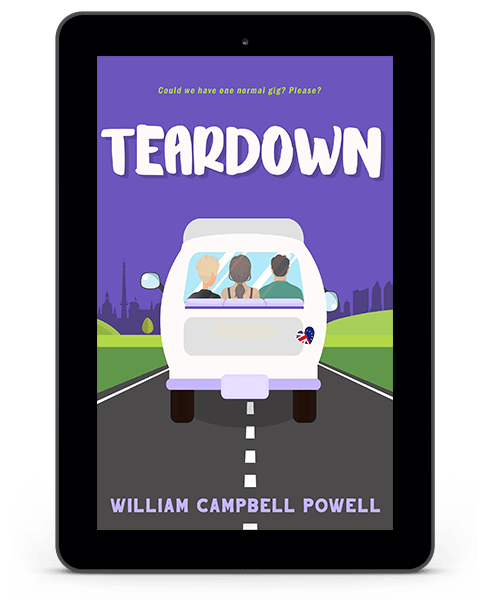
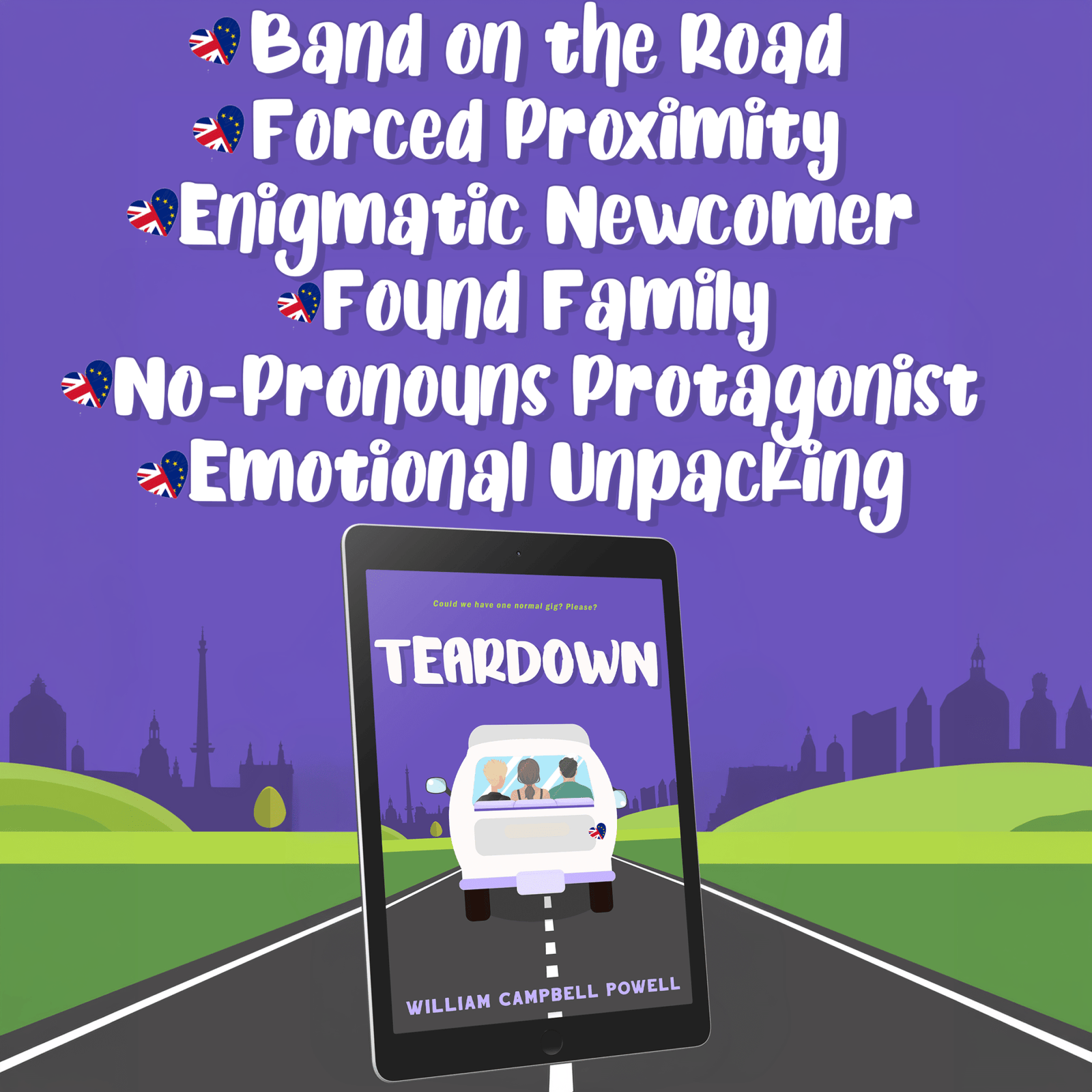
Teardown

by William Campbell Powell

Genre: LGBTQ+ Contemporary Fiction

Growing up in a dead-end, Thames Valley town like Marden
Combe, Kai knows there’s no escape without a lot of talent, hard work—and luck.

Two weeks before the Clayton Paul Blues Band plans to set out on tour to
Germany, their singer quits, and drummer Kai takes matters in hand. With
bandmates Jake and Jamie, they recruit a talented new singer—the enigmatic
Dominique—as the new face of the band and set out on the road to Berlin in a
rickety white van.

Dogged by mishaps and under-rehearsed, the band stumbles through their first
shows, zig-zagging between chaos and brilliance. But as the first gig in Berlin
draws near, the band begins to gel. They’re clicking with their audience, and
even the stone-hearted Kai starts to crumble under the spell, first of Dom and
then…of Lars.

As the end of the tour approaches, Kai must make hard choices. Dom? But she’s
keeping a dark secret. Lars? Not after the acrimony of their last parting. The
band? Or will that dream crumble too?

**On Sale for Only .99 cents on Amazon!**

Amazon * Books2Read * Bookbub
* Goodreads

.

.

Can you, for those who don’t know you already, tell something about yourself and how you became an author?


Growing up, I loved reading. My dad was a book salesman, selling academic books to schools and universities, and he kept samples in easy reach of very-young me. Oh, and there was a science-fiction sample there, too, all waiting for me to lap up. Deliberate? Possibly. I like to think so.


Writing-wise, I enjoyed just one creative year at school, when I clicked with one particular English teacher. It wasn’t until the late 1990s or early 2000s that I next picked up a pen opened up Microsoft Word and resumed creative writing. I like to think it was Ray Bradbury who said a writer’s first million words don’t count (because I reckon him my most inspirational writer). In any case, it took me 3 or 4 books (around 300 thousand unpublishable words) to serve that apprenticeship. In 2002 I was diagnosed with a very rare blood disorder, which for all its scary prospects, gave me time to write and improve. Obviously, I survived, and kept the writing habit. I sold my first novel in 2012.


What are some of your pet peeves?


Pictures that aren’t hung straight. Books where the writer leaves nothing to the imagination and/or leaves all their research showing. Bagpipes.


Where were you born/grew up at?


I did most of my growing up in Birmingham, England. It had (and still has) a vibrant live music scene, great food (it is where Balti curries were invented) and some of the best music- and book-shops (sadly now gone). My friends from that era are still my friends today. Stories that Birmingham has no-go zones and Sharia law are total bollocks.


If you knew you’d die tomorrow, how would you spend your last day?


My first thought on reading the question was that I’d probably be in prison, having offended a right-wing government with my unashamed left-wing politics. So maybe I’d be walking the exercise yard, under the steely gaze of UK Nazis.


However, quite a few years ago I had the misfortune to fall ill with a rare blood disorder, which was sufficiently serious that I needed to re-evaluate what was important to me. Families and friendships were what mattered, rather than ticking off a bucket list. So if I’m not in prison and have a choice, I’ll be spending that last day with family and friends, reminiscing on times, places and events that we’ve shared. We’ll be somewhere quiet and peaceful, sharing good food and a little wine, and laying down some final memories.


Who is your hero and why?


I’m not a career writer, but a software engineer by profession. It’s a male-dominated profession, so my heroes are some of the women who broke through the ceiling and did amazing things. Margaret Hamilton is one. She was the boss of the team that wrote and tested all the onboard software for the Apollo Command and Lunar modules. Her work – which was recognized as having prevented a disastrous landing of the Apollo 11 mission – has been called “the foundation for ultra-reliable software design.”


In similar vein, look up the story of Katherine Johnson. Her story is told in the movie ‘Hidden Figures’.


What kind of world ruler would you be?


Well-intentioned but probably overwhelmed. I’d always want to do the right thing, but politics doesn’t always offer an unambiguous right thing. So I’d probably get deposed pretty quicky, possibly guillotined.


What are you passionate about these days?


Live music tops my list. Now that I’m no longer a particularly active musical performer (though I do write and record music) I love to discover up-and-coming musical talent. I’ve just got back from our second music festival this year.


What do you do to unwind and relax?


Listen to music. Listen to an audiobook. Read a book. Write a song.


How to find time to write as a parent?


Wait until everyone else has gone to bed. Write between midnight and 2am. I can write between 500 and 1000 words in that time. Yes, my sleep did suffer. But the kids are grown up now and leading their own lives, so it’s not a problem any more.


When did you first consider yourself a writer?


I first considered myself a writer when Tor Teen bought my novel EXPIRATION DAY in 2012. They paid an advance, which I reckoned meant I’d arrived. But I’ve changed my opinion there. Self-publishing and hybrid publishing are other options for writers. And you become a writer when you write, not when you publish. So I now consider I’ve been a writer since I started writing, in the late 1990s.


Do you have a favorite movie?


The Princess Bride is certainly up there. But the Muppet Christmas Carol just pips it. It’s our family movie, the one that we all sit down together for.


As a writer, what would you choose as your mascot/avatar/spirit animal?


I’d say a cat. They’re so easily distracted by laser pointers. My equivalent is Wikipedia.

.

.
.

Chapter One

Sunday, September 18, 2016

The Band Hut, Marden Combe


The bus stank of commuters. It wasn’t like a night bus, granted, but
the mix of sweat and cheap scent—and the pungency of diesel—was another
reminder of how much I hated Marden Combe.

A Thames Valley town like every other Thames Valley town, Marden Combe
had a posh, blingy bit, where the bankers, footballers, and celebrity chefs
lived. The rest ran the spectrum from dilapidated through demolished to barely
affordable modern rabbit hutches. The old town centre was closing down, and the
new shopping centre was gridlock hell.

The bus lurched and swung left, past a school named for a long-dead
parliamentarian. Or possibly a royalist. I ought to know; it had been my old
school till I’d turned sixteen. But it had all seemed irrelevant to the more
immediate problem of not getting picked on for being different. There were a
dozen ways and more to be different, whether it was for being too ugly, too
geeky, too slow on the uptake, too shy, too dark, not dark enough, having a
funny accent, or a fundy religion, or being neurodivergent, being too posh,
being too poor, liking the wrong music, or football team, or playing oddball
sports, or using last year’s tech; not liking girls, not liking boys, not
liking either, liking both. Plus others, plus combinations. By more than one
marker, I was weird, and I hadn’t always kept my head down. But there’d
definitely been no bullying at Sir Long-Dead-Parliamentarian School. Or
Royalist, as the case may be. Oh no.

That didn’t come close to summing up the suffocating, hope-crushing,
soul-sucking, shit-brown hole that is Marden Combe. I needed to escape.

If I had a plan, it was that music would save me, as currently embodied
by two pairs of drumsticks in my backpack and the cymbals in their hardcase.
I’d found a few other muzos with a similar plan, and I was heading for the
weekly escape committee meeting.

*

The bus crawled through the town centre—the closing-down bit, where the
last of the character pubs struggled to keep their doors open with, as always,
the pressure on the landlords to boost profits, cut costs, and serve
salmonella-free food, or be booted out with a mountain of debt.

I gave it a nostalgic glance as the bus passed the Lord Nelson, boarded
up and awaiting planning permission for conversion to flats. Once, the very
bricks had rung with rock and oozed the blues. Once. Now, it was just another
live music venue, dead and gone forever.

Still clinging on: the Cherry Tree, where we played a one-in-four
Saturday night residency, alternating with rivals the Dave Green Blues Band,
the twice ill-named Silent But Deadly, and a guest out-of-town band for the
final Saturday. That residency was our lifeline, our oxygen, dependent on our
ability to bring in the punters and dependent on the other bands too. Rivals we
might be, but every band had to pull its weight.

Last night’s gig had been borderline, thanks to the competition from
freshers’ week at the uni. Jeff and Simon had shown the strain as they’d sat us
down after the gig to pay us. A dear old couple, they did what they loved for
bugger-all profit. Simon, a long-term AIDS survivor, was a respected leader in
Marden Combe’s tiny LGBTQIA community. They were never less than friendly to us
as a band or to me personally, but yesterday, Simon got as near to reading the
riot act as made no difference. Times were tough, and if our audience numbers
didn’t pick up…

We got the message.

The lights changed. The bus lurched into motion, taking us up the hill,
towards Marden Combe’s main industrial estate.

*

The bus passed an abandoned car on the grass verge. Last week, a sign
on the windscreen said Police Aware, but evidently, not so aware that someone
couldn’t set fire to it in the interim. That was my cue to get off. I rang the
bell, and the bus pulled to a halt about fifty yards short of a block of
single-storey industrial units. It had been built in the 1960s, and the
brickwork left much to be desired. Ditto the ironwork and the paintwork. Don’t
even think about asbestos. The third unit along was the one I was looking for.
The sign read The Band Hut, and it fit right in with Marden Combe…

I pushed open the door, and all was gloom within. Thick cardboard and
felt covered the windows. I called “Hi” to Wally at the front desk, hunched
over his phone, and the autopilot grunted back. I moved past room 1 (a
folk-metal trio), room 2 (empty), and into room 3, signed with gloss white
paint roughly slapped over its matt black outer door.

Usually, with great rock stars taking interviews in their home studios,
there wasn’t an amp in sight unless it was some boutique marque they’d been
paid to endorse. The studio would be airy, bright, and wood-panelled in glossy
pine, with walls featuring three or four iconic guitars. Double-insulated patio
doors would lead onto a beautifully manicured lawn, the whole set tastefully in
the Cotswolds.

In Marden Combe, they did things differently. Black felt covered the
walls and ceiling of Studio 3. Underfoot, recycled carpet tiles clung to my
shoes, sticky as only years of spilt beer could accomplish. Worn and curling
patches showed where the bass drum spikes had caught between two tiles and
where the studio’s cobbled-together frankenamps had been dragged too many
times. Gaffa tape glinted under fluorescent lights, hasty repairs
criss-crossing the floor. Other marks—cigarette burns mostly—clustered round
the amps; the still-potent reeks of ancient tobacco and stale weed lurked at
the edge of awareness. A tired but eclectic collection of posters hung on the
walls, providing a potted archaeology of Marden Combe’s indigenous music of the
last half decade.

Jake was already set up and sitting on a Band Hut amplifier, cradling
his beloved Fender Stratocaster. He didn’t look up, but I didn’t expect him to.
He hunched over the fretboard, fingers spider-dancing their scales. Half in
shadow, he was a little spiderlike himself, all spindly limbs that gangled and
writhed. His hair, too pale for a spider, was cut short and neatly combed.

After a minute, he finished his phrase, and we nodded to each other.
Jake wasn’t a great conversationalist, so I didn’t push him out of his comfort
zone. It was called ‘letting the music do the talking’. It suited both of us.

It took me about ten minutes to get the studio’s drum kit set up the
way I like it, with my own cymbals in place. All the while, Jake happily
noodled on his Strat. Clay breezed in just as I was finishing up.

Clay was the kind of guy you’d want fronting a blues band. Beautiful,
with ebon-black skin and close-cropped hair, he had a solid baritone voice with
a growl that went up to eleven. Today, he wore jeans and a T-shirt from a Kyla
Brox show, but on stage, he was sharp-cut suit and moves. Twenty-six
years old and—speaking entirely in my capacity as detached observer—hot and
classy as fuck.

“Hi, Clay,” I called.

“Hi, Kai. Where’s Jamie?”

“He said he’d be a few minutes late. The boss is making him do
overtime.”

Which, given that it was Sunday, was brother Jamie’s standard polite
fiction for his housemates roping him into cleaning the kitchen. A little
unfair, given that Jamie is possibly the tidiest human being on the planet. If
Clay had been thinking, he’d have remembered that.

“That’s a bugger,” said Clay.

“Yeah. Tell me about it.”

But then he just stood there. Like a kid busting for a pee but afraid
to ask the teacher.

“D’you need a hand getting stuff out of the car?” I asked.

“No.” He held up the flight case that held his mic and harmonicas. “How
long do you think he’s going to be?”

“I don’t know. He said a few minutes, but I’ve no idea what that is in
real minutes.”

Clay sat on an amp, then got up and walked over to the soundproof door.
He opened it and the second door beyond it. He peered through the gloom. I
could hear the folk-metal band getting into their groove, and good luck to
them, but I was glad there would be a vacant studio between us and their
sawtooth D minors.

No sign of Jamie though.

It was like something was up with Clay. I was almost tempted to ask him
if he was okay. But what if he said no? That was why I didn’t ask personal
questions within the band. We played blues together, and we planned escape. We
memorised the names of one another’s significant others so we could be polite
if they showed up at a gig. Clay’s significant other, Sirelle was—again, in my
capacity, et cetera, et cetera—hot, but she was also Little Miss Disdain. Jake
did not have a significant other that wasn’t made of wood and didn’t have six
strings. Jamie had been a sore test of memory up until Louise, but he was
currently unattached. That was it.

Clay was making me nervous though. So:

“Are you going to set your mic up, Clay? I’ll help you set levels so
you’re all ready to go when Jamie gets here.”

No reason he couldn’t do it himself, but I was also music tech, so I
was allowed to ask.

“Uh, no.”

Then, he expelled a deep, doom-laden breath, and I knew this day, which
had started only medium crap, was going to end full-on shitstorm.

“I can’t wait for Jamie,” he decided. “Ah, guys…I’ve got an
announcement to make.”

Jake looked up but carried on playing irritating little shreds.

“Good news?” I asked, more in forlorn hope than expectation.

“Well, yes. Sort of. I’ve got a new job.”

That doesn’t happen a lot in Marden Combe. Let’s not piss on the parade
just yet.

“That’s good. Well done. So, what’s not to like about that?”

“It’s…in London.”

“Good pay, then, I guess. But I don’t fancy your commute.”

“Oh, it’s not Central London. It’s in Acton. But you’re right about the
commute. Apart from that, though, it’s a pretty good job. It’s a real step up
in my career.”

It was my turn to take a deep breath. “Okay. So why aren’t you dancing
for joy?”

“Well, it’s a big project, and they need to get started right away. So,
I’m starting next week. There’s no flexibility on that date. We’re up against
the wire.”

“Right. What happens when you go on holiday the week after? Are they
okay with that?”

“That’s just it, Kai. This is a huge project. It’s a fantastic
opportunity. I’ll be in right at the ground floor. I need to be there. I’ve
promised them I’ll be there.”

Ah. This is goodbye, then. Why can’t you just fucking say it?

“So what happens to the Clayton Paul Blues Band? What happens to the
tour? Köln, Aachen, Berlin? All those German punters waiting to see us two
weeks from now?”

Clay wouldn’t meet my eye.

“I can’t pass this up, Kai. It’s a dream opportunity for me.”

“And you can’t wait?”

“They won’t wait. I aced that interview, but there’s a bunch of
guys almost as good, ready to start tomorrow. White guys.”

“That shouldn’t matter. There are laws…”

“Shit, Kai. Don’t tell me you don’t know how discrimination
works. The manager liked me, stuck his neck out to make the offer. But if I
start pissing them about, making conditions… It wouldn’t be discrimination,
no sir. But it would be ‘we need someone who can start
immediately’—that’s what they’d say.”

I nodded. I did know. White male privilege, Kai. “And the band?
Your band. Us. The Clayton Paul Blues Band that goes on tour in two weeks?”

“I don’t know.” It was a scream of desperation, and it made Jake stop
shredding. Something had gotten through to him.

“I don’t know,” Clay repeated, quieter. “It’s just a tour. It’s not the
fucking Beatles going to Hamburg to find their destiny.”

“No, it’s not. In the great scheme of history, it’s just a piece of
fun.”

“Well, then. You’ll get over it.”

Eyeroll. Do you know how crass that comes across, Clay? And a
deep breath.

“With the greatest of respect, Clay, fuck you. I do not plan to ‘get
over it’. I said it’s just a piece of fun, but that’s why it matters. Marden
Combe is a shithole of the first water. Nothing happens here. Nothing good has
ever come out of here. If we stay here all our lives, dying will be the best
thing that ever happens to us.

“So yes, it’s a piece of fun. And no, it’s way more than that. It’s the
hope of escape. It’s the dream in our waking lives that makes all the crap
worth enduring—the crummy job or the even crummier no-job.”

A father who was too distant. A step-mom who was too close. But I
didn’t say it. Nobody else’s business.

Clay shook his head. “I can’t be responsible for the crap in your
lives, Kai.” It was a whisper.

Jake turned back to his guitar and started adjusting his pedal board.
He wasn’t going to get involved if he could help it.

“Okay,” Clay continued, “you’d better cancel it—”

“Your band. Your tour. Haven’t you got the balls to cancel it
yourself?”

“I thought…you could find a stand-in for the tour. If you wanted it
that much.”

“A stand-in? And keep the band going afterwards, Clay? Is that what you
want? This band as your bolthole, waiting for you to return when the new job
settles down?”

I let that sink in, then asked him, “Can you commit to that?”

“Shit! I don’t know.”

“Don’t know? Or don’t want to tell us?”

“Put it on hold. We can put the band on hold, can’t we?”

“How long for?” I asked him.

“I don’t fucking know! I’ll be flying over to the US quite a bit. And
there’s a bunch of guys in Japan I’ll need to work with. Six months, maybe?”

And then it hit me. I knew why Clay couldn’t meet my eye.

“The Cherry Tree. You must have known about this last night, and you
didn’t say a fucking word. We’re already in the Last Chance Saloon. This is
Boot-fucking-Hill.”

I’d struck true. His mouth hung open, and the longer it stayed that
way, the more certain I was.

“Y-yes, Kai. I had the offer, but I didn’t know if I was going to take
it. Honest, guys. But I thought it over, slept on it, and knew I had to take my
chance.”

Well, it might be true, but my money was on Clay being too
chicken to stuff the band in front of Simon. It had been too long a pause,
while he crafted a damage-limitation lie.

“This’ll cost us our Saturday slot,” I said. “You know that, don’t you?
Simon knows we won’t find a new singer in time.”

“One of you could—”

“Simon’s already got a plan to fill our slot, else he wouldn’t have
given us ‘the talk’ last night. He’s a lovely guy, but he’s a businessman too.”

“He wouldn’t do that to you, Kai. You’re one of his golden…kids.”

Well, it was true, about being a ‘golden kid’ at least. Simon had taken
me under his wing when I first got the notion I might become Kai. But that
didn’t change a thing because Simon taught self-reliance and owning the
consequences even while he was still putting the pieces back together, with
himself as the prime example.

“You know better than that,” I said. “He owes the band nothing. He owes
me nothing. And neither of us would have it any other way.”

But I did owe Simon. Maybe what I owed him was enough notice to give
another band a clear shot at the residency.

Which was all very noble but not the issue at hand. Time to wrap
this shit up, Kai
.

“You said six months,” I began.

Six months. Six months without a band. I felt the dread rise up like a
wave, ready to pull me under. The Clayton Paul Blues Band was my life.

Had been my life.

Six months though. Six months was more than enough time to build a new
band. If I could pull the rest of the guys through.

Jake was in shock, biting his lip. His eyes darted about the room, to
me, to Clay, back to the fretboard, where spider fingers shaped chaotic chords.

“No good. Jake, you don’t want to be six months without a band, do
you?”

Jake put on his best rabbit-in-headlights gurn.

Bad move, Kai. This isn’t ‘pulling the guys through’.

But maybe I hadn’t screwed up. Maybe Clay sensed that the worst was
over.

“No, you’re right,” he said. “It’s not fair to ask you to wait. It’s
been a blast with you guys, but all good things come to an end.”

He held out his hand. “Kai? No hard feelings? Maybe play together
someday when all this is done?”

I shrugged. But…why burn bridges? If I’d had the chance, wouldn’t I
have done the same?

“Maybe.” I shook his hand. “Good luck with your escape from Alcatraz,
Thames Valley. And don’t cancel the tour. I want to think about that.”

He shook hands with Jake too. There was an awkward silence. Jake went
back to his guitar and began dabbing harmonics.

“Look, guys,” Clay said. “I’d like to stay and say goodbye to Jamie,
but I guess you’ll want to talk over what’s next, and you won’t want me around
for that. I’ve paid the Band Hut man, so the room’s yours till ten o’clock
anyway. Least I could do. Okay?”

The Band Hut man. Clay, his name’s Wally. He’s been the set-up guy
for two fucking years here, and you can’t be arsed to remember his name
.

Clay’s harmonicas and microphone were still in his flight case,
unopened. He picked the case up, squared his shoulders, and left the Band Hut,
leaving us to pick up the shards of a blues band.

Fuck.

*

Jamie wasn’t best pleased when he arrived a few minutes later.

“No Clay? I thought I saw him driving past as I got off the bus. What
happened?”

Jake let me do the explaining. When I’d finished, Jamie’s comment was
brief.

“Stupid bugger.”

Huh? I expected more support from my brother than that. Jamie saw my
worried frown.

“Easy, Kai. I didn’t mean you. You were right to force the issue. He
wants us to give him a free pass back into the band if it all goes tits-up. No
dice. Shame about the tour—”

“Yeah. Shame Clay’s going to miss it.”

Jamie started to say something, but I rode right over him.

“I’ve been thinking about it, guys. We’ve put a lot of work into
rehearsing for this tour, and I don’t want it to go to waste. It’s a vital part
of the Plan.”

The Plan, which was to practise like crazy and hone the set with a
tour—yes, like the Beatles, but in less time. We had Deller Studio A booked in
Oxford for our return, ready to record a sizzling demo to impress the A&R
men in London. Get a record deal. Spend the rest of our lives playing music and
counting money. And spend it somewhere that was not Marden Combe.

Meanwhile, Jamie was being practical. “But we’ve got no singer, no van,
and no driver…”

“Hey, we can fix that stuff. Advertise for a singer. Find one who can
drive a van. Hire a van.”

“That takes time, Kai.”

“We’ve got two weeks. One of us could sing.”

“Not like Clay.”

Jake perked up. Shit! The slumbering giant awakes…

“Yeah. What Kai said. One of us could sing.”

But not you, Jake. Please, not you. Behind Jake, Jamie rolled his eyes. One thing we
agreed on.

“There’ll be a lot of admin too,” said Jamie.

“I guess that’s mostly me, then,” I replied. “You guys have got day
jobs.”

Jamie nodded. “Jake—anything else on your mind?”

“Yeah. Can we play now, bossman?”

“Yeah. I think we need to.”

I fussed around with the drum kit a bit for the sake of something to
do. Jamie plugged his bass into the studio’s amp and twiddled a few knobs until
it sounded okay.

No microphone. Clay had taken his away with him. So I begged Wally, the
front desk guy, to find us a decent mic.

And, of course, with budget rehearsal studios, nothing’s free;
everything’s an extra. Wally played hardman with me. He took the tack that,
yes, Clay had paid, but that didn’t include unlimited mics. He pointed to the
price list on the wall.

“Ten quid, Wally? You cannot be serious. Show me something that’s worth
that much.”

So, he reached into a drawer and pulled out an offering. “It’s a Shure.
Top-line mic.”

I shook my head. “It’s a fucking museum piece. Look—the windshield’s
dented. Somebody’s dropped this, hard. And the lead’s missing a grub screw. You
can’t charge ten quid for this shit.”

He opened his mouth to reply.

I wagged a finger at him. “Here’s five quid and a five-star review for
your customer service. Promise. Okay?”

“Done.”

I set up the mic—it crackled, and I wondered whether I’d sold my review
too cheap. We argued about who’d go first, and Jake won.

Live, we always set up a special mic for Jake to do backing vocals. I
mixed it up, prominent in the stage monitors, but it didn’t go anywhere near
the main bus. We endured it so the audience didn’t have to.

That trick wasn’t going to work in the studio though. We had to be
fair; we had to let him try. Jake gave it his all.

“‘Serves You Right to Suffer’, guys,” he said, grinning and bizarrely
aware of the irony of his audition choice. “John Lee Hooker.”

Indeed, a prophetic choice. Jamie and I set up a slow blues pattern,
and Jake dived in on guitar, catching the groove. He took the guitar down to
nothing and growled the opening lyric. Then he searched for a pitch, found a
note he liked and hung on to it, while Jamie struggled on bass to find the key
he’d chosen. Then Jake played a riff in the original key, clashing horribly
with Jamie’s bass. Jake glared at Jamie, who reverted to the original key.

Jake choked the guitar back again. His voice found another note he
liked. This time, Jamie stuck to the original key and earned another black look
from Jake. It went on like that a long time, back and forth between random
keys, and whatever Jamie did was wrong. After a couple of verses, Jamie
launched into an unmistakable this-IS-the-end-of-the-song fretboard run before
Jake had a chance to start a new verse.

Jake turned to me. I guessed Jamie was in all kinds of bad books for
pissing about with the bass line.

“How was that?” he asked, puppy-dog eager to start his new singing
career.

“That was…astonishing, Jake.”

It was all I could think of to say. It was even true. Technically
‘astonishing’ could mean bad as well as good. But as I saw a puppy-dog joy fill
his eyes, I knew I’d said the wrong thing. The unvarnished truth would hurt him
deeply.

Jamie saved me. “What happened to the guitar, Jake? I don’t think I
caught much guitar.”

“That? No. I guess it was a bit sparse.”

“We do need your guitar. Very much.”

“I’m not sure I could do both. I could learn.”

I jumped in. “Let’s make it our plan B.” By which I meant our plan Z.
“Your guitar is too important to our sound. Jamie? Did you want to try?”

Jamie liked to bounce about on stage, so I couldn’t see how that was
going to work, live. Despite that, he wanted to try out, so we ran through a
couple of numbers. He wasn’t bad—we already knew his pitch and timbre were good
enough for backing vocals—but he wasn’t happy.

“You don’t have to tell me, guys. That was shit. I can’t syncopate
against the bass line. I can’t put any feeling behind it. Not the way Clay
could. Your turn, Kai.”

So I pulled the mic stand around to the side of the kit, set it up so
it didn’t get in the way of the hi-hat, and we gave it a go. I picked ‘I Come
from the Blues’, which was one of Clay’s compositions. It had fallen out of the
set sometime in the last six months, but I loved Clay’s soft, jazzy
butterscotch vocals on it. If it had been up to me, it would still be in the
set, but Clay had said he wanted to move on.

Where did I come from? I come from the blues.

Where am I going? I’m going to lose.

Where is my future? I’m sure I have none.

Where is my hope? My hope is all gone.

I’ve always sung along—off-mic and under my breath—so I didn’t have any
trouble fitting the words in the right places. And I’ve got decent pitch and
rhythm. So I think I did all right.

Now, Jamie wouldn’t meet my eye.

“What?” I demanded. “What was wrong with that?”

He mumbled something.

“I can’t hear you, bro. What did he say, Jake?”

Jake looked away. He didn’t want to get involved in any squall between
me and my brother. Besides, he’d used up all his words for the day.

“I’m not sure how to put this, Kai. You’ve got a good voice. It’s,
well…not very, well, rock’n’roll. No…grit. Too pure. Sorry.”

“I see.”

“Look, we’ll ask around our friends. Social media. There’s got to be
something online.”

I didn’t say anything. I was thinking lots though. About how I’d
discovered that this was something I really wanted to do. And could do. All
that bullshit about ‘too pure’—no, my voice was good. Damn you, Jamie. I will
sing. In this band, if possible. If not…

The rest of the practice was conducted with icy politeness. We mostly
played instrumentals. Jamie sang the few bits where we absolutely needed the
vocal cues. I sat behind the kit pretending to be okay.

It was crap.

.
,

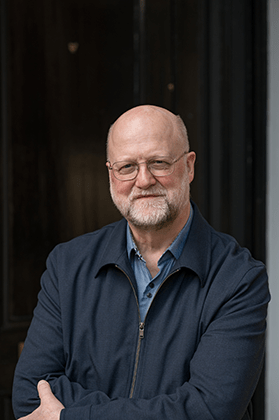
William lives in a small Buckinghamshire village in England.
By night he writes speculative, historical, crime and other fiction. His latest
novel – TEARDOWN – is published by NineStar Press and is widely available in
eBook and paperback formats. Previously, his debut novel, EXPIRATION DAY, was
published by Tor Teen in 2014 and won the 2015 Hal Clement Award for better
than half-decent science in a YA novel – the citation actually says
“Excellence in Children’s Science Fiction Literature”. His short
fiction has also appeared in DreamForge, Metastellar, Abyss & Apex and
other excellent ‘zines. By day he writes software and in the twilight he sings
tenor, plays guitar and writes songs.

Website * Facebook * X * Instagram * Bluesky * Bookbub * Amazon
* Goodreads


Follow the tour HERE for special content and a giveaway!

.


Enter the Teardown Giveaway Here

,

.

~~~~~

Thanks so much for visiting fuonlyknew and Good Luck!

For a list of my reviews go HERE.

To see all of my giveaways go HERE.


.

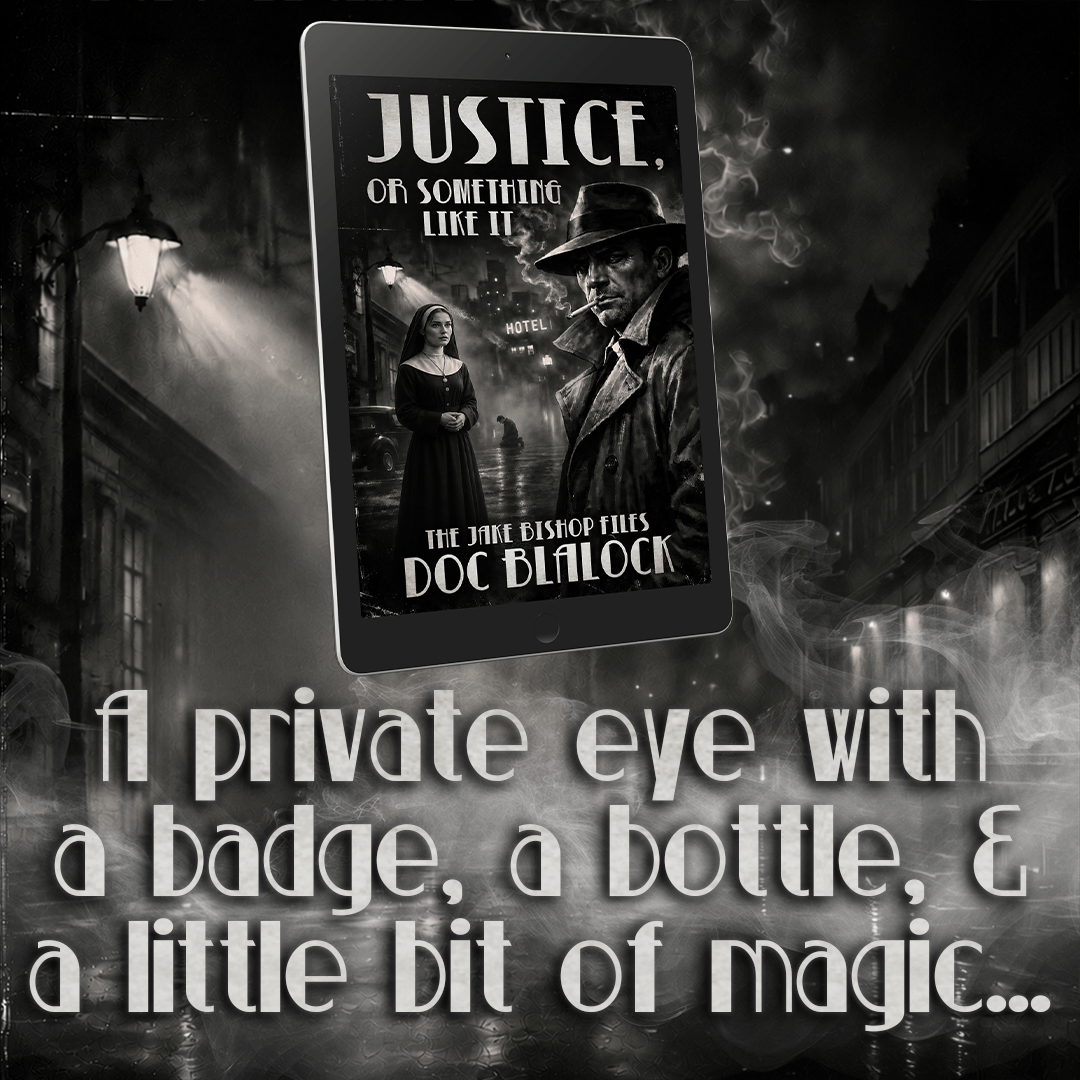
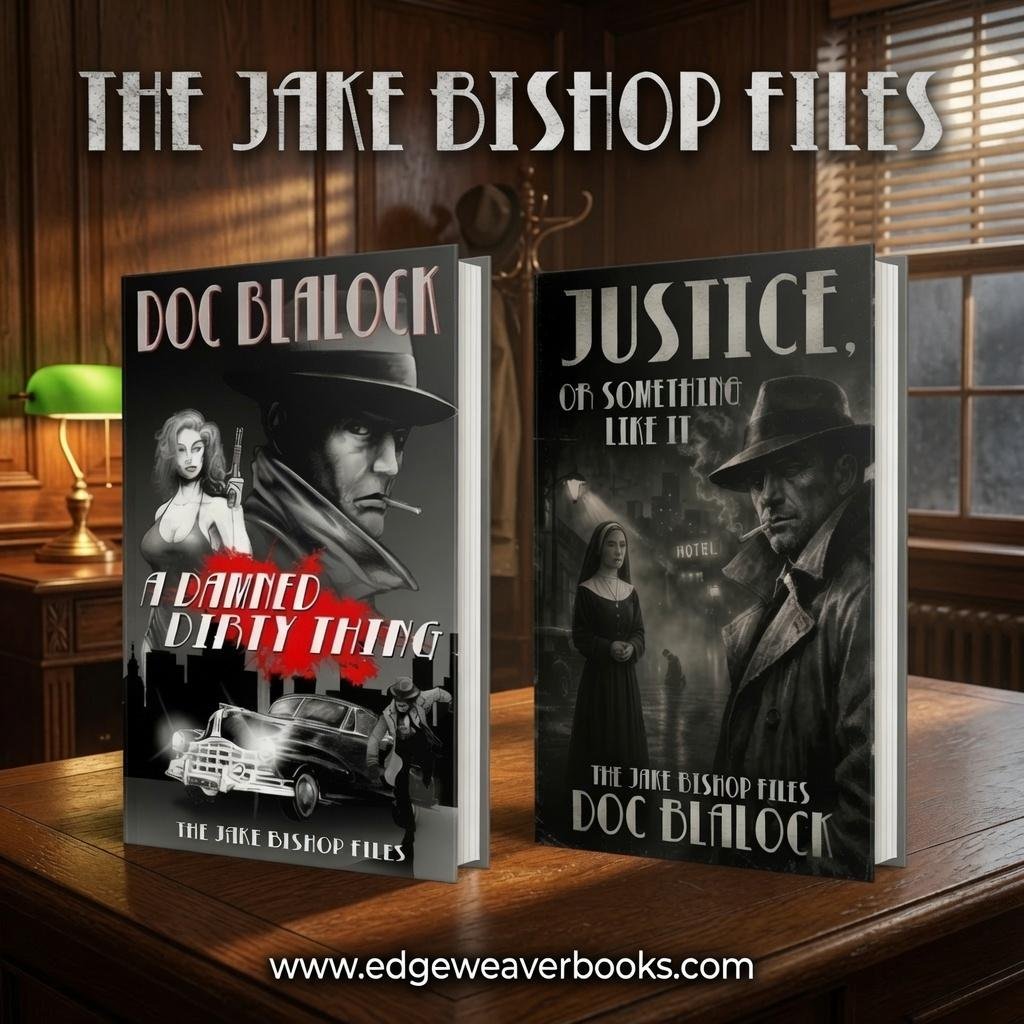
A private eye with a badge, a bottle, and a little bit of magic…

.

.

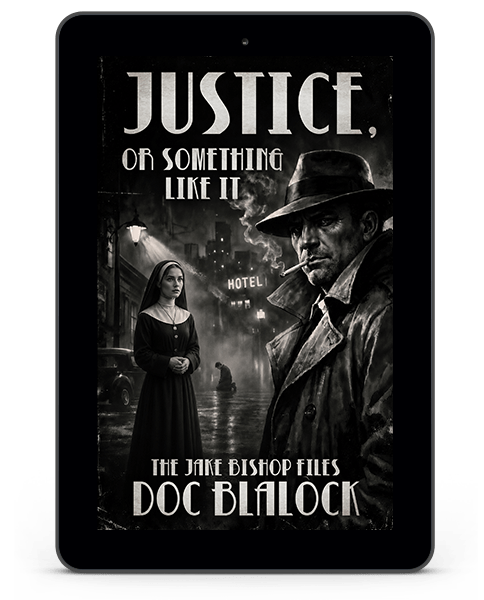
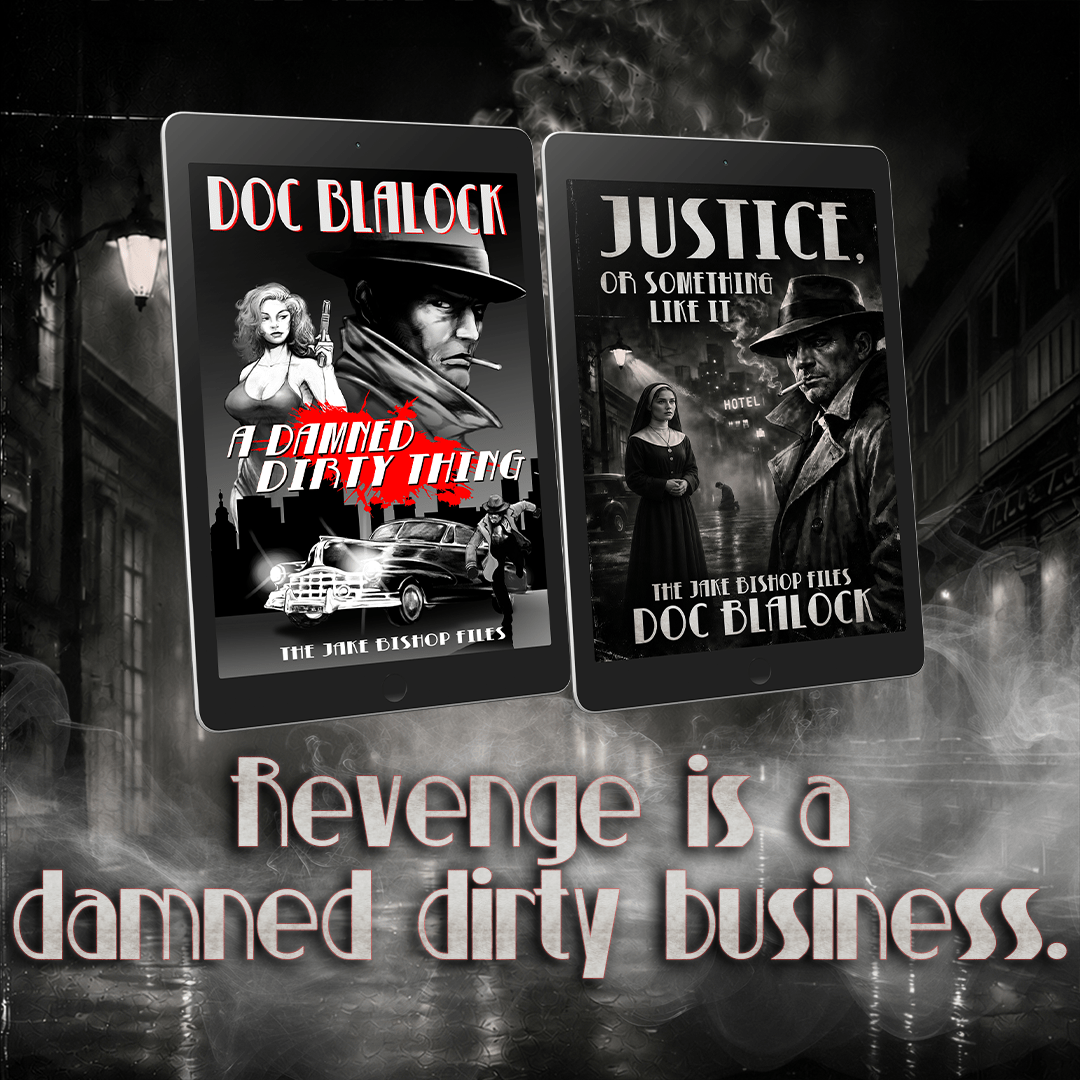
Justice, Or Something
Like It

The Jake Bishop Files Book 2

by Doc Blalock

Genre: Noir Paranormal Sleuth Suspense

In Solomon City, everybody keeps secrets. Secrets are Jake
Bishop’s job.

When a harmless old drunk is caught standing over a corpse,
murder weapon in hand, the case looks open and shut—but he won’t say why he
pulled the trigger. Just that it had to be done.

Bishop knows better. Digging deeper, he uncovers a blackmail
scheme, a shadow war in the Irish underworld, and a threat aimed at the one
person his old friend has left to lose—forcing Bishop to bend the law, and his
own conscience, to see something like justice done.

Amazon * Edgeweaver Books * Bookbub
* Goodreads

.


.
.

“Secrets.
Everyone has them. Some folks keep them for good and noble reasons, others, not
so much. All kinds of secrets. Personal, professional, valuable, harmful or
embarrassing. People will go to extremes to keep them safe. Some folks have
been willing to die for them. Some will kill to protect them. I’m Jake Bishop,
private investigator. Secrets are my job.”

.


.
.
.
.

.

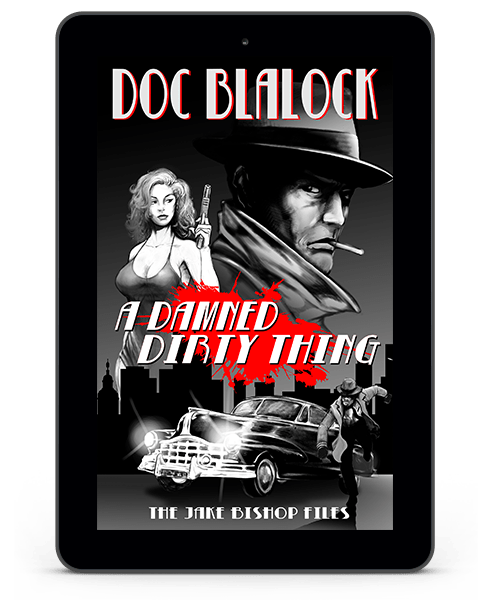
A Damned Dirty Thing

The Jake Bishop
Files Book 1

The explosion should have killed him . . .

Jake Bishop is back on the streets of Solomon City, ten
months after a mob bombing destroyed his office and murdered his partner and
secretary. But Bishop isn’t just any private detective—he’s a “ditch wizard”
able to step through shadow and bend reality to his will.

When the beautiful and mysterious Portia Vance answers his
ad for a new secretary, Bishop thinks his luck might finally be changing.
Together, they begin hunting Vito Morelli, the mob boss who ordered the hit
that nearly ended Bishop’s life.

Their investigation leads them through the city’s darkest
corners—from strip clubs to shadow banking operations, from corrupt cops to
magical wards. But in a world where bullets and spells are equally deadly, and
where everyone has secrets worth killing for, Bishop discovers that the line
between hunter and hunted is thinner than he thought.

Some cases require a gun. Others need magic. This one
demands both.

In the shadows of Solomon City, justice comes with a
price—and revenge wears a beautiful face.

A gritty noir fantasy that proves sometimes the most
dangerous magic is the human heart.

 Amazon * Edgeweaver Books* Bookbub * Goodreads

.

.

.

.
.
,
.
.

Can you, for those who don’t know you already, tell something about yourself and how you became an author?

I’ve been telling stories for as long as I can remember, and I’ve been a lifelong reader of great literature. Writers like Hemingway, Tolkien, and Tom Clancy shaped how I think about storytelling—the efficiency of Hemingway, the poetry of Tolkien, and the attention to detail and complexity of Tom Clancy.

As a counselor, I’ve spent a lifetime listening to people talk—not just what they’re saying, but how they say it, where they hesitate, and what’s happening underneath the words. That sensitivity to voice and subtext is where I think the real strength of my writing lies, particularly in characterization.

When I retired, I finally had the time to dedicate myself fully to writing. Bringing together those literary influences with years of close listening felt like a natural progression.

What inspired you to write Justice, or Something Like It?

It started with a single question: What could push a gentle, broken man who wouldn’t hurt a fly into cold-blooded murder? That tension between vulnerability and sudden violence felt like pure noir territory. I’ve always loved the classic hard-boiled tradition—the rain-soaked streets, the weary detective, the moral gray zones—and wanted to blend it with a touch of the supernatural while keeping the story grounded and human. The result became the darkest, most personal Jake Bishop case I’ve written so far.

Convince us why you feel your story is a must read.

Justice, or Something Like It is the most emotionally charged Jake Bishop book I’ve written. It delivers classic hard-boiled atmosphere, sharp dialogue, and a tightly wound mystery, but it hits harder and goes darker than anything else I’ve written. I hope readers will be invested in the characters and genuinely shocked by where the story lands. If you want a noir novel that stays with you long after the final page, this is it.

.
.

Christopher “Doc” Blalock is a US Navy veteran Corpsman and retired
counselor. He is a prolific fine artist, illustrator, musician, sculptor and
writer, cursed with the itch to create. He draws inspiration from sources
ranging from JRR Tolkien to Tom Clancy. He additionally draws from his love of
classic black-and-white noir films, infusing their moody aesthetic and
storytelling into his writing. A helpless coffee addict, he lives in the
Atlanta suburbs with his childhood sweetheart and a dog of dubious moral
character.


Website * Facebook * Facebook * X * X * Instagram * Amazon

.

Follow the tour HERE for special content and a giveaway!

.


Enter the Justice, Or Something Like It Giveaway

.

.

~~~~~

Thanks so much for visiting fuonlyknew and Good Luck!

For a list of my reviews go HERE.

To see all of my giveaways go HERE.


.

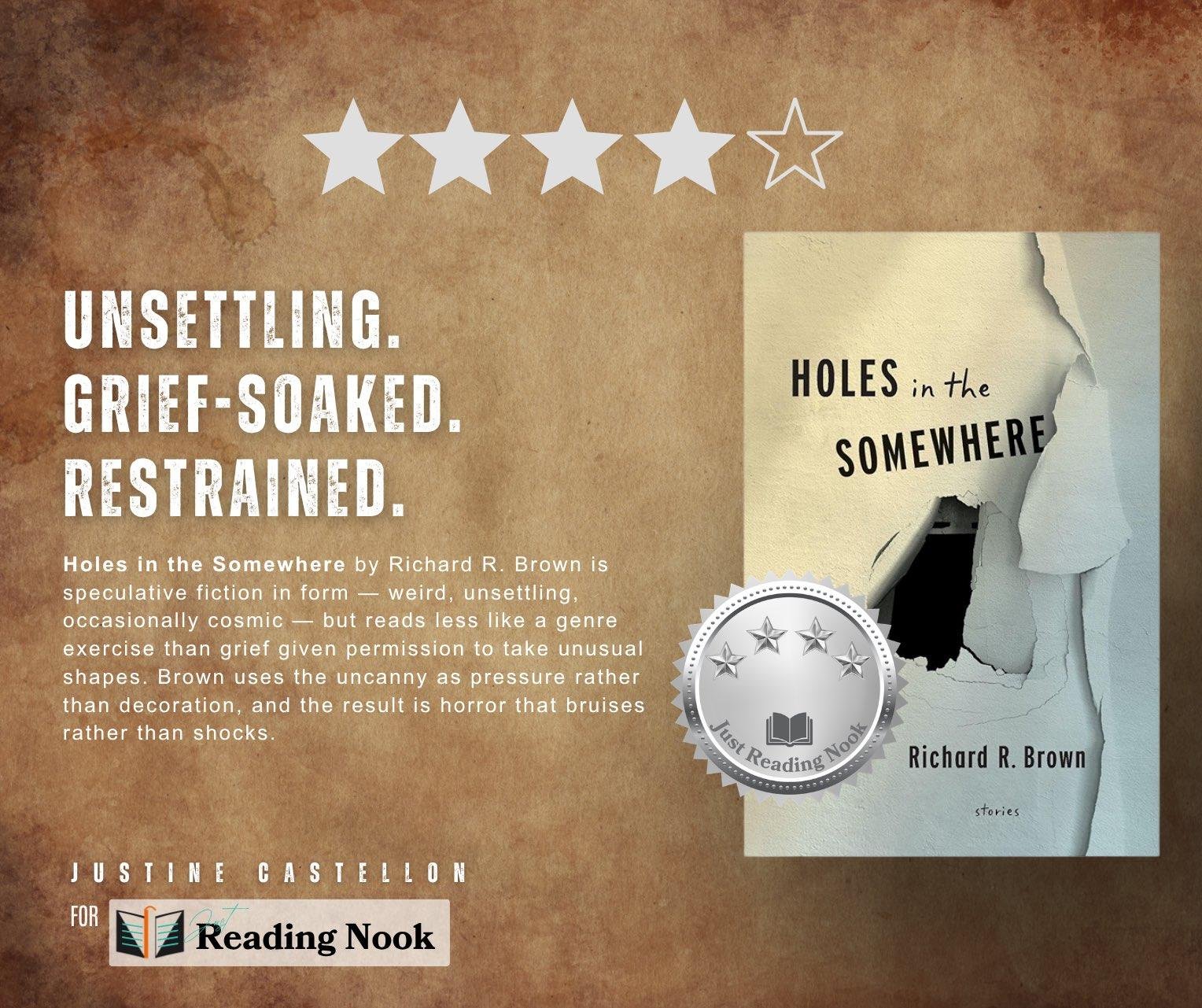
Sometimes grief sneaks up on you and hunts you down.

Sometimes it walks right up and punches you.

,

.

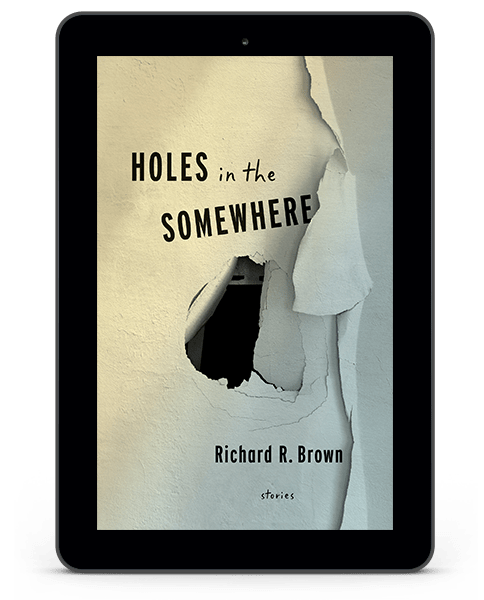
Holes in the Somewhere 

by Richard R. Brown

Genre: Speculative Fiction, Horror Stories

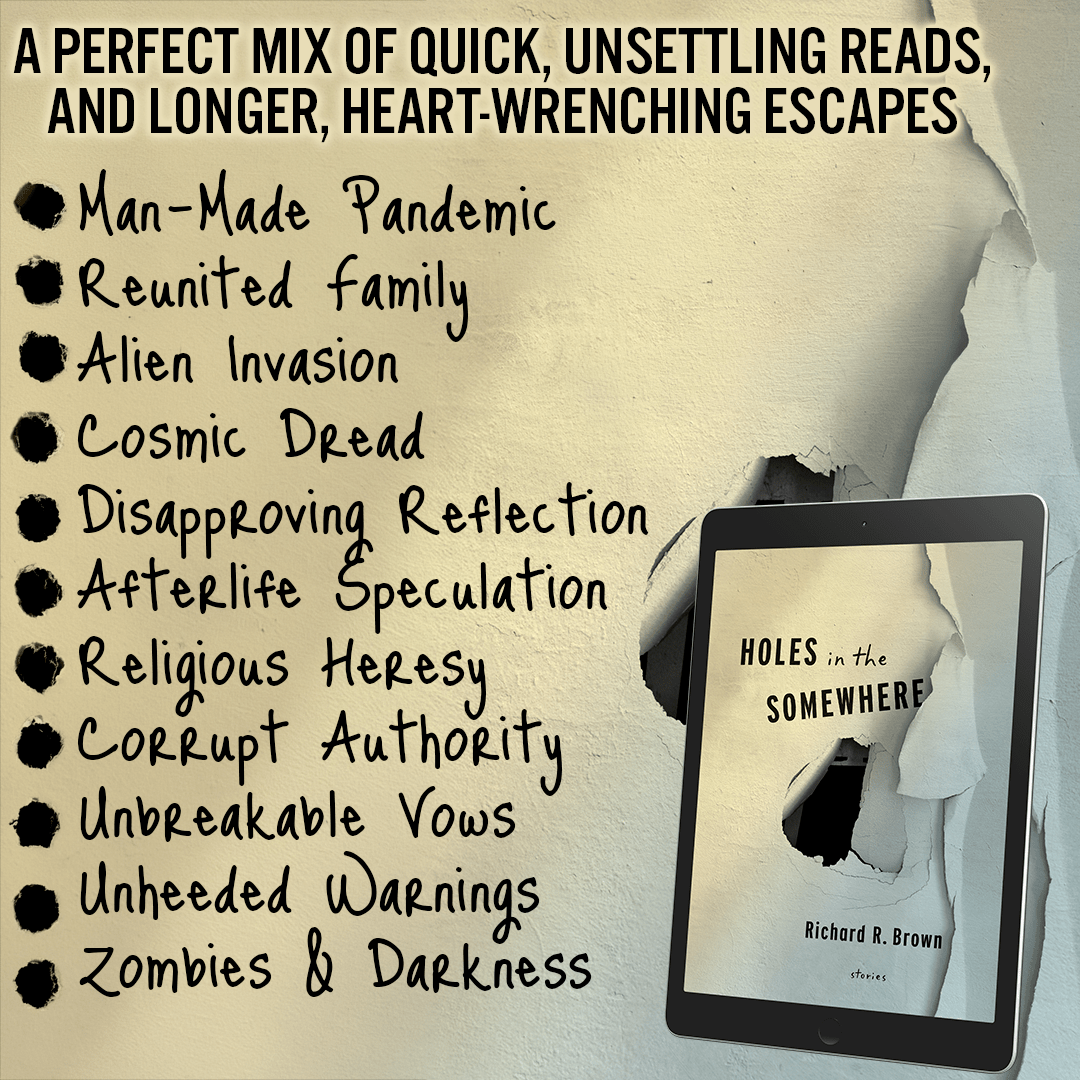
Holes In The Somewhere is a collection of short works,
anchored by a personal memoir of the author’s own experience with grief and
loss after the passing of his father from cancer, by speculative fiction author
Richard R. Brown.

A single mother encounters insanity in the worst possible
person; an estranged parent loses his reunited family to a mysterious bathroom
wall; a group of strangers come together to fight a fungal pandemic; college
students prepare for the extinction of the Sun… these are a few of the
challenges faced by the desperate characters in Holes In The Somewhere. The
choices they make, the dilemmas they wrestle with, all have very supernatural
consequences, but are felt with very human emotions.

These stories will tug at strings your heart thought were
too well-hidden for anyone to know about, and cause the mind to probe the gray
areas between wrong and right. Between normal and paranormal. Behind what’s
real and only to the side of what’s unreal. A perfect mix of quick, unsettling
reads, and longer, heart-wrenching escapes.

What readers
are saying:

“The debut is speculative fiction in form: weird,
unsettling, occasionally cosmic. But it reads less like a genre exercise than
like grief that has been given permission to take unusual shapes.” –
Justine Castellon, Author/Reviewer

“I guarantee there is a ‘gotcha’ story in there for
just about anybody, and if you don’t find at least one that bothers you just as
you’re about to fall asleep, you’re made of sterner stuff than I am.” –
Kenneth Crist, editor-in-chief, Black Petals Magazine

“These stories are weird and creepy and heart-wrenching
in all the best ways. If you enjoy fiction that makes you question everything
and wrecks you emotionally, this is for you!” – Valerie S., 5 star Amazon
Review

Amazon * B&N
* Kobo * IngramSpark
* Bookbub
* Goodreads

.


.
.

.

Excerpt from ‘Death’s Demons’, a story in ‘Holes In The
Somewhere’

The
darkened sky descended into the depths of a dismal dusk, and Jason and Abby
returned to the church. The priest met them at the looming front door and
offered his aging hand in greeting.

“I look forward to hearing your story
again, Jason. I am Father Gregory. I see you have brought a friend. Excellent.
Miss?” The tall, slender man turned to Abby.

At the utterance of his name, Abby
turned white, despite her tan. When he offered his hand to shake, she
reciprocated like a zombie in that old music video. She couldn’t manage to
vocalize an answer to him, though. She winced and visibly recoiled when the man
brought her hand to his lips and kissed the backs of her fingers.

“This is my best friend, Abby. She’s
pleased to meet you,” Jason said, curious at Abby’s unexpected frigidity.

The priest smiled at Abby, then
produced an oversized key ring from his coat pocket. He found a very large iron
key and used it to unlock the gargantuan portal into the church.

“Please, follow me to my office,” he
said, and led them toward the altar. He climbed the three small steps to the
altar and turned left, heading for a door much like the door to the
confessional. As Jason and Abby approached the altar, Abby clutched Jason’s arm
and clung to him. Jason turned his head to ask if she was all right, but was
cut off by Father Gregory.  “Please, make
yourselves comfortable,” he said.

Abby chose a chair in the corner,
leaving the chairs in the middle of the room open for Jason and Father Gregory.
As Jason sat down, he heard Abby scoot her chair next to his and felt her hand
slide under his and grasp it tightly.

The priest closed the office door and
sat in the unoccupied chair. “Would either of you care for a glass of water?”
he asked.‘Either’ came out as ‘eye-thur’, and Jason imagined that snakes would
pronounce it in the same way if they spoke English.

They both shook their heads in
refusal, and Father Gregory sat back in his chair and crossed his legs. “All
right, then,” he said, and looked at Jason with an expectant smile curving his
thin lips.

Jason squirmed under the priest’s gaze
and started the discussion. “Well, I told you about my seeing Death…” he began.

“Yes. Please recount your experiences
for me,” Father Gregory prodded.

.

.

.

What are some of your pet peeves? 


I actively, intentionally, put effort into not complaining about things. If I didn’t, I’d never shut up. But let’s talk about a few of my biggest pet peeves!

I’m mostly blind. Really restrictive tunnel-vision, and what I can see is cloudy and distorted. That’s not the pet peeve. I’m a man. Also not the pet peeve. But you know how men can’t find things in the fridge or cupboards unless it’s beer or leftover pizza? Well, make that man mostly blind and the fridge itself becomes hard to find, let alone specific things in it. My biggest pet peeve (after all that set-up) is when anyone, including myself, moves my things around without telling me.

For eight years, I had a service dog, a Guide Dog, who would steer me around obstacles or tripping hazards away from the house. He retired last summer, and is living his best life on the other side of the country from me now, while I wait for his replacement to finish training. Another pet peeve is when people, friends and foes alike, offer my dog attention and/or especially treats while he’s working. Even these highly-trained dogs are easily distracted, and doing that not only interrupts whatever errand I was on, but it also sets back the dog’s training quite a few steps. I am not the world’s best dog trainer, I have found. Please don’t make me try to retrain my service dog.

I live alone in the upstairs of my mother’s house. She’s almost as old as a certain current U.S. President, so that gives some indication of how much help we have to give each other. Thankfully, they can both still identify pictures of giraffes. I digress. Upstairs. Alone…except, not quite. There’s a ghost (or maybe two) who also like to hang around. Sorry if that’s offensive to them – I’m not aware of how they died, so that may have been insensitive. Anyway, they are able to vocalize. I heard one, in a childlike voice, whisper “Come here, Edison!” (my last service dog’s name) while Edison and I were in our respective beds. I also saw Edison raise his head and look at the spot where I heard the whisper come from, so he heard it, too.
Recently, a much more adult-sounding voice has been heard (by me) saying my name in a sharp, commanding tone, like it’s trying to wake me up. Here’s the pet peeve: It’s trying to wake me up. I hear it around five or six in the morning. Far too early to get up.
 

If you knew you’d die tomorrow, how would you spend your last day? 


If I knew I would die tomorrow, I would spend my last day doing what I love most. I would call my kids (both teenagers) and hopefully they’d answer. I would find somewhere sunny and warm (low 80s…ah, hell, it’s my last day…make that mid-80s!), hope there’s only a very slight breeze, play my favorite music loud, and sing along with it until I fall asleep, then sleep under the hot sun. Sunburn? Who cares? It’s my last day!

.


,
.
.
.

Richard R. Brown is a legally-blind author of speculative
fiction, horror, and thrillers. He writes from experience, having lived through
paranormal events, alien attacks, and cosmic horrors — at least, in his mind
and in the books he listens to. He and his Guide Dog live in the Pacific Northwest.
Richard is between Guide Dogs at the moment as Edison retired last summer.
Edison was at Richard’s side through every story in his book. Richard has no
such guidance for his current novel, but will likely have one for editing help.

Website * Facebook * X * Instagram * Bluesky * YouTube * Bookbub * Amazon
* Goodreads

.


Follow the tour HERE for special content and a giveaway!

.


Enter the Holes in the Somewhere Giveaway Here

.

.

~~~~~

Thanks so much for visiting fuonlyknew and Good Luck!

For a list of my reviews go HERE.

To see all of my giveaways go HERE.


.

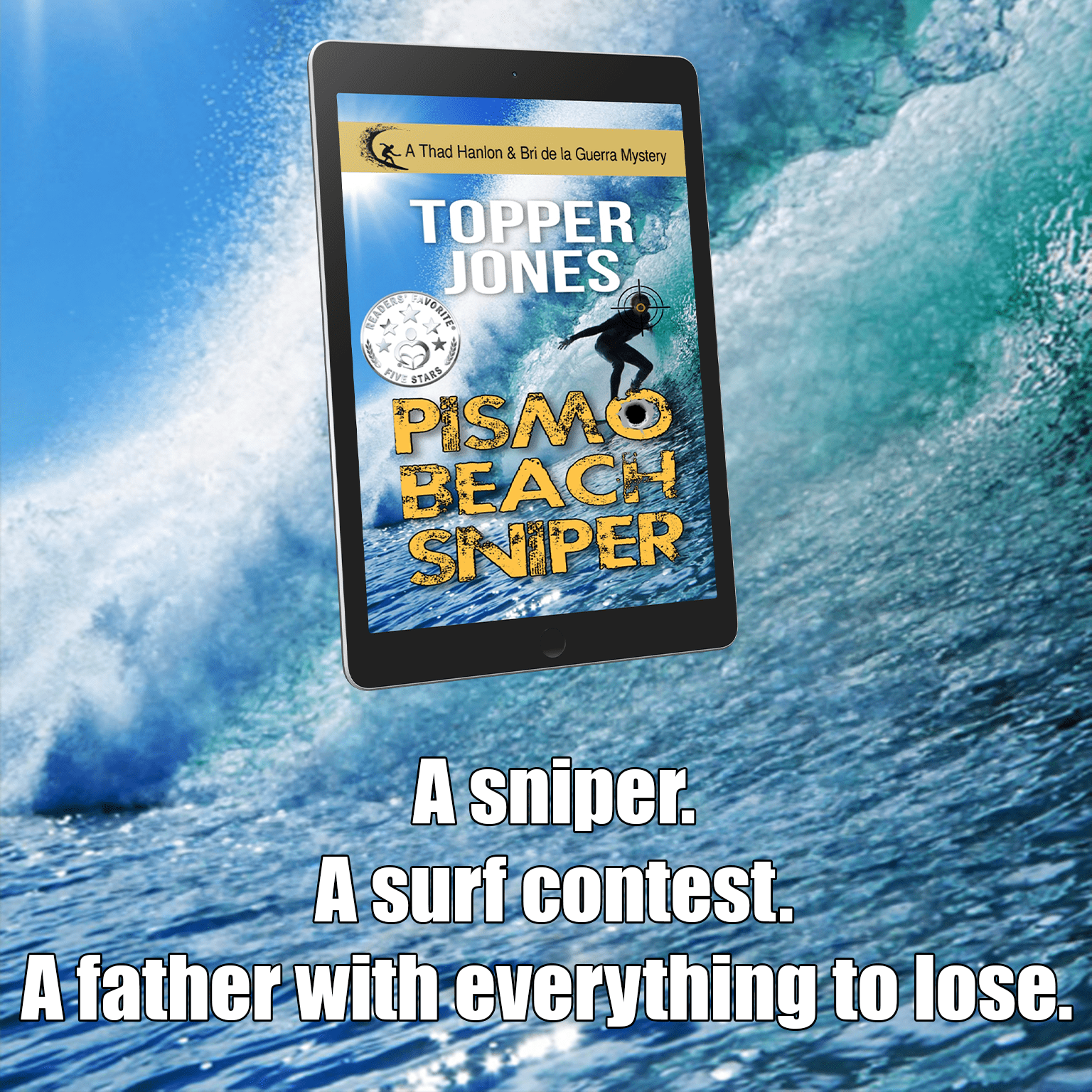
A sniper.

 A surf contest.

A father with everything to lose.

.

/

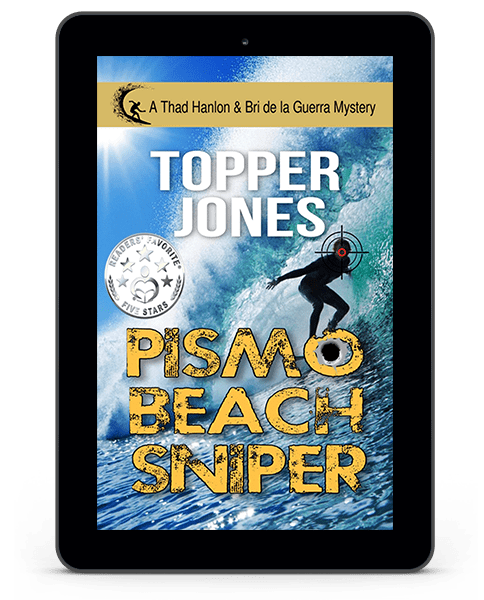
Pismo Beach Sniper

A Thad Hanlon/ Bri de la Guerra Mystery Book 3

by Topper Jones

Genre: Private Investigator Mystery

When sniper fire erupts at the Central Coast Surf Trials at
Pismo Beach, private investigator Thad Hanlon is thrust into every parent’s
worst nightmare. His eleven-year-old son and two teammates are shot while
surfing—one critically injured—plunging the contest into chaos and terrorizing
the tight-knit Five Cities beach community.

The shooter disappears, torching his hideout, leaving only questions in his
wake. Random attack—or the first move in a deadly game? Why target young
surfers? And is the marksman finished…or just getting started?

Urged by desperate parents, Hanlon and his sharp-witted partner, Bri de la
Guerra, race to protect the kids as they train for the upcoming West Coast
Championships. But as the detective duo close in on the sniper, they uncover a
chilling truth: the surf team isn’t his ultimate target—and the nightmare is
far from over.

This gripping thriller will keep you turning pages late into the night.

What Critics Are Saying

“Engaging characters, wit, and suspense elevate this rip-curling
page-turner.”

— Kirkus Reviews


“Pismo Beach Sniper is a tense and fast-moving mystery
with real emotional stakes. The target audience is readers who enjoy mystery,
private investigator fiction, crime thrillers, action suspense, coastal noir,
and family-driven detective series. Readers who like Robert Crais’s Elvis Cole
and Joe Pike novels may appreciate the same mix of banter, loyalty, and
wounded-hearted heroism, though Jones swaps Los Angeles grit for Central Coast
surf and spiritual undertow.”

— Literary Titan   

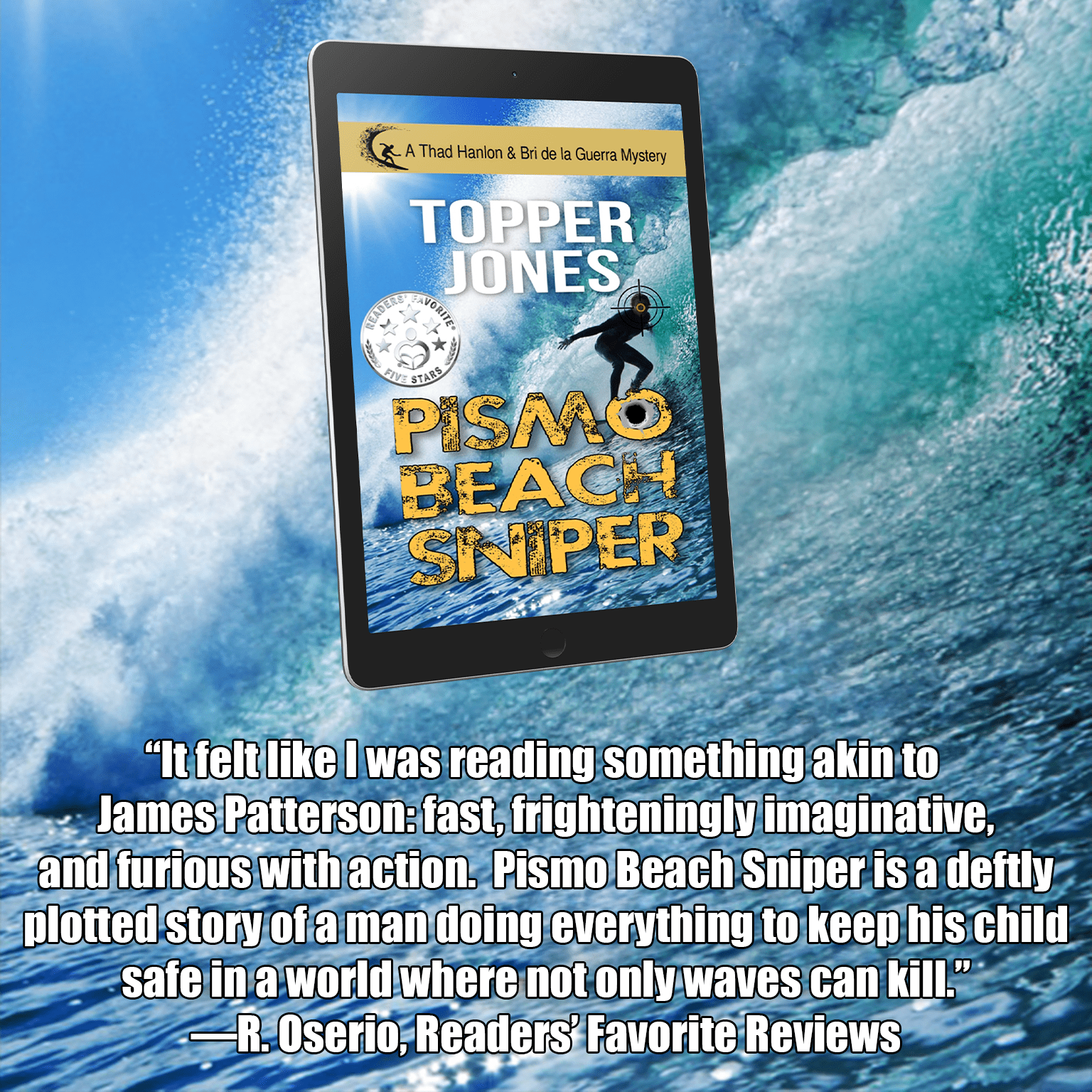
“It felt like I was reading something akin to James Patterson: fast,
frighteningly imaginative, and furious with action. Pismo Beach
Sniper is a deftly plotted story of a man doing everything to keep his
child safe in a world where not only waves can kill.”

—R. Oserio, Readers’ Favorite Reviews

Amazon * Author’s Site * Bookbub * Goodreads

.

.

.

.

Chapter 1

I was sitting under a beach canopy in the spectator
section of the California Central Coast Surf Trials, watching the first heat of
the semifinals, when I heard the sonic crack of a large firearm. Something
long-range like the scoped high-precision rifle my business partner, Bri, uses
to qualify at the Five Cities Shoot’n Center.

“What was that?” my son’s surf coach asked. Gev Burian
was sitting on my left. “Sounded like it came from behind us.”

Bri de la Guerra, on my right, stood to check things
out. “Cityside, yeah. I’m thinking .30 cal. Maybe three-oh-eight.”

I swiveled to scan the low-rise buildings of downtown
Pismo—the seafood cafes, souvenir shops, and beach rentals. Clumps of tourists
meandering down narrow Pomeroy Avenue stopped. Some gazed skyward, herd-like,
examining the highest roofline—the old Hotel Pier Vista. Others rushed indoors.

When a second blast didn’t happen soon after, I saw
pedestrians raise their palms in the classic “what’s up” shrug before
continuing their weekend saunter. Some, trailing well-groomed dogs on leashes,
took refuge in their smartphones.

I turned to face the Pacific as Bri sat in her folding
chair. Coach Gev got out his binocs and we rejoined the hundreds of other
parents, friends, and supporters along the beach to watch the tournament.

Three junior surfers, ages eleven to twelve—”grommets”
in surf jargon—were perched on their boards 100 yards offshore in the chilly
morning waters north of Pismo Pier. The contestants wore different colored
jerseys over their wetsuits. Red jersey had priority takeoff; the next wave was
his. As the kids waited for the sets to roll in, they bobbed in the mushy surf
like sitting ducks.

“Yellow’s down!” Coach Gev shouted. He handed me his
binoculars. “The kid’s slumped sideways off his board.”

“Cramp, maybe?” I pressed the field glasses to the
bridge of my nose, fiddling with the adjustments. “January water temps are
cold, fifty-three, fifty-four degrees. These temps? He should have worn a 5/4/3
mm instead. Maybe even a—”

There was a second sonic crack. I watched Yellow’s board
splinter into pieces. Chunks of the foam core ringed the downed contestant as
he struggled to keep his head above water.

Red jersey, closest to Yellow, dropped prone and paddled
with fury toward him. Just as he was about to grab Yellow’s arm, I heard shot
three. There was a splash near the tail of Red’s board.

Red turned turtle, flipping his tri-fin surfboard over
so the bottom faced the sky. Only his hands, gripping the sides of the
shortboard, were exposed.

Shot four took out Red’s middle fin. Shots five and six
took out the two outer fins. Red let go of his board and sank out of view.

That left the eleven-year-old in the light blue jersey
as the only contender sitting on the water. My son, Zael, was in full
competition mode, hyper-focused on The One Thing—a wave with his name on it. A
wave built by the sea gods just for him, for his performance, his tricks, the
ones he’d stick. The 10-rating he’d be awarded by all three judges. That
perfect ten.

Zael was in the zone, tunnel vision his ally. Chaos
bending to will. He had no clue what had happened to Red and Yellow.

I popped out of my beach chair, sprinted from our shade
canopy to the shoreline, and screamed as I waded in. “Duck and cover, Zael! Get
down! Now!” I waved my arms, zigzagging through the shallows.

My son wasn’t hearing me, wasn’t seeing me, wasn’t even
attuned to my panic despite his gift for sensing things unspoken. Zael paddled
hard for takeoff, slid into the three-foot wave breaking off the pier, and
dropped into the curl. He drove down the line, pumping his board to build
speed, then bottom turned, and angled toward the lip to launch into his
signature 360-degree air rotation and—

Blam.

Shot seven.

Zael’s right leg buckled. He lost balance and angled
into a dive as far away from his board as his leash would let him. When he didn’t
come up for air…

.


,
.
.
.

Are your characters based on real people or did they all come entirely from your imagination? 

Mostly the latter. One of the two primary protagonists in PISMO BEACH SNIPER, Bri de la Guerra, is pure fiction. The other primary protagonist, Thad Hanlon, while also make-believe, was inspired by my nephew, who has competed internationally in surfing like Thad. But that’s where the similarity ends. Unlike Thad, who washed out of the pros, my nephew still competes. And my nephew’s a firefighter, not a private eye.

The ocean feels almost like a character in PISMO BEACH SNIPER. What role does the California Central Coast play in shaping the story’s mood?​ 

The Pacific Ocean is a moody presence. At times, she provides solace from the daily grind. A chance to take a dip, cool off, and catch a few waves. And at other times, when big weather rolls in and the swells kick up, she can be a cruel monster, lashing out with rip tides and pounding surf. In Thad Hanlon’s world, the ocean is simultaneously a source of comfort, danger, and wisdom. When life becomes complicated, he paddles out beyond the break. The rhythm of the waves helps him untangle the Gordian knot of mysteries he’s facing and decide what to do next. In that sense, the Pacific isn’t just a setting—it’s a trusted companion in the story.

The novel blends PI procedural, action suspense, family drama, and coastal noir. How do you balance those elements while keeping the story moving?​

By ensuring tension in every scene. That’s the secret to keeping the story moving when you’re juggling multiple elements.

For each scene, I work from a cinematic framework inspired by Blake Snyder’s Save the Cat!® approach to screenwriting. I start with a simple structure: where the scene takes place, what is happening, and—most importantly—the emotional arc of the point-of-view character.

From there, I focus on what really drives momentum: the conflict. Who wants what, what stands in their way, and what’s at stake if they fail. If I can clearly define Hero—Goal—Obstacles—Stakes, the tension takes care of itself, and the story keeps moving.

Thad’s fear for Zael gives the mystery a strong emotional charge. How did you approach writing him as both a father and an investigator?​

For the father side of Thad, I simply tapped into my own experience raising two sons. While I had the good fortune of a supportive wife to share the journey, there were still plenty of nights spent worrying about our boys—especially during their tween years, when sports, adventure, and growing independence seemed to present a new reason to worry every week. No parent survives those years without a healthy concern for their children’s safety.

For the investigator side, I drew on my professional training as a CPA, software developer, and college professor. I’m analytical by nature. I like patterns, puzzles, and problem-solving. I can be methodical to a fault and have been known to spreadsheet just about everything.

The challenge—and the fun—was bringing those two sides together. When Thad is investigating a case, he wants to follow the facts wherever they lead. When his son is in danger, he’s a father first. The tension between those roles gave the story much of its emotional energy.

Who inspired you to write PISMO BEACH SNIPER?

I have an “idea catcher.” I bet you have one too.

Mine’s a little notebook on the nightstand where I jot down inspirations that arrive while I sleep, dream, or ponder. It’s chock-full of ideas for the next murder mystery—the howdunnits, the whodunnits, the whydunnits, even possible book titles.

But getting from a brilliant idea to a fully developed manuscript sometimes takes more than a notebook.

Sometimes it requires a mentor. A force majeure.

This is the story of the man who inspired me to finish PISMO BEACH SNIPER.

The year is 2022. Mid-January. I’m taking an eight-week novel writing class through the Institute for Continued Learning at Utah Tech University. Dr. Warren Stucki, author of the Dr. Cooper Mystery Series and six standalone novels, is teaching.

On day one, he tells us, “This is the year you write your novel,” and challenges us to complete Assignment #1—NOVEL IDEA SUMMARY SHEET—by the following week.

All we have to do is fill in the blanks:

(a) Working Title

(b) Genre

(c) Protagonist

(d) Antagonist

(e) Main Supporting Character

(f) Setting

(g) A one-line story idea describing the central problem the protagonist faces and the primary obstacles.

Piece of cake, right?

I had a possible title, but that was it.

Something I had come up with in 2016, years before I had even published the first two books in the Thad Hanlon & Bri de la Guerra Mystery Series.

For the assignment’s Working Title, I wrote down:

CowaBANGa!

A mashup of two exclamations that seemed incapable of belonging together.

Cowabunga!—surf slang for “Dude, that was Awwwwsome!”

BANG!—the sonic crack of a high-powered rifle.

It was high concept.

Excited surfers and unexpected gunplay.

But that was all I had.

Assignment #1 forced me to take the next step.

I scratched out the remaining fill-in-the-blanks, relying heavily on the backstories from my first two books. By the end of the eight-week course, I’d developed a working outline, key plot points, three sample chapters, and a draft query letter complete with a three-paragraph blurb.

I was well on my way to writing PISMO BEACH SNIPER, book three in the series.

My takeaway from Dr. Stucki’s class?

A force majeure can make all the difference between a middle-of-the-night inspiration scribbled into an idea catcher and a finished book on the shelf.

When all you have is the germ of an idea, sign up for a workshop. Let the instructor—and the energy of fellow writers—propel you from a mere notion to a fully realized story complete with character arcs, themes, and purpose.

Muse + Force Majeure = Your next masterpiece on the shelf!

What can we expect from you in the future? 

Book Four, of course.

The next installment in the Thad Hanlon & Bri de la Guerra Mystery Series takes place two years after the events of PISMO BEACH SNIPER. Bri is out drumming up new business for the duo’s detecting agency when she stumbles upon a murder that will test both detectives in ways they never imagined.

Here’s the opening scene:

***

Even in the moonlight, Bri recognized the man floating face down in the cliffside pool as Dr. Yicheng Zhang. Potential client. The world-renowned fertility researcher was fully clothed in his signature charcoal wool-blend blazer with well-worn elbow patches, and he didn’t look so good. Pale, bluish skin, and that wild black hair of his fanned out like sea grass. 

Bri sprinted to the rescue hook hanging on the cabana wall and used it to snag the good doctor, pulling him toward the pool steps. She strained to flip him over. His lips, forehead, and tip of his nose were a blotchy purple. There was a fine white froth around his nostrils. She checked for a pulse in a Good Samaritan move she knew didn’t have favorable odds. Still, she had to try. 

The odds didn’t pan out. 

Across the glass wall of the pool that faced the Pacific—brooding more than usual— someone had spray-painted in angry caps:

PERFECTION HAS A PRICE

***

True to cliché, the Five Cities Sheriff’s Department immediately suspects the spouse. But Mrs. Zhang insists she’s innocent, has an ironclad alibi, and hires Bri and Thad to find the real killer.

That’s when the case heats up.

As the investigation deepens, frozen embryos—including those intended for Thad’s future family—become a bargaining chip in a deadly game where science, ambition, and obsession collide.

Shell Beach Slayer (working title) is part mystery, part thriller, and brings back familiar faces, including Thad’s son Zael, now a teenager, and Naiya Ygnacio, his new bride. The stakes couldn’t be higher as Bri and Thad navigate a case that explores designer children, genetic engineering, and the meaning of perfection itself.

.
.
.

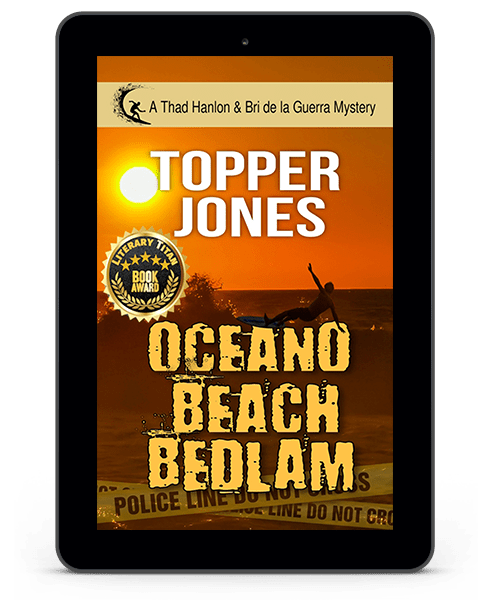
Oceano Beach Bedlam

A Thad Hanlon/ Bri de la Guerra Mystery Book 2

Hanlon & de la Guerra have gone full service. In this
second book in the surfing crime-fighter mystery series, Thad Hanlon and his
martial-arts-obsessed partner, Bri de la Guerra, hang out their shingle as
newly licensed private investigators. Now in addition to fraud-busting, the two
detectives do it all. Background checks. Surveillance. Even finding lost souls.
Just about anything that requires sleuthing or going undercover.

All they need is a client.

That’s when a former exotic dancer from Bakersfield CA shows up looking for her
surf prodigy son who’s gone missing in the wake of cult violence terrorizing
the California Central Coast.

What Critics
Are Saying

“A crunchy detective novel set in the world of California surfers.
Jones delivers a proper beach read, both in form and content.”

-Kirkus Reviews


“Honestly, I had a blast with this one. Oceano Beach
Bedlam is a smart and entertaining read. If you like your mysteries with
surfboards, sass, and just enough heart to keep you caring, this one’s for you.
It’s a great pick for fans of offbeat detectives, fast dialogue, and
sun-drenched noir with a brain and a soul. I’d recommend it to readers who
enjoy Janet Evanovich, Robert Crais, or the beachier edges of Elmore Leonard.”

— Literary Titan  

Amazon * Author’s Site * Bookbub * Goodreads

.
.
.
.
.
.

.

All That Glisters

A Thad Hanlon/ Bri de la Guerra Mystery Book 1

When the facts don’t add up in his surf buddy’s bizarre
death, forensic consultant (and daddy-to-be) Thaddeus Hanlon investigates,
volunteering to go undercover to pick up where best friend Rafi Silva left off
in a secret probe of the U.S. gold stockpile—every last bullion bar.

Rafi’s spunky fiancée, Bri de la Guerra, has suspicions of her own and soon
joins Thad on the hunt for answers. Together, the two amateur sleuths delve
deep, stumbling onto a financial a-stock-alypse in the making, triggering a
brutal manhunt along the Eastern seaboard meant to silence anyone looking to
set the ledger straight.

What Critics
Are Saying

“Jones’ action-packed murder mystery…is
tension-fueled with plenty of twists and two appealing sleuths. In this
detective series opener, Thad Hanlon, a 27-year-old forensic accountant,
becomes the target of a murderous cadre when he accepts a new assignment that
takes him from Los Angeles to the East Coast center of power. Woven into the
gripping plot are sensual, detailed descriptions of Thad’s adventures riding
the waves, which should please the surfer crowd and afford others a visceral
sense of the experience.”

—Kirkus Reviews


“All That Glisters by Topper Jones is well-written with not a
single dull moment. I liked the way the author included elements of action,
mystery, and even some cyber investigating. Overall, I found this book to be an
amazing read.”

—Sefina Hawke, Readers’ Favorite Reviews

Amazon * Author’s Site * Bookbub * Goodreads

.


.
.
.
.

Writing
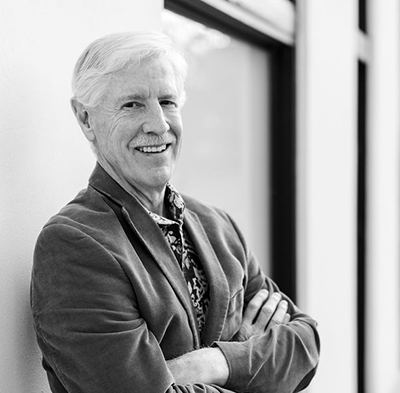
as Topper Jones, award-winning author Christopher G. Jones, Ph.D., delivers
detective fiction with a dash of romance, plenty of action, and memorable
characters. His Thad Hanlon & Bri de la Guerra Mystery Series has earned
Readers’ Favorite Five Stars and the Literary Titan Gold Book Awards.

 Before
writing full-time, Jones taught financial reporting and business systems
development at the university level and worked in public accounting and
consulting. He is a member of The Private Eye Writers of America and
International Thriller Writers, and an affiliate of Mystery Writers of America.

 To
stay close to family, Jones now lives in the southwestern desert rather than
his native California. But when the surf’s up, he’ll make the 450-mile trek to
the coast for a little “water therapy.”

Website * Facebook
*
X
*
Instagram
*
TikTok
*
Bookbub
*
Amazon
*
Goodreads

.

Follow the tour HERE for special content and a giveaway!

.


Enter the Pismo Beach Sniper Giveaway Here

.

.

~~~~~

Thanks so much for visiting fuonlyknew and Good Luck!

For a list of my reviews go HERE.

To see all of my giveaways go HERE.


/

A shuddering, thrilling urban fantasy series.

.

.

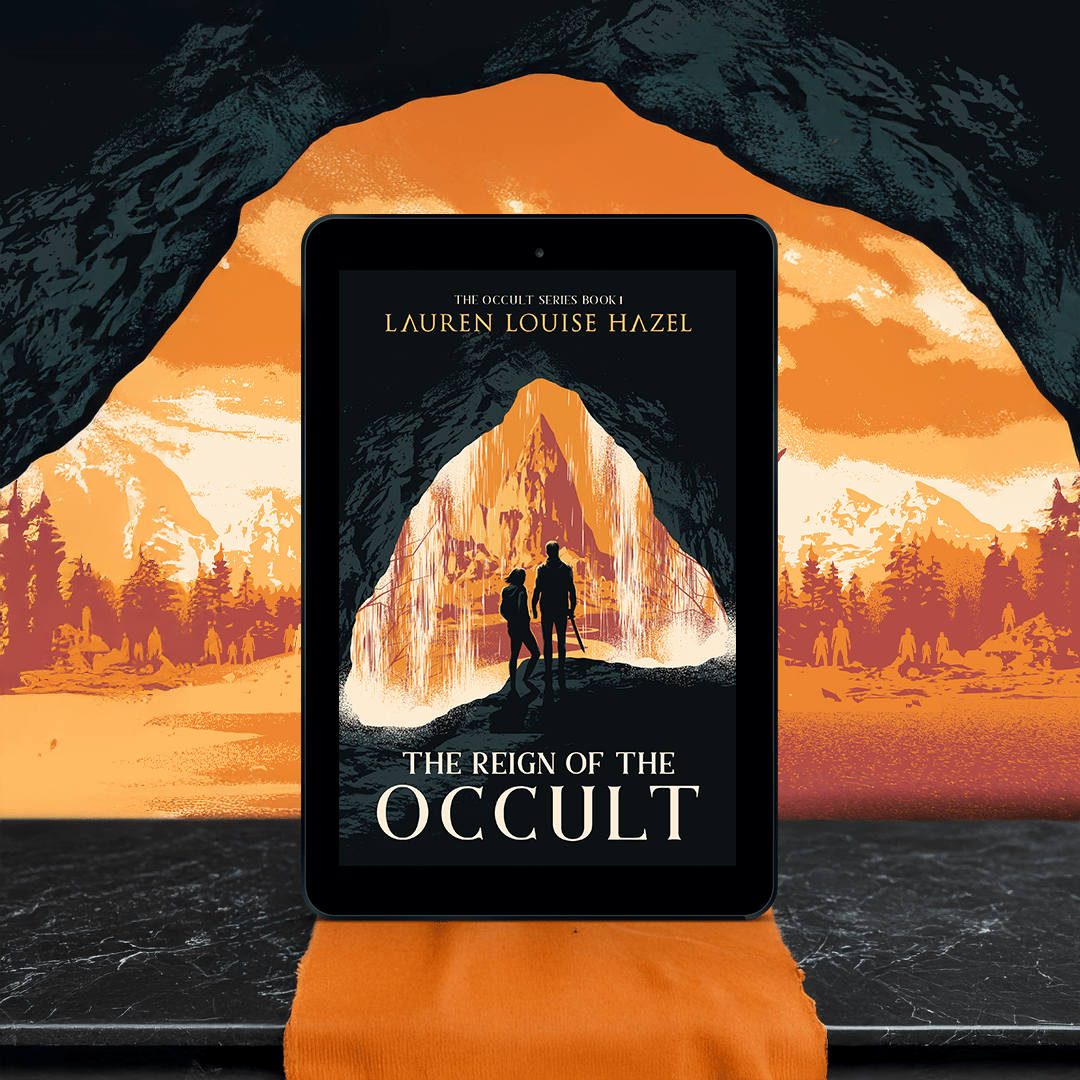
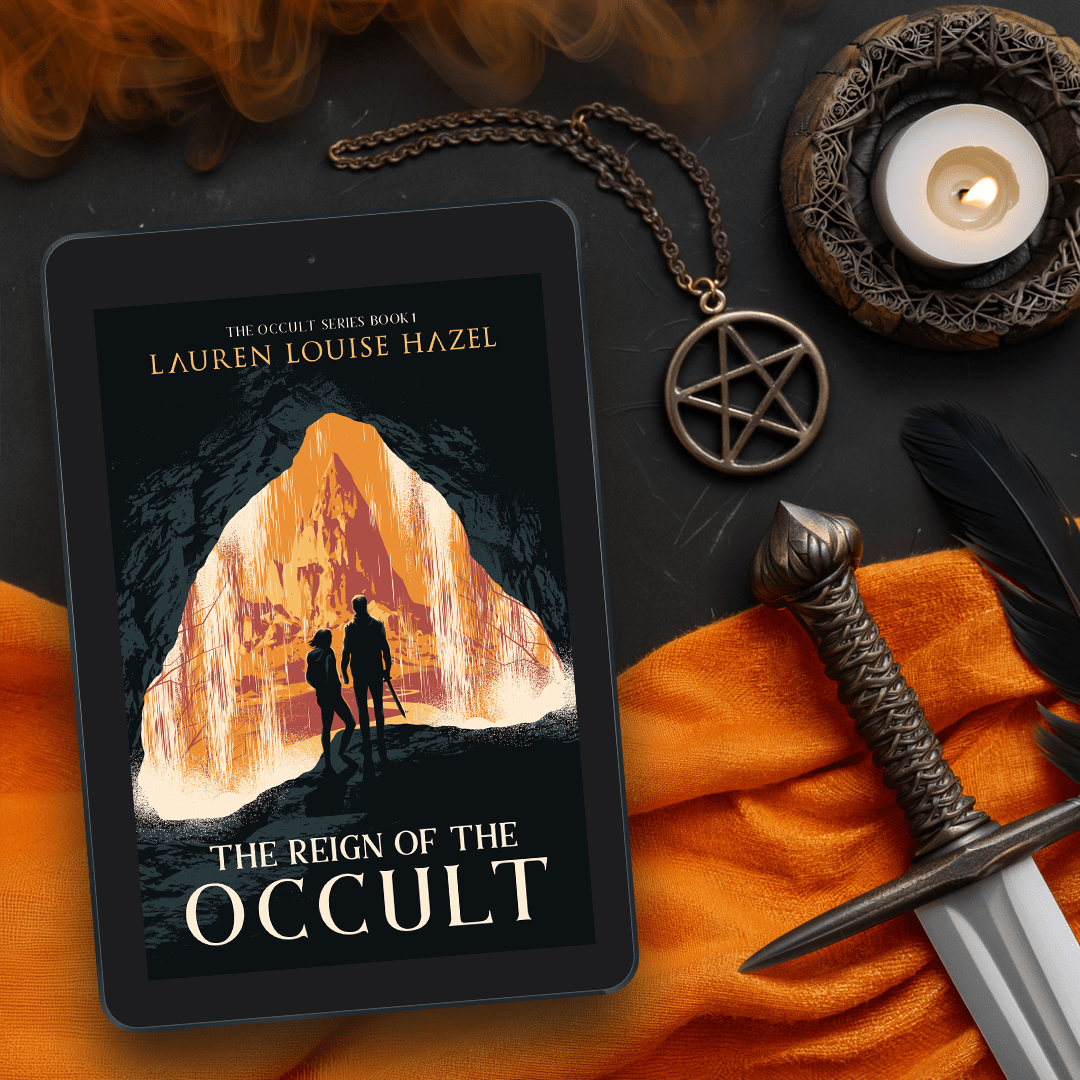
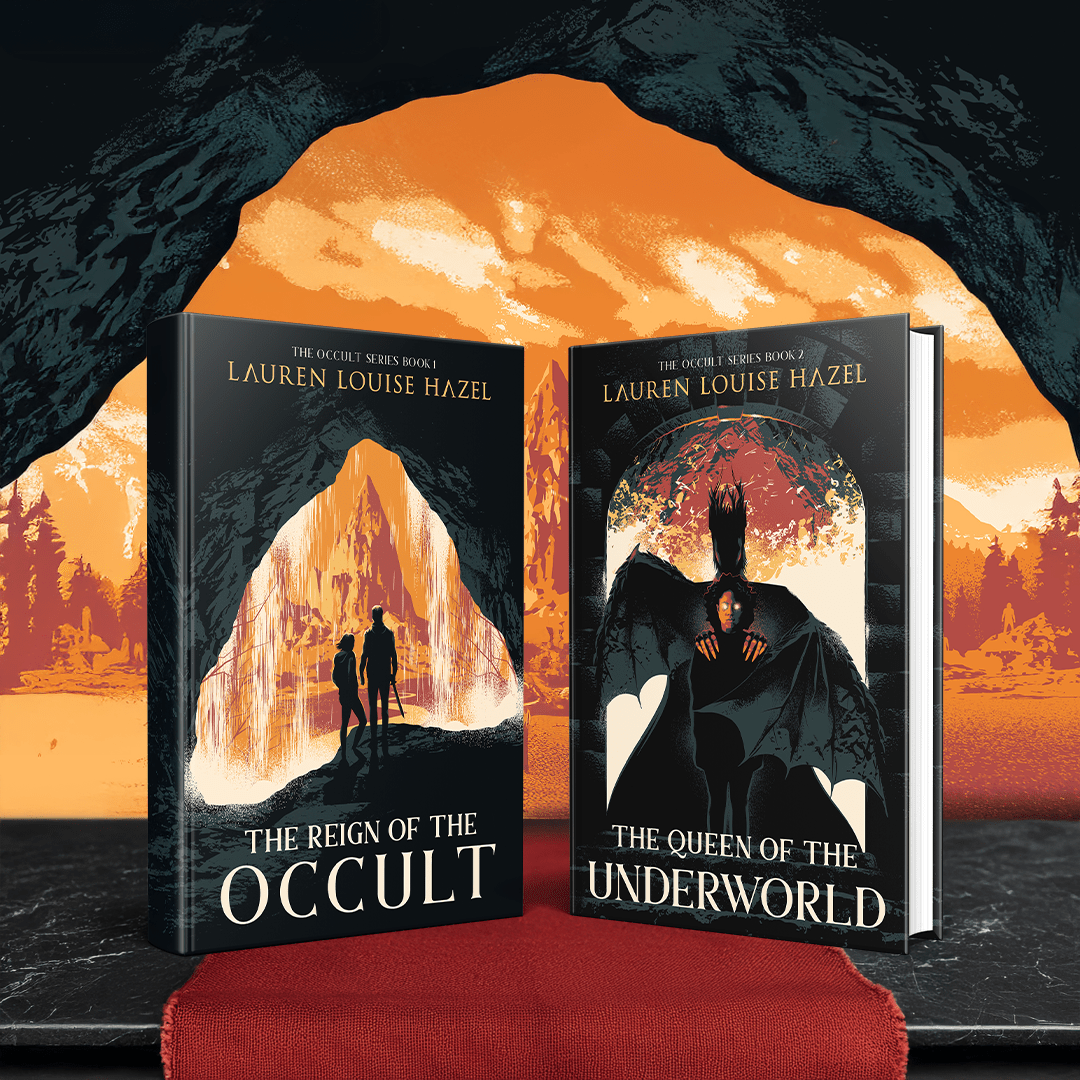
The Reign of the Occult

The Occult Series Book 1

by Lauren Louise Hazel

Genre: YA Urban Fantasy

The Reign of the
Occult is a shuddering, thrilling, urban fantasy for Young Adults. Filled with
hair raising chases through shadowy streets, frightening fights and
mind-blowing magic, it’s sure to keep many a different genre loving reader
happy.

The battle between the Underworld, full of darkness, and the Overworld, full of
light, has been evenly balanced for millennia. Caught between them is the
mortal world, where humans have become so afraid of a magic they cannot
understand or control that they allow the Occult to rule them. After the Occult
joins forces with the Underworld, the balance shifts and the Overworld is
decimated.

But still, in the mortal world, the magic won’t die. It appears when a
supernatural being and a human have a child, like Prue.

This is the first volume in an epic new fantasy series that spans the three
richly detailed worlds as Prue, her non-magical half-brother Everett, and all
Magic Users, fight to survive. They are being hunted by the Occult, who turn
the Magic Users they capture into tools to eliminate their own kind and,
eventually, to destroy all traces of magic.

Universal
Link
* Amazon * Bookbub
* Goodreads

.


.
.

Chapter 1 – Run

“Prue!”
Everett gasped, unable to disguise the desperation in his voice. His legs were
aching, his lungs burning, and his heart was pounding erratically in his chest
– a reminder that, despite everything, he was still alive.

Maybe not for much longer.

He wheezed,
attempting to inhale more air, but from the weakness in his legs, he knew he
wouldn’t last much longer.

“Prue! Which
way?” he cried, casting a panicked glance at his sister. He imagined he could
hear them, the cocking of their guns, drawing near. Every flicker of movement
in the streetlight, every sound, felt magnified, as though even the shadows
were poised and ready to pounce.

“Both ways
are blocked,” Prue replied at last, her feet pounding the pavement beside Everett,
faltering only as they approached the junction. She frowned, eyelashes
fluttering, and clenched her fists, her nails leaving angry red indentations in
the palms of her hands. She was very pale.

“What are
you talking about?” Everett gasped, slowing to a canter.

“Nothing is certain.”

Everett,
while used to his sister’s cryptic remarks, was not in the mood for games. “That’s
not helping!” he cried, skidding to a halt as they reached the turning. He cast
a glance over his shoulder. “Are we going left, or right?”

Prue froze
and her eyes did too, as they often were when she saw things nobody else could.
“I told you,” she said, in a detached tone. “Both ways are blocked.”

Everett
cocked the gun he’d held loosely in his palm, trying to ignore the way it
slipped slightly in his grasp, dampened by his sweat-slick skin. “Does that
mean we’re dead either way?” he asked, with a carelessness he didn’t quite
feel. He checked his ammunition, if only to busy his shaking hands, knowing it
would probably make little difference in the end. Maths had never been his
strong point, but he knew one gun against hundreds were never favourable odds.

“They’re
coming,” Prue informed her brother, although she did not meet his eyes. She was
staring into the blackness at the other end of the street; Everett followed her
gaze, but as always, saw nothing.

“Where—?” he
began, before freezing. He couldn’t see, only hear, the rapid pounding of
footsteps along a cobbled street. Low at first, the sound was growing louder,
clear in the otherwise silent night. The hairs on the back of his neck were
standing up in warning. “Ok, you’re right,” he conceded, in a generous tone, “They’re
coming! No foresight needed for that. Which way do we go?”

Prue shook
her head, dark hair clinging to her bowed face, her eyes crunched in
concentration. She was covered in sweat.

“Wait— wait—”
Everett muttered, in a panicked breath, realising his sister was going to be of
no help. He could see them now, shadows moving in the darkness, emerging at the
end of the street. The Officers of the Occult. He shot three times in quick
succession – one, two, three – and something must have found its mark, from the
strangled cry of pain that followed. They were still alive, then. Good.

Everett had
only a moment to feel relief before the others swarmed. They were closing in on
them. Although in range, they had yet to fire a single shot; as he expected,
their aim was to capture, not to kill.

“Something
is changing,” Prue said from beside Everett. She clutched her head, fisting her
fingers into her hair, as though physically trying to remove something from her
mind. “Another factor is clouding things. His choices are unclear. He’s
conflicted already.”

“Prue!”
Everett cried, trying to pick something of use from her incoherent ramblings.
He pushed her sideways, behind the wall of a garden and out of sight – at least
for the moment. They were running out of time – the Officers would be upon them
in less than a minute, and then there would be no escape. “Pick a way! Which
way has more chance of survival?”

Prue gazed
up at the sky, but she was seeing nothing. “Left,” she replied at last, “Maybe
he will spare us.”

Without taking a second to contemplate what his
sister might mean, Everett grabbed her slippery hand and pulled, turning a
sharp left, the Officers of the Occult temporarily vanishing from view. 

.


.
.

.

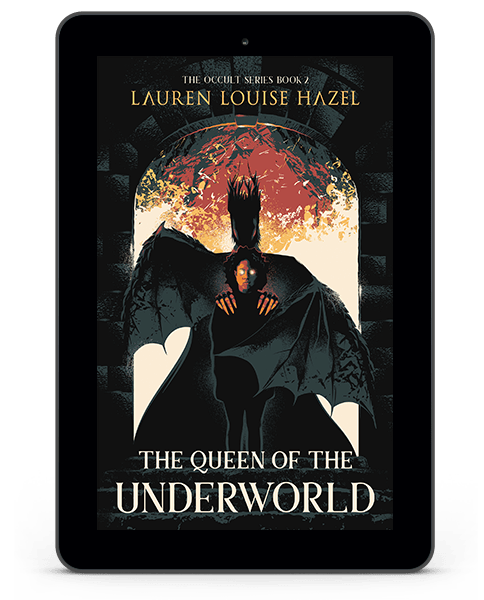
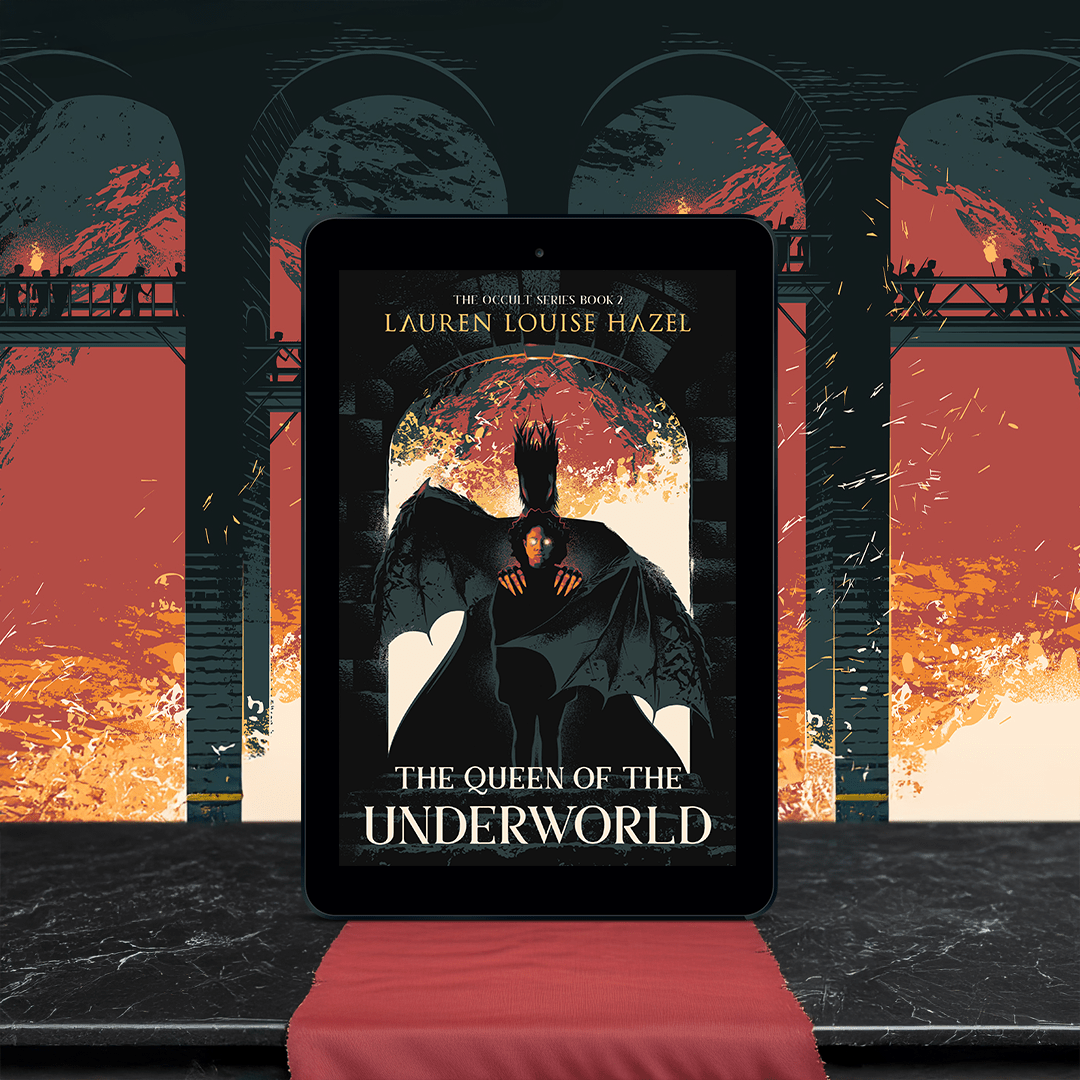
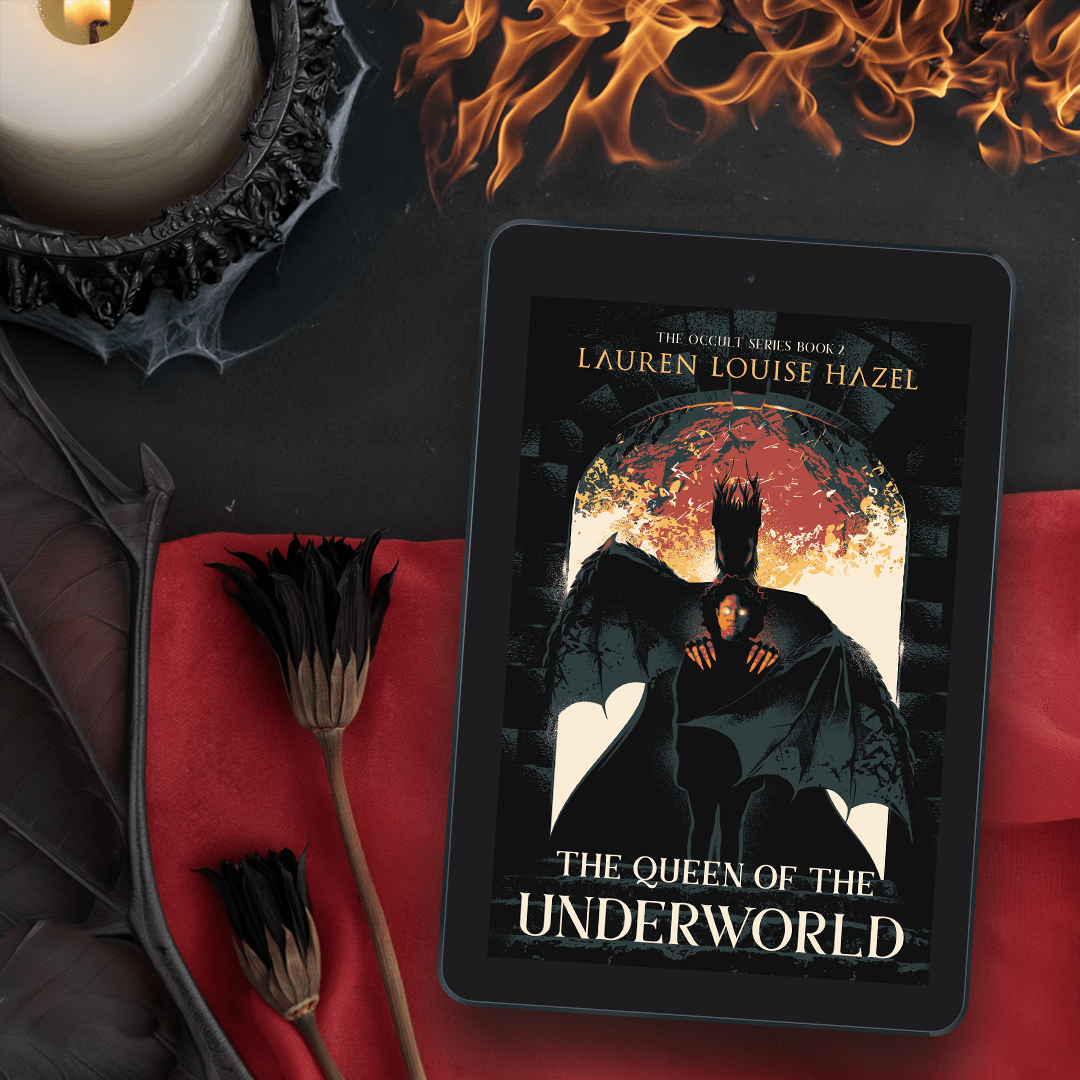
The Queen of the Underworld

The Occult Series Book 2

The Queen of the
Underworld
 is the second novel in the award-winning The Occult Series
by Lauren Louise Hazel.

Following the fall of The Occult and its Head, Prue receives visions of The
Queen of the Underworld—a powerful Demon who was once overthrown by her allies
and exiled from her homeland—rising in its place.

Prue sees that the Queen is connected to Prue’s best friend, Lily. This leads
Prue and her half-brother, Everett, on their mission across worlds to destroy
the Queen and save their friend. But nothing is what it seems.

The Queen is ready and waiting for them—and she will stop at nothing to secure
her future and wipe out anyone who opposes her.

Universal
Link
* Amazon * Bookbub
* Goodreads

.

.
.
.
.
.
.
.

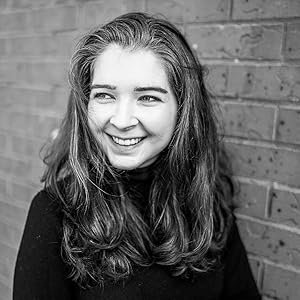
As a kid, my dad would always take my sister and I to Waterstones. He always said that the only thing he would always buy us, would be books. While my sister was more interested in numbers, I was more interested in creative subjects. My mum bought me a first edition of Harry Potter and The Prisoner of Azkaban, which would be worth a fortune if my cousin hadn’t torn out the front page. I’m still mad about it…

During school, my friends and I were obsessed with fantasy shows and novels, which has never faded. We used to have sleepovers, watch Buffy and Angel all night long. We also saw every Harry Potter in the cinema – at least a dozen times when they first came out and theorised about the ending of the books. I read the books so fast that I always knew the endings before everyone else, and everyone was mad when my sister told them that Dumbledore is murdered by Snape before anyone else got to it.

I started writing more seriously in 2010. During my first year at university, I had health issues and had to have an operation. In the following months of recovery, I was reading a lot and decided to write something. I was stuck indoors and so I wanted to do something more productive. I chose to start a fantasy novel, because that is what I loved. I had read The Wind-Up Bird Chronicle, and I wanted to capture a modern world, but with a magical twist.

The Reign of the Occult was born. The first in The Occult Series, it’s a fast-paced urban fantasy. In the Mortal Realm, magic is outlawed and hunted by a mysterious and sinister organisation called The Occult. The protagonist is Prue, a girl who is cursed to see the future but never to change it. At the time, a female lead in a fantasy adventure was reasonably rare. The Hunger Games had just come out, which I loved, and the genre boomed following its release. Like me, a lot of writers followed suit and it’s much more mainstream now.

I took inspiration from Dante’s Inferno to create the 3 different worlds. I was studying history at university, so I’m really interested in myths and legends, and I included myths from all over the world to create the Demons in The Underworld and The Fae in The Overworld. The Occult in the Mortal Realm is grounded much more in reality – based on dictatorships I had studied, including The Third Reich. A big part of the story is the teenagers overcoming incredible odds to defeat evil. I absolutely love this theme in The Lord of the Rings, that you don’t need great power to overcome great evil.

The theme of teenagers fighting to reclaim their freedom and discover their own power, is present in all my stories. It’s something that comes from my own experiences, overcoming health issues and pushing through against the odds.

Following the original release of The Reign of the Occult, I was in a significant road accident, and I had ongoing injuries. I had to pause my plans to release the second book in the series, The Queen of the Underworld.

Since then, I’ve worked hard on my recovery. One, not to lose my day job. And two, to get The Queen of the Underworld completed. The editing was very difficult with my injuries, but I did not give up. I completed the edits and released the second book in 2024.

Now, I’m fighting fit and ready for my next series, The Tarot Series. The first novel is called The Book of Wands and it’s due for release in 2026. The protagonist, a girl named Olivia, inherits a Tarot Book following the death of her grandmother, which she claimed could predict Past, Present and Future… I picked a female protagonist, which I could relate most to, and had the Tarot Deck be passed down through the female line. I think it’s important for young women to understand and claim their own power.

Pieces I have removed from the main piece, placed here – keep these so that you can use in your newsletters and content marketing:

Her brother Everett is her protector – although he doesn’t possess any powers, he is street smart and savvy. The story is their journey through the 3 worlds – The Mortal Realm, The Underworld and The Overworld – fleeing from The Occult. My sister claims that Everett is based on my baby brother, Ben, but I did not realise that while I was writing it.

It took me about 8 years in total to finish The Reign of the Occult. I started working for a small company in HR, and eventually asked me to move over and build their security function from scratch. While personally I’m much more creative – interested in Art, History and English – my job is much more technical. I’m a Cyber Security Manager now in a role that is mostly dominated by men. It has been a successful career, and I’ve done the writing on the side. It was only during Covid, when I didn’t have to travel to work, that I had more time to work on the manuscript.

I finally decided I was going to finish a book if it killed me! Once I finished the first manuscript, and realised that I could finish one, the manuscripts that followed were much, much faster. In my mind, the writing has changed from a hobby to a job and now I treat it seriously. If it’s in my calendar, then I’ll do it.

.
.

Lauren Louise Hazel is a Cyber Security Manager by day and
writes YA fantasy by night. She has one annoying brother and younger sister. As
she was growing up, the only item her dad would buy her without demanding her
pocket money was books. He’s hoping the writing is successful so he can get a
Ferrari!

Some of Lauren’s favourite books and influences include the
classics – like Lord of the Rings and The Hunger Games – and anything by Haruki
Murakami and GRR Martin.

Website * Facebook * Instagram * TikTok * Bookbub * Amazon
* Goodreads

.

Follow the tour HERE for special content and a giveaway!

.


Enter The Occult Series Giveaway Here!


.

.

~~~~~

Thanks so much for visiting fuonlyknew and Good Luck!

For a list of my reviews go HERE.

To see all of my giveaways go HERE.


.

Dive into a different world, where nature and friendship are
full of surprises.

.

,

Living at the Edge of the World – Winter

The Papala Island Adventure Series Book 1

written by S. J. Barratt

narrated by Gill Mills

Genre: Middle Grade Eco Adventure

Twins Tabitha and Timothy leave London for a wild Shetland
island — no Wi-Fi, no friends, and a mysterious great-uncle. In Papala, they
discover a new way of life, unexpected friendships, and courage they never knew
they had.

A fun, eco-conscious story for ages 9–12 that the whole
family will love.

When their parents sail the world without them, 12-year-old
twins Tabitha and Timothy are sent to the remote island of Papala, known as the
“Bird Island.” Great Uncle Tamhas becomes their guardian in a world
as strange as the island itself.

Tabitha is frustrated with the island’s isolation and
limited Wi-Fi, but Timothy is delighted to uncover the island’s natural
secrets. The twins soon realise however, they are not the only newcomers to the
island.

Discover a story about courage, friendship and the joy of
embracing the unfamiliar. Dive into a different world, where nature and
friendship are full of surprises.

You’ll love this story of courage and friendship. Buy now
before the price changes!

Check out: https: //www.sjbstories.com to know more!

Get it in Audiobook!

Audible * Amazon ebook * Apple * Kobo * Bookbub * Goodreads

,

.
.
.
.
.
.
.
  1. Can you, for those who don’t know you already, tell something about yourself and how you became an author?


“Living at the Edge of the World – Winter, the first audiobook in my Shetland island series, was inspired by my own outdoor childhood and by a desire to encourage today’s children to look up from their screens and rediscover adventure outside.”

I’m a British children’s author and I grew up with mud on my boots, dogs at my heels, and a book never far from reach. Raised in leafy green, Hertfordshire (North East direction from London) my childhood was split between outdoor adventure – riding ponies, building camps in the woods, cycling with friends – and disappearing into stories. Shy and introverted, I was happiest reading, often forming friendships around books, including quiet “reading clubs” where we sat together in companionable silence for hours at a time! As a teenager, reviewing books for my local library felt like a natural next step. Although I briefly considered journalism as a career, the fast pace and relentless deadlines didn’t seem to leave much room for reflection or empathy. I then trained as an actor, which was invaluable for learning how to analyse characters and bring them to life, skills that continue to shape my writing. I loved exploring the depth of roles, but I soon realized that the constant focus on self-promotion and performance wasn’t the right fit for me. Life then led me to France, where I’ve spent many years in corporate communications for agriculture and sustainable development—storytelling with purpose, in a quieter kind of spotlight.

Becoming a writer began as a personal writing project while I was recovering from an operation. I knew I wanted to write for children, inspired by the contrast between my own outdoor upbringing and how much time children today spend indoors, absorbed by screens.

I immersed myself in research and went in search of the perfect agricultural setting, eventually discovering the island of Foula, home to just thirty people who live closely with the land, sea, and animals in Shetland, Scotland. It felt like the ideal place to begin. From there, the real learning started, and the stories grew. Today, my writing aims to offer young readers and listeners a sense of freedom, resilience, and curiosity, while gently encouraging a healthier balance between the digital world and the natural one.

  1. What is something unique/quirky about you? 

Having two nationalities (Born in Pasadena, USA but to British parents) and living today in France, which adds a third culture, means I’ve never fully felt I belong in one place. That outsider perspective has become a strength in my writing, helping me create characters who are finding their footing in unfamiliar worlds and helping readers accept diversity and cultural differences.

  1. When did you first consider yourself a writer? 

I first considered myself a writer the moment my work was recognized beyond my own desk, earning its first placing in a writing competition. That turning point came in 2024, when my book received a Silver Medal at BookFest in the Children’s – Diversity & Multi-cultural category. Soon after, it was awarded a Bronze Medal at the Global Book Awards 2024 for Children’s – Geography & Culture, and in 2025 it became a *Finalist in the Children’s Book Excellence Awards. Those moments shifted my writing from a “project”, to becoming part of my identity as a “writer”.

  1. Which of your novels can you imagine being made into a movie?

I can easily imagine Living at the Edge of the World – Winter and the second book, Spring coming alive on screen, ideally not just as films, but as a gentle, episodic series for middle-grade children aged 9–12. The world of Papala, and the adventures of Tabitha and Timothy, lend themselves naturally to visual storytelling: the changing seasons, the closeness to nature, the quiet bravery of everyday exploration.

What excites me most, though, isn’t the idea of children sitting and watching for long stretches. I would only want a film or series if it actively encouraged them to step away from the screen afterward. Each episode could feel like an invitation. Prompting children to go outside, build a small camp in the woods, invent their own adventures, or take their dog for a walk and really notice the world around them.

  1. What literary pilgrimages have you gone on?

In October 2023 my son and I traveled to Shetland to hunt for the aurora borealis. We explored the mainland and the islands of Yell and Unst, hoping to see the northern lights. We weren’t lucky enough to catch the “pretty dancers,” as they call them in Shetland, but every day brought something beautiful – sunsets, rainbows, and interesting cloud formations. Watching otters play along the coast in Yell or climbing into a Viking boat on Unst was a joy in itself, and a reminder of how travel can spark creativity.

Last year I travelled to Sri Lanka to an Ayurveda retreat. It was a simple, focused holiday: time to care for my health, relax, and edit my third book. Having space to work on my writing while being somewhere special was such a gift to myself.

Both trips reminded me of the joy of discovering new places and the value of taking time for yourself. Whether exploring remote islands or spending quiet days writing, travel and new places can provide a space to refresh, reflect, and find inspiration.

  1. Tell us about your main characters- what makes them tick? 

One of the things I love most about writing this book series is exploring the dynamic between the twins, Tabitha and Timothy. They are so alike in some ways, yet completely different in others, and that contrast drives much of the story.

Tabitha is all about online validation and influencer dreams. She’s deeply connected to the world through screens and social media, and her character reflects the pull of that digital life. Timothy, on the other hand, “Wiki-Tim”, is grounded in curiosity and a love of nature. His fascination with facts and the natural world lets me bring in real-life information about the island and its wildlife without it feeling forced. This dynamic mirrors something I value personally: while I enjoy engaging with my online community, nothing restores the soul quite like a walk in nature.

The twins’ contrasting perspectives also highlight one of the broader themes of the book: adapting to new environments and finding joy in unexpected places. Timothy, with his naturalist mindset, adjusts easily to the remote island life. Tabitha, initially frustrated by the isolation, gradually discovers a niche that allows her to combine her love for social media with the adventure and discoveries the island offers. It’s a journey about embracing change, connecting with the world around you, and finding balance between digital and real-life experiences.

Through these characters, I wanted to show that even when two people, or twins, are very different, mutual respect, curiosity, and openness can lead to growth, adventure, and unexpected joy.

  1. Who designed your book covers? 

The book covers and all the illustrations for Living at the Edge of the World – Winter were created by the incredibly talented young illustrator Jenny Nutbourne, who lives and works in Scotland. https://www.tiktok.com/@nutbourne_ Our connection came through Dundee University, where my son did his degree.

I’m a very visual person, and for me, images are an essential part of the creative process. When I start a project, I often look for pictures that capture the essence of my characters or the world they inhabit. Working with Jenny brought these images to life, enhancing the storytelling in ways that words alone sometimes have limitations. Her illustrations not only complement the text but also provide inspiration and a visual anchor for the story, making the world I’ve written about feel even more real. Working with Jenny is also a a reason why I went the self-publishing route as an author as I wanted full creative control.

  1. Did you learn anything during the writing of your recent book? 

One of the biggest challenges in writing my recent book was making sure the children truly drove the story. I wanted the kids to take center stage, shaping the action, while the adults remained in the background, present enough to make the world feel realistic, but never so much that they overshadowed the young characters.

For the main antagonist, Tabitha, I started her as a spoiled, unhappy girl, frustrated at being stuck in Papala, a remote island in Shetland, far from trendy London. In the first book, her character arc showed her learning to adapt to this rugged new life. The second book pushes that growth even further, while also giving her brother, Timothy, a chance to shine. The third book, which hopefully will be published later this year, explores Tabitha’s character even more, teaching her not to rush to act but to speak up with thoughtful action.

Beyond the twins, there are two other key young characters: Fenella, a local girl who offers insight and guidance, and Omar, a newly arrived refugee who immediately connects with the island’s wildlife. Each brings a unique perspective, but the core challenge remains: how to let the children have their own adventures in a believable way.

I drew inspiration from authors like Enid Blyton and Katherine Rundell, who are experts at creating rich, child-led worlds where young characters are fully in charge.

  1. Anything specific you want to tell your readers? 

Yes! I want readers to know that even though my books have an eco-fiction theme and encourage your children, grandchildren, or students to spend more “green time” rather than screen time, the stories are far from dull. They’re modern, full of fun, and packed with adventure.

A recent reviewer described how she and her son “learned by stealth” while reading about the twins, Tabitha and Timothy. They were so caught up in what would happen next in the story, they absorbed all kinds of fascinating facts about Shetland’s wildlife and flora without even noticing!

I also hope readers gain a better understanding of how farming can work in harmony with nature. Agro-ecology is all about balance, which is especially important in crofting in Scotland, where every bit of land matters. The books show that adventure, learning, and environmental awareness can go hand in hand.

  1. How did you come up with the name of this book? 

The inspiration came from reading about the Shetland island of Foula, which I found utterly fascinating. It’s one of the most remote islands in the archipelago, home to just 30 people, and is also famously known as the “Bird Island.” The island’s wild, rugged beauty and sense of isolation perfectly captured the atmosphere I wanted for the book, and it is known as the “End of the World”. This name seemed to fit naturally with the story, even if I based the series on an imaginary island called Papala.

  1. If you could spend time with a character from your book, who would it be? And what would you do during that day? 

I’d love to spend a day with Great Uncle Tamhas, who looks after the twins for three months while their parents are away on a world cruise. I can imagine a day on his croft, helping him with the kale planting, fishing for trout in the stream, and even cutting peat to keep the fires burning.

After a day of hard work, I’d sit down to one of his farmhouse meals, starting with a bowl of soup and fresh homemade bread, followed by his famous mutton stew. There’s something so comforting about the rhythm of croft life, and I can’t think of a better way to spend a day immersed in the island’s traditions, landscape, and food.


  1. Convince us why you feel your book is a must read. 

I wrote this book because I wanted to inspire kids to step away from screens and rediscover the joy of the world around them. In a time when phones and tablets seem to rule, my story invites young readers to see that adventure isn’t just something on a screen. Adventure is out there waiting for children in the woods, along a bike path, or even in their own backyard. Through fun, imaginative stories, my book gives kids agency, the exciting knowledge that they can create their own adventures, whether it’s just riding their bike, or exploring with their dog. It’s not just a story; it’s an invitation to play, explore, and connect with nature in a way that will stay with them long after the last page is turned.

A review from Australia said recently: “Books like this are still very important. It should be on every family’s book shelves. Not only will these stories  encourage kids to become readers, Living at the Edge of the World – Winter & Spring help kids learn and realise that living without their phones is also an adventure.”

  1. Have you written any other books that are not published? 

Yes! I’m currently working on the third book in this series: Living at the Edge of the World – Summer, which is shaping up to be an exciting mix of myth and environmental awareness. It follows the same team of characters, alongside selkies – mythical seals that shed their skins to become human on land. Through their story, I explore marine pollution and the importance of protecting our oceans as well as our livelihoods. The selkies act as a symbol of care and responsibility, showing young readers how thoughtful, deliberate actions, rather than rash decisions, can make a real difference. It’s a story full of wonder, adventure, and inspiration, encouraging kids to engage with the world around them and how small voices can make big waves when you speak up for what matters.

  1. If your book had a candle, what scent would it be?

I love this question!  It reminds me of the book – The Storm Keeper’s island by Catherine Doyle, where a different candle was needed for each episode of time travel. If my books were a candle, the scent would shift with the seasons: Winter would be peat fires, the comforting aroma of home-cooked soup, bread and bannocks. Spring would carry sea salt spray and the fresh scent of rain on green grass full of spring flowers. Summer would smell of warm earth, sun-dried fields, berries and rhubarb and the intoxicating smell of outdoor adventures. Autumn? The tang of wind off the waves, hints of the first peat fires and root vegetables roasting in the oven… and a book that is not written yet!

Audiobook Questions:

  1. What made you decide to get the book made into an audiobook?

I realised that so many people are busy and don’t always have time to sit down and read, and having studied acting myself, I know how much a good narrator can bring a story to life – just as an illustrator does for a printed book. So creating an audiobook felt like a natural and complementary way to share my stories. Also a great way for a family to share the story during a road trip!

https://canopyaudiobooks.com/

  1. Who did the narration on the audiobook and what made you choose them?

When it came to choosing the narrator, I was lucky to find Gill Mills at Canopybooks. Gill is the owner of the company and auditioned for the narration alongside other actresses who could narrate with a light Scottish accent. From the start, it was clear she was the perfect fit. She threw herself into the work, shutting herself away for days at a time to ensure the voices of each character stayed consistent. Every character has their own unique intonation and accent, and she brings them all vividly to life.

Because I’m a trained actor, the idea of narrating the audiobook did cross my mind, but I quickly realised I wouldn’t even come close to her ankles, let alone fill her shoes! I feel incredibly fortunate to have found Gill and Canopybooks. I honestly cannot recommend them highly enough to authors considering an audiobook. Gill will bring your stories to life in a way that is truly magical at a very reasonable price.

  1. How many audiobooks do you currently have and are there any more on the horizon?

I have two audiobooks published: Living at the Edge of the World – Winter & Spring and when the third book is published, I will of course ask Gill if she wants to narrate the third!  I just hope she will say, “Yes! I would like another trip to the island of Papala!”

  1. Do you have a favorite scene from the audiobook? What makes it special?

The final chapter is definitely my favorite. It’s where the themes of courage, friendship, and embracing the unfamiliar come together in a thrilling way. The three children face a pivotal moment that tests their bravery. Tabitha, the protagonist, takes a bold risk that puts herself and her brother and friend Fenella in real danger.

I don’t want to give too much away, but I will say this: there are Vikings involved… and a burning viking boat! It’s a scene full of tension, teamwork, and adventure, and it perfectly captures the heart of the story. It also reflects my own belief that true friendship and courage often shine brightest when we step into the unknown and we accept cultural differences.

,
,

S. J. Barratt is a self-published, professionally edited
children’s author whose eco-themed stories celebrate the connection between
people and the natural world. Rooted in an English countryside upbringing and
shaped by a career in agriculture, she blends a gardener’s curiosity with a
storyteller’s warmth to her writing. Now based in Lyon, France, Suzanne creates
tales that inspire middle-grade readers to swap screen time for green time—and
rediscover the wonders waiting just outside their door.

Website * Facebook *Instagram * TikTok * Bookbub * Goodreads

.

.

A former BBC broadcaster and journalist, Gill Mills brings
over 20 years of experience in entertainment to her narration. Known for her
warm, resonant voice, she began her voice career while DJing on BBC Radio 1 and
has since voiced numerous TV and audio productions. She now runs a content
company specialising in podcast and film production from her studio in East
London.

LinkedIn* Instagram

.

Follow the tour HERE for special content and a giveaway!

.


Enter the Living at the Edge of the World – Winter Giveaway Here

.

.

~~~~~

Thanks so much for visiting fuonlyknew and Good Luck!

For a list of my reviews go HERE.

To see all of my giveaways go HERE.


.

Political unrest, war over valuable mines, forbidden love,
and a homesick dragon bound in chains threaten the land of two moons.

.

.

Land of Two Moons

by D.L. Gardner

Genre: YA Epic SciFi Fantasy Adventure

“The gritty
reality of trench warfare and the smoky chaos of riots is striking in D. L.
Gardner’s Land of Two Moons…a rich and ambitious fantasy novel that
successfully builds a world trembling on the brink of magical and political
upheaval. This is a delicate, intricate novel that rewards patient
reading.” – Independent Book Review

Arthur and Hallie are twin siblings, son and daughter of the
Duke of Lodesmoor. Humble teenagers who befriend the village people and
sympathize with their grievances. Their father, Lord Balmier, whose duchy is
approaching financial collapse, uses his subjects as pawns in a battle over a
string of valuable mines.

Lord Balmier sees his son’s sympathy toward the serfs as an
alliance against him and soon acts to squelch Arthur’s sedition.

Hallie clings to a forbidden love, and both siblings must
resist their father’s harsh rule.

All the while they are unaware that their mother keeps a
mystical dragon named Killian, bound in chains by a spell, whose fate will
affect them all.

As the twin moons approach a rare and magical eclipse,
alliances shift, secrets unravel, and Arthur and Hallie must choose between
loyalty, freedom, and sacrifice to save their people and themselves.


“With strong
pacing and a cast of memorable characters – including a homesick dragon, this
is the perfect book for fans of the ‘fantasy’ genre. Highly recommended!” – The
Wishing Shelf

***Check
out the kickstarter campaign!**

Amazon * B&N * Books2Read

.

.
.

.

Land of Two Moons will be a limited edition leather
hardcover signed and numbered, a special edition case laminate hardcover, an
eBook, and a paperback with printed edges. A rigid slip case is available for
the hardcovers.

***Check out the kickstarter campaign!**

.


.
.

Prologue

     Pattin didn’t know what they were fighting for. All he
knew was that when their commander yelled the order he was to let loose his
arrows toward another trench opposite theirs somewhere in the Red Sands desert.
Rumor was they were fighting over mines, dukes, power, and money. Nothing he’d
ever be privy to. It didn’t matter. He was here because he’d been conscripted.

He’d been in this trench for nine days straight. Hot,
drenched in sweat, sick to his stomach, and with little to eat or drink. Tired
of swatting flies and stepping over the bodies of his comrades, he was ready to
leave. No one wanted to be here, especially not the lads from Bidsworth, and
especially not on the front lines.

He spat the dust out of his mouth and bit another piece
of jerky.

“When is she going to come for us?” he asked his
friend.

“Tonight, they said. Maybe,” Ivan whispered.

“What do you mean, maybe? She promised.”

“She can only take five at a time.”

“Bloody Marks, she’s been here every night for a week.
What’s she going to do, get everyone but us? The more people who leave, the
less chance of survival for those who stay. I’m too young to die in this rat
hole.”

Ivan shrugged—a hint that he wasn’t happy about the
situation either.

“We could try and make a run for it on our own,” Pattin
whispered, his lips barely moving, glancing around the desolate countryside.

Over the sand, the heat waves danced, crafting a mirage
of water, a deceptive illusion that only a fool would pursue. Bait for the
enemy. Pattin licked his lips, wishing for a drink of cool water from the
springs in Bidsworth, his homeland, a wealthy duchy whose stone structures
mirrored the color of the red earth. Here in the wasteland, iron ore poisoned
the vegetation, and there was nothing but dust as far as the horizon. The
soldiers hated this place, and rumors of desertion were burning the ears of the
agents at base. The officers were watching the troops like hawks.

“Fool. We’d have bolts in our backs, dead. Is that what
you want? If I’m going to desert, I’m doing it with Kezia.” Ivan wiped the
sweat from his brow; his face caked with red earth. Even his eyelashes were
laden with dirt.

“What makes her so special that she can get us out with
no one noticing?”

Ivan snickered and glared at him. “She’s the duke’s
daughter, remember? Plus, she’s smart, crafty, and wicked.”

“Duke sabotages his own army through his daughter!”
Pattin mumbled.

“Stop complaining or she’ll never come and get you.”

Pattin wiped his brow, his mouth fixed in a frown. She
might not come for him at all. It’s everyone else’s luck to be saved by a
duchess.

“Heads up!” The dreaded warning arrived just
as a flurry of bolts blotted out the sun.

Pattin covered his head with his shield. Ivan lifted
his own targe to cover his body while the plummeting projectiles thundered on
it.

“Move!” came the command.

Like a terrified beetle, Pattin crouched on the ground
and joined the others, locking his shield with Ivan’s as the company crawled
through the trench, hands and knees bleeding, while avoiding the corpses of
friends who didn’t survive. Away from the onslaught they moved, abandoning
their supplies. Someone would be sent back for them when the sun settled on the
horizon and the two moons rose.

Soon everyone here would have to leave the trenches and
charge at the enemy. That was a standard maneuver, and it was just a matter of
time. Hand to hand combat would kill him, Pattin was certain. With practiced
ease, he could loose an arrow, always striking the mark. But his end would come
by the cold steel of a sword. He hoped it would be tomorrow. He wasn’t ready to
die today.

Maybe Kezia would draw his name and come for him
tonight. Maybe he would live through this bloody war, after all.

.


.
.
.

What kind of world ruler would you be?

Ha! This is a loaded question. Thank you, Silver Dagger Blog Tour for posing it to me.

Shall I start my campaign now? Or should I wait until the deep freeze?

In all honesty, I would probably be the worst world leader ever. But then, you can’t be a leader unless someone follows you and I was never very successful at having more than a cluster of children running along behind me.

Why wouldn’t I be a good leader?

  • I can’t hear very well. My husband and I spend more time saying “What?” than having a real conversation.
  • My voice doesn’t carry. I’ve been to book events and said “Hello” to a dozen people and they walk on by.
  • I hate talking in front of an audience. So much, I stutter. I was in a play in high school once. I was the Countess in You Can’t Take it With You. I looked really pretty in this gorgeous dress with a shiny tiara in my hair. I was so nervous I forgot all my lines. It was embarrassing and everyone was mad at me. I never got cast in another part again, thank goodness.
  • I find it difficult making a decision. Just the other day I was ordering something from a home-based business, and I changed my mind so many times I flooded them with emails. No one knew what I was ordering.
  • When I do make a decision, I think about it afterwards until I conclude I made the wrong decision. Then it’s too late and then I feel guilty.
  • I don’t fly. If I had to go to a country overseas, I’d have to take a cruise boat. That would hold up a few meetings, I think.
  • As far as the campaign? I detest competition. Once they started slandering me, I’d drop out. I’m not much of a soldier. I am certainly not officer material. I can think of having a backbone. I give my characters in my stories plenty of valor and honor. It’s all wannabe for me. I have inner strength, but rarely does it show outwardly. Unless I’m mad. Then everyone hides.

So. In conclusion, please do not nominate me for world leader. I don’t even want to tell them how to do their job!

.
.

.

D.L. Gardner is an
award-winning author, artist, filmmaker, and screenwriter with over 28
published works to her credit. Writing and painting are her passions and
fantasy her forte. When she’s not pounding keys on the computer, she’s canning
salsa, picking apples, listening to the voices of critters in the woods, or
watching flowers grow. She loves visiting far-off lands through books by both
reading and writing.

Her genres include all fantasy, historical, and mystery.

.

Get to know D.L. through her websites and blogs or send her a message her on Kickstarter.

.

Currently a FINALIST (2025 March) in
the Cannes World Wide Film Festival for her screen adaption of her book An
Unconventional Mr. Peadlebody.

.

Other awards include Wishing
Shelf book Award 2023 for audio, B.R.A.G. Award 2022 for the Cho Nisi series,
Book Excellence Award 2019 and 2015 for Ian’s Realm and Cassandra’s Castle.
Best Screenplay adaptation from her book Dylan at the Paris Screenplay Awards,
Mile Hill International Screenplay Awards, L.A. Edge Awards, European
Cinematography Awards, and Moondance Film Festival. Best Screenplay Award for
adaptation from her book An Unconventional Mr. Peadlebody at Veers Film
Festival, Best Screenplay Award for adaptation of Ian’s Realm at the Twin Falls
Sandwiches Film Festival and many more.


Website * Newsletter * Facebook * Instagram * Bookbub * Goodreads

.

Follow the tour HERE for special content and a $20 giveaway!

.


Enter the Land of Two Moons Giveaway Here

.

.

~~~~~

Thanks so much for visiting fuonlyknew and Good Luck!

For a list of my reviews go HERE.

To see all of my giveaways go HERE.


Bait the Devil by Winter Austin Banner

.
BAIT THE DEVIL
by Winter Austin
February 2 – March 13, 2026 Virtual Book Tour


Synopsis:
A BOUNTY OF SHADOWS


In bounty hunting, clean jobs are a myth. Dot knows—she’s seen the blood.

Dot Ybarra doesn’t bluff. Fresh into her bounty hunting career, she’s already earning a reputation for results. But when a “routine” rogue bounty—taken as a favor to her lawyer cousin—turns lethal, she’s staring down a case with international reach, bodies in its wake, and the stench of power. Her business partner, T.J. Roman, is hiding a secret. If Dot finds out … well, she can’t find out. It would end the effective partnership they’ve built. But the trail won’t wait. What should have been a clean pickup of a fellow military veteran spirals into a hunt through the shadows, where one wrong move could see them both buried in an unmarked grave. To stop the predators at the center of a violent trafficking ring, they’ll have to go straight into its core—and make themselves the bait. Every step makes them vulnerable to each other as well. The devil’s coming for them. Dot plans to be the one still standing after he bites.

.

Bait the Devil Trailer:

.


.

Book Details:

Genre: Modern Western Thriller

Published by: Tule Mystery Publication Date: January 19, 2026 Number of Pages: 285 ISBN: 9781969218651 (ISBN10: 1969218657) Series: A BOUNTY OF SHADOWS, Book 2 {Amazon, Tule}

Book Links: Amazon | Kindle | Barnes & Noble | Apple Books | Goodreads | BookBub | Tule Mystery

.
Enjoy this peek inside:
From Chapter 1
Two hours later, they had managed to corral the quickly sobering Freddy into the back of the Suburban, with no more eventful chases, and turn him over to the county jail. Freddy’s bail bondsman paid out their fair share of the bond and a huge tip after some hard pressing on T.J.’s part about the circumstances leading up to Freddy’s apprehension. Once the check was cashed, a celebratory late lunch at one of the best Basque eateries Dot had found in Boise was the best way to top off a successful day of bounty hunting. Parked behind the Bar Gernika, she and T.J. sat in the back end of the Chevy Suburban with the hatch up eating chorizo sandwiches with smoked cod croquetas and a bowl of green olives dripping in garlic olive oil. Dot slurped down half of her Coke, then shook the ice in her cup. T.J. pointed the remains of his smoked beef chorizo at her. “We should register for the SHOT show in Vegas.” “Why?” “Because we can.” T.J. pulled his duh face. Dot rolled her eyes and bit into her sandwich. “Have you ever been there?” T.J. asked. She shook her head, wiping smokey chorizo juice from the corner of her mouth. “The woman raised to be a hunter and a firearms collector has never been to the great SHOT show?” He lowered his reflective sunglasses and eyed her over the top of the rims. “Never?” “You do realize my family wasn’t made of money.” Dot popped one of the croquetas into her mouth. “And that’s in the dead of winter, when we couldn’t just up and run off while we were in the middle of lambing season.” “All the more reason you should go now.” T.J. grinned. “A lot of the best bounty hunters meet up there.” Dot scowled at her partner and sometimes bunk buddy. “Lemme guess. You wanna show off your shiny new partner to the boys?” “Maybe.” His grin turned devilish. “Or maybe I wanna see you kick their asses.” Dot wadded up the sandwich wrapper and chucked it at T.J.’s head. “I’m not a toy.” The crumbled ball of waxed paper bounced off his forehead and landed on the Suburban floor between them. “Really? Then why are you so easy to wind up?” “You sonofa—” Dot lunged for his throat but was quickly subdued. Their moment of levity was interrupted by a shrill ring from T.J.’s phone. “Damn it,” he snapped and patted down his body in search for his cell. Dot found it lying on the makeshift floor behind his hulking frame. She snatched it up and checked the screen. She batted her eyelashes at T.J. “Don’t you dare,” he snarled. She pressed the green icon to answer the call. “Well, hello, cousin dearest.” Lawyer-extraordinaire and covert purveyor of information, Vivian Montgomery was Dot’s second cousin. And apparently had earned a spot on T.J.’s contact list under the moniker of Hot Ass Lawyer. “Dot? When did you start taking business calls?” Vivian asked, her brisk tone underscored by the sound of her heavy breathing. “What are you doing?” Dot asked. “You sound like you’re saving the horse and riding a cowboy.” “Oh, grow up. I’m on a treadmill. Put T.J. on the phone.” “You shouldn’t run on those things. They destroy your knees and back,” Dot chided. “When I want health advice from a cigar smoker who jumps from helicopters for fun, I’ll call.” “I don’t jump from the helo. Unless it’s crashing. Even then, that’s sketchy shit.” T.J., giving a rumbling growl, jerked the phone from Dot, and pressed it to his ear. “Vivian, what do you need?” He waited a moment, then with another low growl, pulled the phone from his ear and put it on speaker. “You’re on speaker.” “I need a huge favor from the two of you.” “When you say huge favor, how huge are we talking?” Dot asked. “You know, I think I liked you better when you were a brooding, isolated eremite whose main goal in life was equal parts trying to piss off her mother and keep her out of trouble,” Vivian shot back. “Love you too, coz.” “Now shut up and let me finish.” The whining sound of the treadmill belt slowing echoed over the phone connection. “I just got a call from one of my colleagues. She had a client fail to appear today.” “Shouldn’t the defendant’s bail bondsman be calling us?” T.J. asked. “It’s … complicated.” Dot smiled as T.J. groaned. “Vivian, every time you rope us into one of your firm’s problems with their unruly children, we’re out money, time, and patience. We’re called bounty hunters for a reason. Bounty is in the name.” “Roman, if you keep up the condescending behavior, I’ll expose your dirty little secret.” “Dirty secret, huh,” Dot piped in. “What’s that?” He thrust a finger at her nose. “None of your business. Vivian, if you so much as breathe out of line, I’ll make you regret it.” “Will you do me the favor?” T.J. stared at Dot, who shrugged as if to say, Why not? “Fine. Mark my words, I’ll be cashing in on this huge favor sooner than you think.” “I wouldn’t have bothered you with this, expect the guy is a veteran, and you two being veterans yourself, I figured he’d be more likely to work with you than anyone else.” “What’s on his file?” Dot asked. “That’s the complicated part. Officially, his file says he was picked up a third time for carrying with the intent to sell. Unofficially, he’s … classified.” Dot frowned as she and T.J. locked eyes. As a former army ranger who spent a lot of time flying in and out of forward operating bases in Afghanistan, T.J. knew all about classified situations. Dot, as the main helicopter pilot shuttling him and his team back and forth, though never read in on his actual missions, typically was under strict orders of her own. “Vivian, I’m not getting fuzzy feelings about this,” T.J. said. “Neither am I. It’s why I’m calling the two of you in. The judge wants to issue a bench warrant. My colleague was able to ask for a delay before it’s submitted. She was given three hours to present her client or the warrant is released. If you’d rather, you could consider this job PI work instead of fugitive recovery.” The shingle hanging outside their business office did say private investigators. At this point, that title belonged to T.J. and T.J. alone. “Still not selling me on this,” he said. “If there’s no bench warrant, there’s no cash for catching him.” “Hang on.” Vivian spoke to someone, her voice muffled, then she was back. “The firm will pay you a finder’s fee.” T.J. continued to stare at Dot. She could sense what he was thinking. He was torn. Take this off-the-cuff job and cash in on the favor department with Vivian to help a fellow veteran? Or say fuck it and play hooky for the rest of the day like he’d planned? Dot didn’t really have much of a say in the business dealings of their partnership since she was eight months into the training phase as a fugitive recovery agent and she wasn’t a licensed PI. It didn’t stop T.J. from pressing her for her opinion, who argued that, because she was about to start taking bounties on her own, she needed to take the reins more often. “If it helps you make a decision, I’ve got his last known address and a phone number along with a photo,” Vivian said. “This won’t be a hard catch.” “Stop saying that. Every time you tell me it’s an easy one, it turns into a disaster,” T.J. snarled. “He’s right,” Dot added. “Okay, I retract my statement. But, please say yes. Huge favor to me. I’ll do anything.” “Anything?” Dot glared at him. “Within reason,” Vivian shot back. “We’ll do it,” Dot said, tired of T.J.’s runaround. “Send us the four-one-one, and we’ll go check it out.” T.J. glared at her; his dark eyes flashed a warning. Dot returned his glare with a smug look of her own that dared him to bring it. “Thank you, coz. Hurry. There’s only two hours left before the bench warrant goes out. Then it’ll be a free-for-all.” “You couldn’t have called us about this an hour ago?” T.J. groused. “Shut your yap, Roman,” Vivian said. “There. Info sent.” His phone dinged. “His name is Cade Porter. He was a staff sergeant in the Marine Corps.” Vivian sucked in a breath. “Oooh.” “Oooh, what?” T.J. insisted. “If this is right, he was in an artillery unit.” “Oh my God.” T.J. groaned. Dot grinned. Not only did acting on a favor for Vivian chafe T.J. in the chaps, but doing it for a Marine with explosives expertise was going to make that chafe burn. Throughout their long, storied history, there had always been a deep-seated friendly animosity between the army and the Marines. Push came to shove, however, they still had each other’s backs. “If that crayon eater blows us up, I’m going to haunt you,” he said. “I look forward to the visits. Now get going.” Vivian ended the call. T.J. shoved his phone in a side pocket of his cargo pants. “Tell me again why we let Vivian help us out?” “Because,” Dot said as she scooted out of the SUV’s backend, “she’s good for the money. And I trust her intel more than I would some of your bail bondsmen.” “You say that because you’re biased.” “Nire familia da. Garrantzitsua da.” T.J. paused before closing the hatch. “I speak Pashto, Arabic, some Spanish, and Oklahoman. I do not speak Basque.” Dot chuckled. “Time to learn, Danger Ranger.” “Load up and let’s roll.” *** Excerpt from Bait the Devil by Winter Austin. Copyright 2026 by Winter Austin. Reproduced with permission from Winter Austin. All rights reserved.


.
About Author Winter Austin:

.

Winter Austin

Winter Austin perpetually answers the question: “were you born in the winter?” with a flat “nope,” but believe her, there is a story behind her name. A lifelong Mid-West gal with strong ties to the agriculture world, Winter grew up listening to the captivating stories told by relatives around a table or a campfire. As a published author, she learned her glass half-empty personality makes for a perfect suspense/thriller writer. Taking her ability to verbally spin a vivid and detailed story, Winter translated that into writing deadly romantic suspense, mysteries, and thrillers. When she’s not slaving away at the computer, you can find Winter supporting her daughter in cattle shows, seeing her three sons off into the wide-wide world, loving on her fur babies, prodding her teacher husband, and nagging at her flock of hens to stay in the coop or the dogs will get them. She is the author of multiple novels.

Catch Up With Winter Austin:

AuthorWinterAustin.com Amazon Author Profile Goodreads BookBub – @WinterAustin Instagram – @iasuspensewriter Facebook – @author.winteraustin

,

Tour Participants:

Click through the other tour stops for can’t-miss reviews, insider interviews, exclusive guest posts, and more chances to win! Click here to view the Tour Schedule  


Saddle Up & Win: Autographed Winter Austin Novel + Gift Card
This giveaway is hosted by Partners in Crime Tours for Winter Austin. See the widget for entry terms and conditions. Void where prohibited.

.

BAIT THE DEVIL by Winter Austin | Gift Card & Book Can’t see the giveaway? Click Here!

Get More Great Reads at Partners In Crime Tours

.

~~~~~

Thanks so much for visiting fuonlyknew and Good Luck!

For a list of my reviews go HERE.

To see all of my giveaways go HERE.


.

His mountain solitude shattered.

Her lab prison escaped.

Together they’ll find refuge or die trying.

.

.

Shadowed Skies

by Haley Cavanagh

Genre: YA Clean Dystopian SciFi Fantasy Romance

.

Hunted for their blood. Fighting for their future.

River

He’s the last of his kind, a winged warrior
hidden in the mountains. River Shaw has lost everything: his sanctuary, the
only shield from a world that fears and hunts him. When Delene, another of his
kind, crash-lands into his life, wounded and on the run, his solitude is
shattered.

Delene

She’s a fugitive
with a secret, escaping the clutches of dark forces that took everything from
her. Delene Fairborne’s flight to freedom leads her to River and the spark of a
bond neither can deny.

In a landscape
scarred by betrayal and danger, River and Delene must navigate their growing
feelings and the sinister scientist who will stop at nothing to harness their
power. Shadowed Skies is where love takes wing, hope soars, and destiny
entwines. Dive into a world where every heartbeat is a rebellion, every glance
a promise, and every flight a taste of freedom.

Amazon * B&N * Betterworld Books * BAM * CollectiveInk * Thriftbooks * WalMart *  Goodreads

.


,

.

I wake to a muscular, silent figure looming over me, his wings
casting unnerving shadows. Intelligent dark eyes scrutinize
me from his smooth, brown face framed by cropped black hair
and raven quills. He’s been around the block.
My guard shoots up. I’d stand, but my body’s too weak from
the climb. “Your nest, huh? Sorry, I didn’t see your name on it.”
“It’s carved right over there.” He points past me to the
rockface. My eyes travel over the stone, where he’d etched River
in craggy letters. The carved name is so tiny I didn’t notice.
“Now you’re supposed to tell me your name. That’s how this
goes.”
I blink. “Delene Fairborne. Listen, would you mind if I––
ow,” I scrape against the wall and suck air through my teeth. I
clamp my eyes shut.
“Are you okay?”
I shrug the blanket off, and my injured wing flops lamely
near my shoulder. River’s eyebrows lower, and he comes closer.
“Let me look.”
He stows his serrated hunting knife, presents empty hands,
and crouches to examine my injury. “Relax. I won’t hurt you.
Let’s see the damage.” He’s gentle, avoiding the wound and
handling my feathers softly. He lightly touches the bandage.
“Dr. Lytle runs the Stockade, the underground bunker and
lab where the humans imprison and experiment on our kind.
His men hunted me down and shot me with a crossbow as I tried
to escape. The wound is still healing––I changed the bandage
earlier, but without a spare set of clothes, I had to tear strips off
my pants to re-dress it.”

“Hmm.” He examines the back with a frown. “There’s an
exit wound.”
“Yeah, I pulled it out.”
“Well, that was stupid of you. You could have died if those
goons pierced a blood feather.”
My temper flares. “Oh, as opposed to leaving it in. I’d rather
take my chances, thanks.” My voice is hostile, though I’m
grateful for his help. I still don’t know who he is or what he
wants, and my mother warned me to be on my guard.
River sits back on his haunches, sighs, and meets my eyes.
“Doesn’t look good. How long have you been here, kid? A day
or so?”
“I’m no kid. I’m seventeen.”
“Well, I’m eighteen. So, you’re a kid.”
“By what, a few whole months?” I snicker. “Okay. If a kid
free-climbed in the pitch-black up a hundred-foot cliff to get
here, I guess I’m a kid.”
After examining the wound, he says, “The damage looks
fixable. Let’s clean this well to prevent infection.”
“I’ve cleaned the wound.”
“Clean deeper,” he admonishes. “I don’t have antibiotics, but
I’ll try to get some. Or at least honey. Honey heals.”
He hesitates before retrieving water, then takes a rag from
his pouch and soaks the cloth. With the knife still in hand, he
comes closer.
“Look … You seem all right, but I’m a lone wolf. I operate
solo. You have a target with a big ‘X’ on your back. I feel bad for
you. I do. But you know how it is with our kind.” He gives me
a blatant look, so here’s your cue to leave.
“Gee, I’d kindly vacate the premises, but I can’t fly.”
He rubs the back of his neck, agitated. “The valley’s full of
drones. And they’ve got at least a dozen soldiers combing the
forest.”

“I’m sorry.” I shift my eyes down. “You never asked for any
of this.”
“None of us did,” he waves me off. “The soldiers are here.
I’m screwed either way.” He pauses and assesses me. “Stay the
night. Then after that, I’m sorry, but you need to find somewhere
else to hide.”
The night might be all I need. “Thank you.”

.

.

Behind the Scenes: The Inspiration for Shadowed Skies

Every story has an origin, and Shadowed Skies was no exception. This novel was born out of a mix of inspiration, personal experience, and a love for dystopian adventure with a touch of the fantastical. Today, I’m taking you behind the scenes to explore how this story came to life—from its first spark of an idea to the fully realized world of the Evol-humans.

  • The Spark of an Idea

The first whispers of Shadowed Skies emerged during NaNoWriMo 2019. At the time, life was a whirlwind of responsibilities, and most of my writing sessions took place in the carpool lane while waiting for my kids. It was during those stolen moments that River and Delene’s world began to take shape. I wanted to write a story that blended high-stakes survival with the emotional depth of identity, freedom, and resistance.

  • Wings, Science, and the Ethics of Experimentation

I’ve always been fascinated by the intersection of science and ethics, particularly the unintended consequences of genetic experimentation. What if human beings were engineered for a purpose—only to be discarded when that purpose no longer suited their creators? This question became the foundation of Shadowed Skies and the plight of the Evol-humans. Designed as super-soldiers with avian DNA, they were meant to be resilient, capable of thriving in extreme environments. But as history often repeats, humanity fears what it does not understand. The same people who created the Evol-humans turned on them, leading to their persecution, imprisonment, and fight for survival.

  • A World Shaped by Dystopian Influences

I’ve always been drawn to dystopian fiction, from classics like 1984 and Brave New World to modern YA series like The Hunger Games and The Darkest Minds. These stories highlight resilience in the face of oppression, a theme that resonated deeply with me. However, I wanted to add a unique twist—rather than a purely tech-driven future, Shadowed Skies introduces an evolutionary shift, where biology itself becomes both a weapon and a weakness.

  • Survival in the Wild

Much of Shadowed Skies is set in rugged, mountainous landscapes, inspired by the breathtaking wilderness of Utah. I wanted to capture the raw beauty and danger of the wild—how nature can be both a sanctuary and a merciless force. River, one of the main characters, has learned to live off the land, a skill that not only defines his character but also plays a crucial role in the survival of those like him.

  • Characters with Heart and Struggle

At its core, this story is about two people who refuse to be caged—literally and figuratively. River, haunted by loss and determined to stay hidden, must confront his past and decide if he will fight for more than just his own survival. Delene, who has suffered unimaginable losses, refuses to let fear break her spirit. Their journey is one of trust, resilience, and ultimately, hope.

  • The Journey from Draft to Publication

Like any novel, Shadowed Skies went through multiple drafts, revisions, and deep dives into worldbuilding. Thanks to an incredible editorial team and supportive readers, the story transformed into what it is today—a thrilling blend of action, suspense, and heart.

  • Final Thoughts

Writing Shadowed Skies was an adventure, one that challenged me in ways I never expected. I hope readers find themselves lost in this world, rooting for River and Delene as they navigate a future shaped by both humanity’s cruelty and its potential for redemption.

Thank you for joining me on this behind-the-scenes look at Shadowed Skies! I’d love to hear from you—what are your favorite dystopian worlds, and what elements make them unforgettable to you?

.

Haley Cavanagh is
a military veteran, wife, and mother. She was awarded the League of Utah
Writers 2020 Silver Quill Award for Retaliation, the second novel in her
Oceanstone Initiative series. Haley is an alumna of Columbia College, a musical
theater nut, and she loves to dive into any book that crosses her path. Haley
resides with her family in the United States and enjoys spending time with her
husband and children when she’s not writing. She loves to hear from her readers
and encourages you to contact her via her website and social media.

Website * Facebook
*
X * Instagram
*
Bookbub * Amazon * Goodreads

.

Follow the tour HERE for special content and a $20 Amazon giveaway!

.

a Rafflecopter giveaway

.


.

~~~~~

Thanks so much for visiting fuonlyknew and Good Luck!

For a list of my reviews go HERE.

For a list of free eBooks updated daily go HERE

To see all of my giveaways go HERE.

.


In 1942, Major Ray
Hawkins must assemble a unit of civilians and military to keep the Nazis from
releasing a desert djinn against the Allied forces in North Africa. They will
have to employ conventional warfare and unconventional witchcraft to accomplish
the mission.

.

.

Devil in the Desert

.

Office of Supernatural Directives Book 1

.

by Russell James

.

Genre: Historical Horror

.

.

It is 1942 and a
secret group within the Nazi SS is on the hunt for objects of the occult,
hoping to harvest their power for wonder weapons to win the war. Its leader,
Gruppenfuhrer Karl Weitz, has more than military might behind him. He has
recruited the Ochre Witch, an Eastern European sorceress capable of adapting
what they seize to serve the Reich’s needs.

.

Only one team can stop the Axis powers from winning World War II.

.

Army Major Ray Hawkins is tasked with creating the Office of Supernatural
Directives to stop these fanatics. He assembles a team that includes a female
WASP pilot, an enlisted man with a passion for language and puzzles, a
mysterious American ex-pat from the French Foreign Legion, and a young Romany
woman who will need to embrace the mystic Gypsy teachings she’s spent her life
despising.

.

Their first mission unfolds in Tunisia, where Weitz and the Ocher Witch plan to
release a djinn the locals call the Devil in the Desert. It wields the power to
spread debilitating fear. If Major Hawkins and his band cannot stop the djinn,
it will sow panic among the Americans and Rommel’s Afrika Korps will crush the
invasion force. But Hawkins’ new team has many weaknesses, and Weitz and the
Ocher Witch will exploit every one of them to win.

.

Amazon * Bookbub * Goodreads

.

.

Ray followed General Charles Vernon into a side room where an Indian British Army captain with a full moustache and beard sat at a wooden table. He wore a Sikh turban. Ray had heard that the Sikhs were ferocious in battle. He stood up, ramrod straight and stared through Ray. Ray was a fit 5’ 9”. This towering captain made him feel small.

“Major Hawkins, this is Captain Singh. He’s going to brief you on some top-secret material. None of which you can discuss with anyone once you leave this room.”

Ray and Singh exchanged nods and the three sat down. Singh’s back never strayed from being perfectly vertical. He opened a folder.

“You are briefed on the SS organization?”

“Yes, a parallel army staffed with Nazi fanatics more devoted to Hitler than to the Fatherland.”

“They are indeed fanatics, steeped in the nonsense ideology of the Aryan master race. That includes a firm belief in the occult and supernatural, which they consider the source of their superiority, a source that ‘cross-breeding’ with ‘inferior races’ has now denied them. Hitler himself is completely taken with such ideas.”

“Lunatics believe insane things.”

“There is an entire section within the SS devoted to such research. It is called the Ahnenerbe. They have agents combing the world for phenomena that the Germans can use to create wonder weapons and win the war.”

Ray laughed. “Well, good for them wasting resources chasing ghosts and Loch Ness monsters.”

“We wish that it was a waste of time.”

Singh took out another sheet of paper. This one had a drawing of a sea creature crushing several Phoenician galleys. The enormous creature looked like a hideous cross between a sperm whale and an octopus.

“Phoenicians called it a lotan. Powerful sea creatures able to destroy ships with impunity.”

Ray had read more than his share of fantasy and science fiction tales. “The kraken myth.”

“Similar, except these were no myth.”

Singh pulled out a black-and-white picture with TOP SECRET printed along one side. Despite the grainy quality, the subject was easy to make out, though hard to believe. An octopus-like creature held aloft two halves of a submarine. Tiny sailors hung on to the canted conning tower.

“The Ahnenerbe found them, resurrected them, created them. The plan was to have the Luftwaffe attack from the sky and a combination of U-boats and leviathans attack from the sea. They would starve England into surrender during the first winter.”

Ray couldn’t believe what he was hearing. He looked up at General Vernon, who was taking it all in stride and had apparently already known all of this.

“They’re animals,” Ray said. “They’d be no match for modern weapons.”

“Not animals, supernatural creatures. Impervious to conventional weapons.”

“But England survived. How?”

“The details are classified. But I can tell you that supernatural threats require supernatural remedies. That’s the best advice I can give you.”

“Advice? Why would I need advice about this?”

“We are about to jump into this war on the ground in a big way,” the general said. “The Brits had a whole section working on rooting out the Ahnenerbe and destroying whatever technology they’ve created. We’re going to start our own similar team. General Eisenhower picked you to lead it.”

“Me? I’m an infantry officer.”

“Which gives you the leadership experience. Eisenhower liked your fitness reports and your stint as company commander of that experimental light reconnaissance company. You showed the ability to think outside the box tactically.”

“Whoever runs this operation needs to have an open mind about anything the Nazis might try to find, no matter how out in left field it might be.”

“Our men stay close to the front,” Singh said. “Ready to respond to anything out of the ordinary advancing troops come across. Sometimes those clues have sent us deep into enemy territory to intervene before things got too far along for us to stop it.”

“Thank you, Captain Singh,” the general said. “That will be all.”

“Certainly, sir.” Singh collected his papers and left the room. He closed the door behind him.

“We need a unit to do what the Brits were doing,” the general said. “Your group will be called the Office of Supernatural Directives. You’ll have vague orders that give you a lot of latitude in going wherever you need to be. But you’ll have to be low-key. I think you can appreciate that your unit is best kept secret from the public and even within the military itself.”

“Yes, sir. People would think we were crazy.”

“Worse, they might think that you weren’t, and the last thing we need is a war-worried populace also starting to panic over supernatural threats. Hell, people would never sleep.”

Ray was starting to wonder if he ever would again.

“Are you up for the challenge, Major?”

He honestly didn’t know what to say. The whole idea was so bizarre, chasing Nazis who were chasing myths. He had an important staff job in logistics now that he was damn good at. Once American troops started taking the fight to the Axis, the soldiers who kept them supplied would be the difference between victory and defeat.

“It’s a lot to take in, sir. I think –”

The door opened. General Eisenhower stuck in his head. His eyes lit up when he saw Ray.

“General, you found Major Hawkins! Superb. Captain Singh has briefed you, Major?”

“Uh, yes, sir.”

“Outstanding. Great to have you lead this new team. I know I can count on you.”

The general disappeared and the door closed.

“Looks like the General accepted for you,” General Vernon said.

“Looks like he did.”

“Head over to G1 and start looking through personnel jackets. You need to assemble a team.”

***

.

.

Trucks, tanks, and more!

There are a number of vehicles the OSD team comes across during their adventures in Devil in the Desert. I did a lot of research to pick specific types that would be historically accurate to the time period. Not wanting all that research and fun facts to go to waste, I’ll share them with you here.

German Army Kubelwagen

Americans had the Jeep. The Germans has a Kubelwagen.

Ferdinand Porsche, future-father of the 911 sports car, designed this inexpensive, lightweight military transport vehicle in 1938. The Volkswagen Beetle, a promised “people’s car” that the war put on hold provided the basis. Unlike the Jeep, this was only two-wheel- drive, but it still proved tough to get stuck, even with only a 985 cc engine.

Full-scale production of the Type 82 Kübelwagen started in February 1940 and continued with only minor changes all the way until 1945. By then 50,435 Kübelwagen vehicles had been produced. Only small modifications were implemented, mostly eliminating unnecessary parts and reinforcing others which had proved unequal to the task. Prototype versions were assembled with four-wheel-drive (Type 86) and different engines, but none offered a significant increase in performance or capability over the existing Type 82, so these designs went nowhere.

This interior picture show how utilitarian the interior was, and that the body was anything but bulletproof. But it had more room and more protection from the elements that the Jeep. In fact, it was captured and re-used by so many Allied soldiers that the U.S. Army even made a field manual for its troops so they could repair and maintain one correctly.

M3 “Lee” Medium Battle Tank

As entering World War II looked inevitable, American armor dated from the last big war and was hopelessly obsolete. The stopgap answer was the M3 Lee, officially Medium Tank, M3. It carried a 75 mm main gun mounted in the tank body, and a smaller cannon in the turret. It was relatively easy to build, relatively inexpensive ($55,000), and the main gun packed a decent punch against the armor rolling when it was first deployed in 1941.

But the design had some serious drawbacks. First, unlike every other tank in WWII, the main gun wasn’t in the turret. That meant you needed to spin the entire tank to aim the gun. There was a reason no other army had tanks like this. Other drawbacks included a high silhouette, the inability to take a hull-down firing position, riveted construction that could send popped rivets into the crew area when an enemy round hit, and poor off-road performance. But until the superior M4 Shermans arrived, this was all the Americans had. Production ended in 1942 after making 6,258 of them.

The turret was produced in two forms, one with the main gun on the right, like the picture for American standards, and one with the main gun on the left for British requirements. American tanks were called “Lee,” named after Confederate general Robert E. Lee, British tanks were known as “Grant,” named after Union general Ulysses S. Grant. Nearly a thousand M3s were supplied to the Soviet military under Lend-Lease between 1941 and 1943.

In the Pacific, where it was a match for the lighter Japanese Army tanks, the M3 did soldier on until 1945.

Opel Blitz Kfz 305 Ambulance

The OSD is not above using captured vehicles to get around, especially since masquerading as the 417th Medical Holding Battalion on paper, they can’t very well requisition one without getting unwanted attention. One of the vehicles they use is a German Army Opel Blitz Ambulance.

The Opel Blitz was the workhorse truck of the German Army. First delivered to the Wehrmacht in 1937, by the time bombing destroyed the factory in 1944, over 130,000 had been delivered. It could carry a payload of over 2.5 tons, travel up to 50 miles per hour, and had a range of over 200 miles. All this was accomplished with only a 74 hp engine. The truck was renowned for its hardiness and ease of repair.

There were literally dozens of variants of what was officially named the Kfz 305. One of these was an ambulance version that definitely saw service with the Afrika Korps in Libya and Tunisia. As these were the most likely vehicles to escape destruction in combat, it seemed a good choice to be the truck Major Ray Hawkins can get his hands on.

All the color pictures here I took at the American Heritage Museum in Stow, Massachusetts. I highly recommend a visit there to see their excellent collection of military vehicles from many time periods, but especially World War II. They even let you drive a Sherman tank.

Those are a few of the vehicles mentioned in Devil in the Desert. I hope they matched what my descriptions planted in your mind’s eye.

If you haven’t gotten a copy of this WWII horror thriller yet, head over to Amazon and get yourself one today.

.

Russell R. James was raised on Long Island, New York and spent too much time watching
Chiller, Kolchak: The Night Stalker, and Dark Shadows, despite his parents’
warnings. Bookshelves full of Stephen King and Edgar Allan Poe didn’t make
things better. He graduated from Cornell University and the University of
Central Florida.

.

After flying helicopters with the U.S. Army and a career as a technical writer, he
now spins twisted tales best read in daylight, including horror thrillers Dark
Inspiration, Q Island, and The Playing Card Killer. He authored the Grant
Coleman Adventures series starting with Cavern of the Damned and the Ranger
Kathy West series starting with Claws. He resides in sunny Florida. His wife
reads his work, rolls her eyes, and says “There is something seriously
wrong with you.”

.

Website * Facebook * X * Instagram * Bookbub * Amazon * Goodreads

.

.

Follow the tour HERE for special content and a giveaway!

.


a Rafflecopter giveaway

.

.

~~~~~

Thanks so much for visiting fuonlyknew and Good Luck!

For a list of my reviews go HERE.

For a list of free eBooks updated daily go HERE

To see all of my giveaways go HERE.