A revolutionary medical breakthrough. A technology, so advanced, people will kill to prevent its discovery. Dr. Taylor Abrahms, rising above his troubled past, is an expert in the burgeoning field of Medical Virtual Reality. A gifted researcher, he’s created an experimental fusion of virtual reality, artificial intelligence, and microsurgery that will revolutionize the way surgery is performed. With the Virtual Heart Project (VHP), Taylor can enter a virtual recreation of his patient’s beating heart and perform critical, life-saving surgery entirely within the realm of virtual reality. But in the political war zone of San Francisco University Medical Center, not everyone is thrilled. With a health care crisis threatening to bankrupt the nation, advanced biotechnology is a flashpoint in health care reform. Taylor’s research is scapegoated and he finds himself caught between warring factions in medicine and politics that will do anything to shut his project down, a battle that rages all the way to an upcoming Presidential election. Soon, Taylor finds himself the target of nonstop attacks: the destruction of his career, scientific sabotage, and murder, as those associated with the Virtual Heart Project are killed, one by one. Fighting for his medical career and eventually his life, Deadly Vision tells the tale of Taylor’s battle against overwhelming odds, political machinations, sabotage and murder, to bring this modern technology to reality and save the life of someone he loves.
,
Praise for Deadly Vision:
“Severin’s debut novel follows a doctor whose cutting-edge research gets him entangled in a conspiracy involving artificial intelligence, an upcoming presidential election, and the use of virtual reality… the greatest strength of the book is in the author’s deep character development. Abrahms isn’t merely a cardboard hero with unbreakable ideals—his traumatic childhood, during which he dealt with his mother’s death from heart disease, an alcoholic and abusive father, and his younger brother’s suicide, make him a character that readers will understand, identify with, and root for. The book’s subtle political commentary as it tackles timely issues is a clear plus, as well. An up-to-the-minute thriller that entertains and enlightens.” ~ Kirkus Reviews “Deadly Vision is a gripping novel of suspense ingeniously plotted. Dr. Severin writes with an expert’s hand in virtual reality and medicine, creating a unique, intriguing and intelligent medical/techno thriller that blew me away from its opening page.” ~ Robert Dugoni, New York Times Bestselling Author of The Jury Master and The Tracy Crosswhite Series. “Deadly Vision is a unique and fast-paced read where political intrigue combines with compelling family drama, techno-thriller vibes, and a smattering of medical fiction. This is an unparalleled reading experience.” ~ Independent Book Review “If you have the Michael Crichton itch, T. D. Severin is your new favorite author.” ~ Terrance Layhew, author and host of the Suit Up! Podcast “Half fast-paced action adventure, half thoughtful look at the world we live in, Deadly Vision reviews the complex ethical, financial, and political considerations that impact the medical community and the advancement of medicine through the lens of a taut thriller. The focus of the novel remains clear throughout, despite taking the reader down many different paths. A highly recommended read for any fan of a good thriller with plenty of added bonuses for those with interests in medicine, technology, and political intrigue.” ~ Best Sellers World
.
DEADLY VISION Trailer:
.
.
Book Details:
Genre: Medical Thriller, Cyber Thriller, Psychological Thriller
Published by: Penmore Press LLC Publication Date: March 6, 2025 Number of Pages: 466 pbk ISBN: 9781957851945 (ISBN10: 1957851945)
Robert Chan froze in place, staring at the shadows in his hallway. From the bedroom where he stood, Chan couldn’t see the shadows’ origin, just the elliptical darkness, spreading across the walls, creeping down the hall. As the sun descended beyond the distant Golden Gate Bridge, a chill seized the air, but Chan didn’t feel it. His eyes were fixed on the hallway, studying the growing shadows, searching for signs of movement, or a flicker. A sign they came from something alive. Shadows had always terrified Chan. As a child, long after his parents had gone to sleep, he’d lie motionless in bed, his face half-hidden by the blankets, staring at the ceiling. Moonlight, filtering through the branches scratching outside his window, cast a dance of light and darkness above him. Lurking within this specter of shadows, he’d see the spirits of his grandmother’s tales, the kuei-shen — the phantoms of the deceased trapped between the world of the living and the dead. Too frightened to move, he’d lay immobilized, watching as the shape-shifting kuei transformed, taking the forms of lions and dragons. He’d see the kuei-shen as they descended upon him, feel them as they entered his flesh, melting into his soul. The chill of their deathly presence within. He’d carried those visions throughout his adult life. Still, no number of childhood nightmares could prepare him for what he faced now. Chan’s eyes shot from the hallway to the suitcase lying upon his bed, lid propped half-open, socks and underwear dangling over the edge. He rushed to the case, stuffed in two pairs of grey slacks, then dashed back to the closet. Glancing at the rows of cotton shirts, he shoved the stripes aside and grabbed the white Oxfords. Less eye catching, he thought, more anonymous. Anonymity had never been one of Chan’s concerns before. As a young and hungry engineer in the Medical Applications Division of CyberTech Systems, he’d done everything in his power to avoid it. In the cutthroat world of Silicon Valley, anonymity in the corporate workplace was the high-tech kiss of death. In order to advance to the high-paying executive levels, Chan had to stand out, be noticed. And he did. Clocking in a string of over fifty consecutive 80-hour weeks, his work habits routinely drew the notice of the upper levels of CTS management. His ascent through the ranks of engineers was unprecedented. But that was before he found the files. Now, all he hoped for was to get out alive. Shoving the Oxfords into the suitcase, Chan glared at the manila envelope on his bed. His stomach tightened. The envelope looked so mundane, so ordinary, like it contained any number of IKEA catalogs or Publisher’s Clearing House winner entries. There were no outward clues as to what it contained. The deception. The hidden discovery that was causing his once carved-in-granite life to crumble around his ears. He wanted to grab that envelope and rip it to pieces, shred it; pretend he’d never found the files; get back to his life of deadlines and coding assignments, his twice daily visit to Starbucks with Elizabeth, his routine afternoon stop at the Porsche dealer where he’d been eyeing the new Boxster, dreaming of himself behind the wheel. But it was too late for that. He’d been working on AI programing for a team of researchers at San Francisco University Medical Center, a special project assigned to him by the CEO himself, Reginald Erickson. All the engineers knew he was working on this assignment. His cyber-trail through the CTS database easily traceable. Every keystroke monitored and replicated. Each step readily apparent to someone who knew where to look. The ringing of the phone snapped Chan to attention. He jerked from the bed, his eyes darting to the receiver then beyond to the digital clock on the far wall. It was 5:00 P.M. Panic seized him. No one should be trying to reach him at this hour. Not here. Normally, he’d still be at CyberTech logging in another eighteen-hour day pounding out code. No one should know he was home. The phone rang again. Chan winced. His eyes shot to the envelope. He had to get out of there. Get the files to the Federal Building; get the evidence into the hands of the Justice Department or the FBI or whoever, get filtered into the witness protection program and hope to start a new life as an elementary school teacher in Wichita or Amarillo or someplace else he’d never heard of. Let the Attorney General, the world, see what he’d discovered before it was too late. Maybe they could put a stop to this. But how do you stop a Presidential election? The phone rang a third time. Chan ignored it, shoved the folder deep into the suitcase, covered it with a sweatshirt and slammed the lid closed. Yanking the suitcase off the bed, he rushed to the front door. At the doorway, he paused, for just a second, turning to take one last glance at his apartment, his home for the last six years. The delicate Chinese watercolors, the bonsai he’d trimmed each morning, the wooden crucifix above his bed for his daily prayer. It all seemed like such a waste of time now. His plans to become a chief engineer, create his own start-up, propose to Elizabeth next Valentine’s Day were worthless. Vanished like rain drops that never reached the ground. He swallowed hard and ran into the hall. He didn’t get more than two steps before the first shot rocked him. The force of the gunfire lifted him off the ground and sent him hurling backwards through the open doorway. He collapsed onto his back, his vision dimming, descending into a miasma of swirling reds and greys. Pain, like fire, ripped across his belly. A metallic smell filled his nostrils followed by the coppery taste of his own blood. Chan tried to swallow the blood bubbling into his mouth, but couldn’t. He became vaguely aware of the gaping hole that now occupied his lower abdomen. Warmth flooded down his flank, collecting at the small of his back. Pools of blood gathered on the white carpet. His eyes half-focused, Chan watched, as each crimson pool began to morph into vague shapes, like clouds taking patterns. In the blood, he saw the faces of his mother and his father, both dead for years. He saw the face of a long-lost uncle, and his childhood friend, Wong, who’d died in a car accident. He saw Elizabeth. The pain sank deeper into his belly. He fought for breath. With the last of his strength, he craned his head towards the door where he could just make out the silhouette of a lone figure, a bald man, standing over him. He concentrated hard, trying to cement the image, and slowly, a vision came into form. His eyes locked on the muzzle of the silenced 40 caliber H&K pistol now aimed at his chest. Chan sighed and allowed his head to fall back. Around him, the bloody pools gathered into new shapes, like the shadows of his youth, forming lions and dragons. Despite himself, Chan smiled. He closed his eyes and allowed the darkness to seep into his veins, bringing with it a quiet peace, the realization that he wouldn’t have to run anymore. The kuei-shen had arrived. *** Excerpt from Deadly Vision by T.D. Severin. Copyright 2025 by T.D. Severin. Reproduced with permission from T.D. Severin. All rights reserved.
About Author T.D. Severin:
.
T.D. SEVERIN. MD., is a physician/surgeon and the author of the award-winning medical thriller, DEADLY VISON. T.D. Severin, is an internationally renowned professor of medicine, who has been publishing both fiction and non-fiction since 1994. His writing has appeared in national and regional magazines/journals around the world, while his first novel, Deadly Vision, was the winner of the 2025 American Fiction Award, and The 2025 International Impact Book Award, and is a Finalist for the Clive Cussler Adventure Writers Award, the 2025 Global Book Award for Fiction, and was an award winner at the SEAK National Medical Fiction Writing Competition. T.D. Severin has been named one of the Nation’s Best Ophthalmologists by Newsweek Magazine, and has been honored to receive the prestigious Telly Award, the Oscars of public access television, for his work on medical television programming. T.D. has trekked across Tibet, scaled Mt. Everest, scuba dove the Great Barrier reef, white water rafted through the Australian Rain Forest, and delved into the mysterious ancient history of Malta, Istanbul, and the lost kingdom of Siam, all of which makes it’s way into his writing. T.D. lives with his wife and two pups in the San Francisco Bay Area and Florida, where he is currently at work on his next medical thriller. A former radio disc jockey, he also runs the heavy rock record label Ripple Music: www.ripple-music.com.
Click through the other tour stops for can’t-miss reviews, insider interviews, exclusive guest posts, and more chances to win! Click here to view the Tour Schedule

A Killer View: Enter to Win in the Deadly Vision Gift Card Giveaway!
This giveaway is hosted by Partners in Crime Tours for T.D. Severin. See the widget for entry terms and conditions. Void where prohibited.
Secrets can’t stay buried forever—but maybe some should.
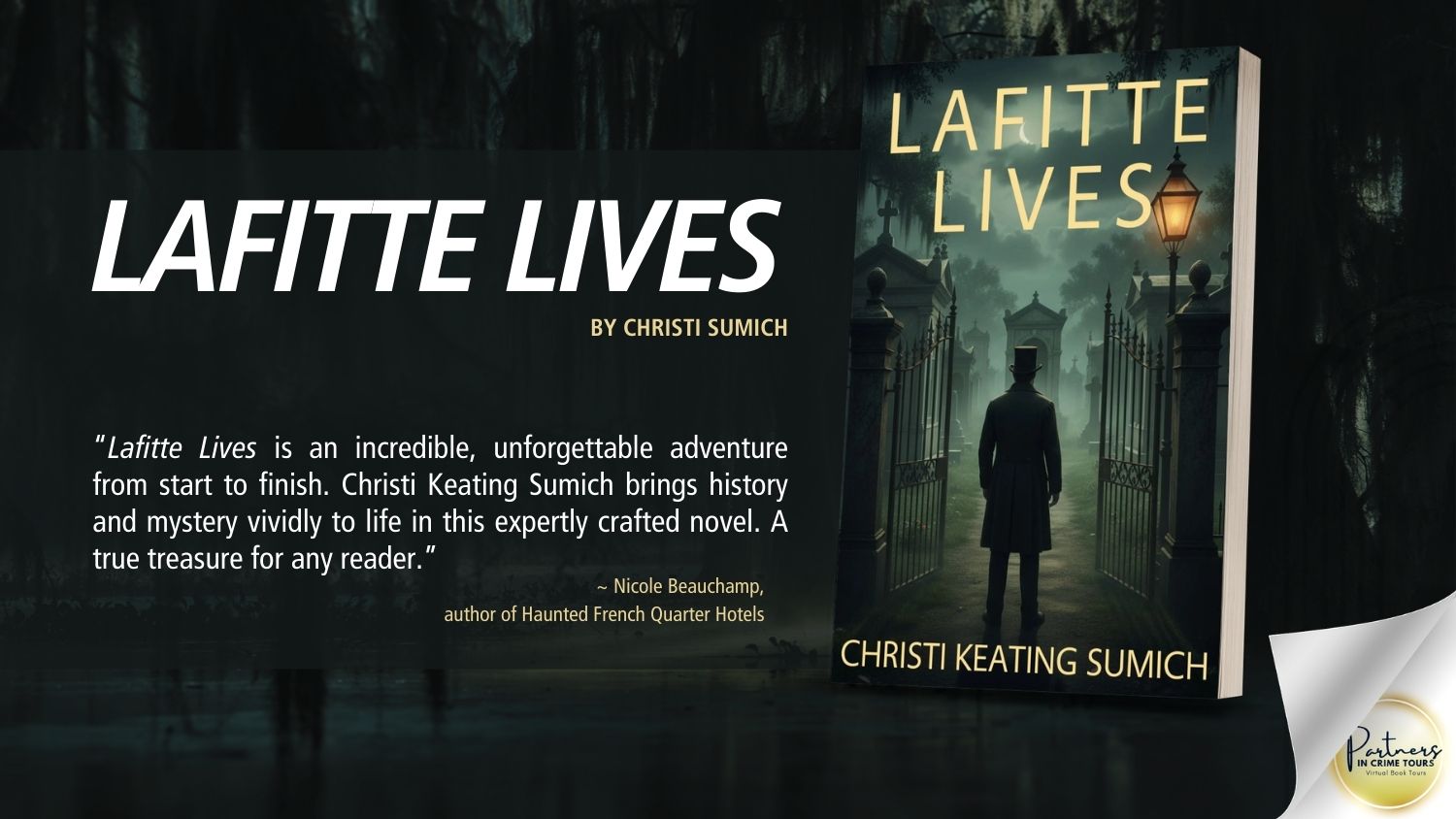
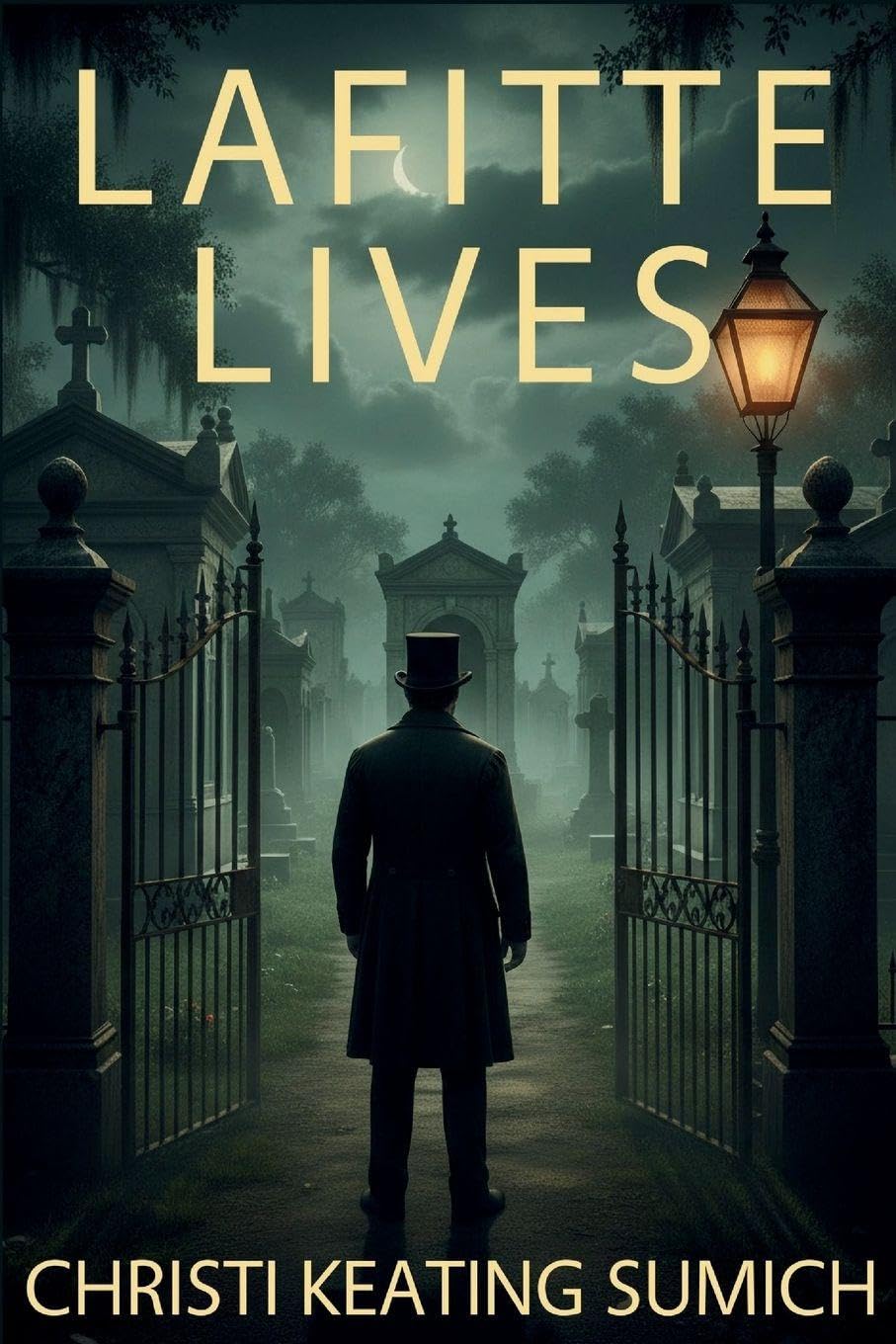
In bustling, multicultural 1831 New Orleans, Tobias Whitney, the sexton of St. Louis Cemetery No. 2, uncovers a journal sealed inside the tomb of Dominique You—war hero of the Battle of New Orleans, privateer, and half-brother of the notorious pirate Jean Lafitte. Convinced that the journal holds the key to Lafitte’s lost treasure, Tobias turns to his sharp-witted and outspoken wife, Mary Catherine, to translate its cryptic French passages. Tobias and Mary Catherine discover secrets they could not have imagined—secrets that could change their lives forever. But is it really the truth? As the journal warns, Never trust a pirate!Lafitte Lives blends meticulous historical research with a page-turning mystery, bringing the legend of Jean Lafitte to life while telling the redemptive story of Tobias’s grief and Mary Catherine’s quest to help him overcome it.
.
Praise for Lafitte Lives:
“Lafitte Lives is an incredible, unforgettable adventure from start to finish. Christi Keating Sumich brings history and mystery vividly to life in this expertly crafted novel. A true treasure for any reader.” ~ Nicole Beauchamp, author of Haunted French Quarter Hotels “In August 1831, Tobias Whitney, Sexton—caretaker—of St. Louis Cemetery No. 2 in New Orleans, makes a startling discovery. Hidden in a hollow space in a mausoleum is the diary of Dominique You—half-brother of Jean Lafitte. The diary offers a first-hand account of Lafitte’s life after his reported death in 1823. As the title implies, Lafitte Lives. Find a comfortable seat, grab your favorite beverage, and let your imagination loose as Christi Keating Sumich delivers an engaging tale of the infamous pirate and patriot who may—or may not—have faded into the swamps and bayous of south Louisiana.” ~ Michael Rigg, Author of the New Orleans-based medicolegal thriller, Voices of the Elysian Fields “Lafitte Lives is a ripping good pirate yarn surrounded by a touching story of family heartbreak and healing, all wrapped up in a tantalizing mystery. Steeped in rich period detail, it’s a tale filled with secrets and surprises readers won’t see coming. After all, never trust a pirate!” ~ J.R. Sanders, author of the Shamus Award winning Nate Ross series
.
Lafitte Lives Trailer:
.
.
Book Details:
Genre: Historical Mystery
Published by: Level Best Books Publication Date: February 24, 2026 Number of Pages: 320
The worst part of the job was the smell. A decaying human body releases an oddly distinct scent. It is a horrid mixture of rotting eggs and cabbage, mothballs, feces, and an off-putting garlic-like odor, depending upon the gases released at each stage of decomposition. Being an observant sort of chap, Tobias Whitney was well-versed in the stink of human decay able to discern how far along a body was in the process of decomposition based on the particular aroma the tomb was emitting. It might be a cloying reek or a putrid stench. The time of year was a contributing factor. The hot, humid summer months were the worst. So much rotting flesh in one place combined to produce a nauseating medley of noxious aromas so foul that even Tobias, who spent his days in the cemetery, felt his stomach churn as he inhaled the soupy air. Tobias had smelled foul odors before, of course. Anyone who lived in New Orleans long enough had. At this time of year, the privy behind his cottage was the stuff of nightmares. A body could get used to almost anything, though. Tobias had taught himself to focus instead on the delicate, honeyed scent of the flowering sweet olive bushes planted in the courtyards of homes all through the Vieux Carré, or the French Quarter as the Americans called it, for the express purpose of making the stench of so many privies in such close proximity more bearable. Similar aforethought had gone into the landscaping at St. Louis Cemetery No. 2, where Tobias had been sexton for nearly three years. Unfortunately, the ethereal scent of fragrant flowering bushes and trees planted along the perimeter and throughout the cemetery grounds was far too subtle to mask the stink. It invaded his nose and marched its way down to his mouth. He let out a breath he’d been holding and put his sleeve against his nose as he inhaled. He spit to rid himself of the foul taste. Both actions proved futile. It was no wonder. The body interred within the tomb he was cleaning had been laid to rest less than a year before, and the tomb’s inhabitant to his right was an even fresher burial. As sexton, he was responsible for maintaining the cemetery. Some months were busier than others, and August was keeping him at sixes and sevens, between all the yellow fever burials and the rains making a mess of the cemetery pathways. The cemetery had flooded recently, causing the crushed oyster-shell gravel to flow in rivulets between the above-ground tombs and collect in the lowest spot. Unfortunately, the lowest spot was the site of a recently built tomb. The cemetery consisted mainly of above-ground tombs, whose care kept Tobias busy, though he remained fascinated by the structures. Above-ground burials were the custom here, in part due to the French and Spanish colonists who settled in New Orleans, and for more practical reasons. Guthrie Toups, the octogenarian and retired sexton whom Tobias replaced, had justified the tomb burials in the most colorful fashion. “These tombs are your bosom friend.” He had waved his gnarled hand about, indicating the structures surrounding him, as he shuffled through the cemetery with Tobias on one of his final days on the job. “Smell like shite in summer but keep the floaters pinned down.” When Tobias failed to comment, Guthrie explained. “Used to be, I worked at St. Peter Street Cemetery. All those souls went right in the ground. Two times I recall the rainwaters floodin’ the place somethin’ fierce. Coffins poppin’ up like gophers in springtime. Some washed down the street, right up to folks’ houses. When the lids came off, now that was a sight!” A shudder wracked Guthrie’s gaunt frame, rippling through his threadbare coat. “Took us weeks to round up the coffins. And then to find out who belonged where! Can’t put a body back in a hole when you don’t know who he is and which hole is his,” Guthrie shook his head. “Damn shame. You think lookin’ after these tombs is trouble until you gotta put coffins back whence they should never have been disturbed.” Guthrie, who insisted on being called by his Christian name, had been gone from the cemetery for three years and from the world for two. Technically, he had never actually left St. Louis No. 2. He was enjoying his eternal rest, only one row of tombs over from where Tobias was currently toiling. Tobias considered whether Guthrie’s take on the tradeoff of floaters versus smell was valid. “Shite” seemed far too euphemistic a way to describe what was assailing his senses. Had the souls surrounding him been laid to rest underground, there would be no discernible odor, even in the August heat. However, in addition to being above ground, the vaults in St. Louis No. 2 were not airtight, a necessity since exposure to the elements ensured the bodies would decompose in a timely fashion. Following the bevy of recent rainstorms that Tobias’s wife referred to as “gully washers,” an additional component of stale, stagnant water added to the cemetery effluvium. “God’s teeth!” declared Tobias in frustration, blowing out a breath of putrid air as he gazed at the dispersed gravel and mud piled up along the front and sides of the low-lying tomb. He continued raking, attempting to redistribute the mud-soaked mess along the paths that separated the tombs. It was slow going. The puddles of standing water made the task challenging, and, of course, another drenching rain would produce a similar mess. It was the sort of mindless labor that allowed a person time to think, though Tobias, as of late, preferred not to indulge his brain in aimless wandering. It inevitably led back to dark and painful places. Instead, he compensated by replacing his internal monologue with the voices of others, imagining how they might describe what he was presently seeing. It engaged his mind and allowed him to distance himself from his thoughts. He often remembered the tombs’ description, construction, and proper care, as Guthrie had first explained them to him. Even now, he could so vividly recall the old man’s gravelly voice, brittle as the oyster shells underfoot. “Needed these tombs, the city did. So many coming to New Orleans after Jefferson bought her up, and so many dying here. Nowhere to put a cemetery unless you want to go digging graves in a swamp!” His guffaw had echoed off the tombs. When Guthrie first began his tutelage, Tobias doubted that he could absorb any new information, so clogged was his brain with other thoughts. Still, the details distracted him. He yearned to learn all he could about the cemetery and the tombs where the bodies rested. He was fascinated, he feared morbidly so, with the amount of sadness one place could contain within its walls. Tobias could sense the pain and loss felt by the loved ones of St. Louis No. 2’s inhabitants, the heaviness of their collective grief threatening to crush him at times. He felt the familiar weight bearing down on him as he looked to his left, at the open tomb whose faceplate had been removed in anticipation of its next occupant, a newly deceased young woman who would be interred there tomorrow. The tomb was empty now, as she would be the first inhabitant. He took a moment to wipe his brow and allowed himself to be transported back to the first time he had viewed an open tomb. “‘Nother good thing ‘bout tombs is how many bodies you can stuff inside,” Guthrie had explained. Tobias had to bend his lanky frame nearly horizontal to match the smaller man’s permanently hunched posture, but by doing so, he could peer into the yawning darkness of the tomb, the unnatural stillness of the space raising the hairs on the back of his neck. “This one’s a single vault,” Guthrie said. “When the first one of the family dies, we put him in there, coffin an’ all. When the next one goes, that first one gets taken out of the coffin, and what remains of him gets put down in the caveau.” He motioned to the dark, far reaches of the tomb, beyond and below, where the coffin was to be placed. “And so it goes ‘til all the family is holed up in their tomb together. Here’s hopin’ they get along, cuz that’s some close quarters!” Guthrie punctuated this with a cackle and a bony elbow to Tobias’s ribs. Guthrie’s litany of anecdotes and explanations encompassed nearly every inch of St. Louis No. 2, including the perimeter walls of the cemetery itself, comprised of stacked tombs that Guthrie had told him were called ovens. “Cuz they look like ovens put one atop the other, and they heat up the bodies faster than cookin’ ‘em. That’s a good thing when you need to get a lot of bodies buried all at once.” Guthrie’s mood had turned somber, the smile leaving his face. “I can remember stacking bodies up in ‘24 and ‘25 when Yellow Jack came for so many, and there was nary a place to put ‘em. Brought ‘em to the cemetery by the cartload and dumped ‘em right outside the cemetery gates, they did. Left those poor souls rotting in the sun, spreading their miasma over the city like a damned blanket. Least these ovens do the trick!” The thought of yellow fever victims drew an involuntary shiver from Tobias, even this day, in the summer heat. Guthrie’s voice in Tobias’s head was sometimes the only company he had, not that he was complaining. Tobias craved solitude and was thankful to have this job. It paid a decent wage, enough for his family to live simply but comfortably, and perhaps best of all, it allowed him time to read. He looked wistfully at his favorite reading bench, positioned in a particularly serene spot deep within the cemetery. The only sounds were the cooing of doves and the whining buzz of cicadas, so incessant this time of year as to become background noise. He felt the book’s weight in his pocket, ever-present and beckoning him to take a break. His vision blurred. He wiped the sweat from his forehead yet again to prevent more of it from dripping into his eyes. He yearned to lose himself, if only for an hour or so, in the all-absorbing action-adventure stories he loved so dearly. For the past few years, escaping from the world had become necessary for his survival. Strange, he often mused, that spending his days surrounded by the dead would be the only way he could cope with the living. Strange, but understandable, given what happened to him three years ago. With a stubborn shake of his head, he said aloud, though no one else was around, “Not ‘til I put this tomb to rights.” Most families who owned vaults cared for them or paid the cemetery to perform the maintenance, which at the very least required replastering and whitewashing the brick from time to time. Even though the cemetery was relatively new, consecrated only eight years ago, he could already see the ravages the subtropical climate wreaked on those tombs without a caretaker to maintain them. “Orphan tombs, these ones are,” Guthrie had said of the tombs left to crumble. “Got no livin’ kin to care for ‘em.” He had shaken his head, the wiry gray hairs swaying with the movement. “A whole family gone and no one to remember them.” Tobias considered Guthrie’s words as worked this day. As he raked, he looked over his shoulder at one such orphan tomb and read aloud the inscriptions on the faceplate, “Constance Bulwark, born 1770, died 1824. Faithful wife, loving mother. ‘Blessed are the pure in heart, for they shall see God.’ Jeremiah Longstreet, born 1758, died 1827. Honest in labor, kind in spirit. May his soul rest in peace.” To preserve the dignity of the inhabitants within, he cleaned and made minor repairs to the orphan tombs, though it was technically beyond the purview of his duties. “You’ll not be forgotten,” he assured them before turning his attention to the task at hand. The tomb before him was not an orphan, as the cemetery was contracted to maintain it, but it might as well have been. Its inhabitant had received no visitors since he was laid to rest. Still, this particular tomb had intrigued Tobias since its construction last November. Like most in St. Louis No. 2, it was brick. While not as extravagant as some tombs Tobias had seen, he found the elevated parapet facade aesthetically pleasing in a simple, elegant way. However, the feature that most fascinated him was the nameplate commemorating the occupant, Dominique You. You was a Freemason, as such, his tomb sported the square and compass symbol prominently carved into the top of the marble nameplate. Below the name was an inscription in French. Tobias was Irish and could not discern the writing, but he knew from the accounts he had read in the papers that the inscription was from Voltaire’s La Henriade: Intrepid warrior on land and seain a hundred combats showed his valor.This new Bayard without reproach or fearCould have witnessed the ending of the world without trembling. Dominique You was an infamous privateer and, some say, the half-brother of the notorious pirate Jean Lafitte. Tobias had read all about the adventures of the two buccaneer brothers in the weekly broadsheets he purchased. Lafitte had been killed in 1823, the same year St. Louis No. 2 opened. But while Lafitte’s whereabouts in the years before his death remained a mystery, Dominique You had lived out his final years in New Orleans, keeping a tavern and serving on the city council. He may have been a privateer, but he was also a war hero, having served valiantly as a gunner in the Battle of New Orleans, warding off a British invasion of the city by commanding a company of artillery composed of fellow pirates. Stories about Dominique You and Jean Lafitte were legendary around New Orleans and made the adventure novels Tobias read pale in comparison. Tobias vividly recalled his excitement when Dominique You was buried right in front of where he was now standing. Although You died in a state of penury, the people of New Orleans did not forget his heroism. He was given a lavish funeral at the Cathedral of St. Louis, with full military honors, the likes of which the city had seldom seen. Throngs of mourners had followed the coffin to the cemetery. As the sexton, Tobias had been there to witness it all. Many brought flowers to lay on his tomb, chrysanthemums or early-blooming camellias. Others brought magnolia leaves, fashioned into wreaths or dried herbs tied into bouquets with bits of ribbon or string. There were also rosaries, little vials of holy water, candles, and voodoo tokens left on You’s tomb. The mourners were as varied as the offerings they brought, well-dressed gentlefolk alongside the more common sort. They were all here for the same reason: to pay their respects to the man who helped save the city from the British fifteen years before. Tobias had caught snippets of conversations all around the tomb. One, in particular, stayed with him. A group of rough-looking men, ill at ease in their mourning attire, had gathered at You’s tomb. One of the men said, “Sailed with him, I did. No finer man you’d want at your side when things turned hairy. I’d trust him with my life.” “As would I,” his mate agreed. “Fought beside him, too. Best cannoneer I ever saw. That’s why the general said he’d storm the gates of hell with Dominique as his lieutenant!” Tobias had been particularly impressed with this, considering General Andrew Jackson was now president of the United States. He watched as they poured a slug of rum next to the tomb. It soaked into the gravel, leaving the scent of molasses and cloves lingering in the air like a final tribute. Tobias wondered with a shudder if these men were pirates themselves. He’d had little time to dwell on it, as a Mason engaged him in conversation shortly after Tobias overheard this exchange. The man donned a fine wool suit, well cut and fashionable, with a frock coat that gracefully skimmed the back of the knees of his trousers. Tobias usually donned a working man’s attire for his days in the cemetery, loose-fitting tweed trousers and a jacket, although on this day, he donned a suit. It was one he used to wear as a shop owner before he became a cemetery sexton, though now he donned it only for Sunday Mass. His wife, Mary Catherine, would have his hide if he showed up to work on the day of an interment of such prominence in anything less. Tobias felt rather nattily clad until he beheld the sartorial superiority of the man. Despite their difference in clothing, the Freemason was eager to engage Tobias in conversation, and Tobias found this agreeable. Funny how he spoke to almost no one these days, save his family and his close friend, the proprietor of his beloved bookshop, Chapter and Verse. Yet within the walls of the cemetery, he came back to life, if only for a short time. He felt at home here as much as he did in his cottage on Bienville Street. Though he knew precisely why this was, he found it a disconcerting aspect of his personality that he was more comfortable with mourners than with those unaffected by death. “Not a business in New Orleans stayed open today. Everyone’s here to pay their respects,” the man told Tobias. “I suppose you heard the cannons fired for him?” Tobias assured him that he had, and added that he’d also noticed the flags flown at half-mast. The Mason nodded. “He was a proud man, Dominique You.” The man seemed uneasy in the cemetery, as Tobias found most people to be. He suspected the Mason’s attempts to converse stemmed from a compelling need to fill the silence. Tobias noticed the man’s unconscious fidgeting with the intricately designed collar that nestled just below the tie on his starched white linen shirt, the adornment an indicator of his status among the Brotherhood. He spoke with a French accent, and his eyes told the story of a man who accepted the inevitable tribulations of life while still finding joy in living. Tobias was immediately envious of him. “Had not a penny to his name at the end but did not tell a soul of his troubles.” The man gazed wistfully at Dominique’s tomb. Tobias would have left him to his thoughts, but he continued. “We would have come to his aid, I can assure you of that. But Dominique was never one for charity. Tough old sailors rarely are. At least we could honor him in this way.” With a tip of his top hat by his white-gloved hand, the man moved on, presumably finding Tobias too taciturn. Yet for all the military fanfare and grandeur surrounding the funeral, now, a mere nine months later, the tomb lay quiet. Tobias had seen no visitors at the tomb since that day. Dominique You had never married, and although he had been a rather upstanding citizen in the twilight of his life, he did not appear to have close friends, at least not that Tobias had seen. Close friends visited a grave from time to time, but not even his brothers from the Masonic lodge had come. And those had been the folks most upset by his death, at least if public grieving was any indication. Then again, Tobias had seen a lot of grief in his tenure at the cemetery, and it had been his observation that even members of the sterner sex could make an enormous fuss over the coffin and then never come back. The people who looked the most distraught, as if they did not care to go on living, usually got over it by morning. It was the ones who never took their eyes off the coffin, even as it made its way into the vault, that you could be sure would put flowers there for years. Real grief was mostly invisible. It consumed a person from within, leaving only an outer shell that appeared to the world as a whole being, but was hollow inside. Tobias ought to know. He recognized it in others because he was just a shell himself. Tobias wondered once again why the Freemasons had chosen this spot for You’s tomb. It seemed a poor location in the cemetery to build a tomb, but it was not Tobias’s place to say so. It was kind of the Freemasons to construct it for their brother, even if they had decreed it was to be sold in fifty years. This stipulation did not surprise him, as he knew people sometimes purchased tombs this way. The odd part to him was that an entire tomb would be dedicated to only one person when many held multiple family members. Tobias would have thought a single man with no surviving family, and one who did not have much money, would not need a whole tomb to himself. But perhaps his contribution as a war hero had moved some hearts to loosen their purse strings and fund this stand-alone vault. This was a monument to Captain Dominique You, and Tobias would do his part to honor his memory by mucking out the mess around the man’s final resting place. He finished raking the gravel around the front, repositioning it as best he could amid the puddles that stubbornly lingered even with the scorching August sun. Now he moved to the side of the tomb, where the ground was slightly lower, causing even more water to pool. He could not do much else until the water drained, which might take a while in New Orleans. In the meantime, he could wipe away some of the mud that had splashed onto the tomb from the rainstorm. He pulled a clean rag out of his pocket and decided to concentrate on the nameplate on the front of the tomb. It was then that Tobias noticed the oddest thing—the marble plate was not flush against the bricks. Tobias chided himself for not observing this before, but as he studied it closely, he realized that it appeared to be placed properly from the front. It was not until he looked from the side that he could see the marble stone was bowing. This was indeed curious, as he himself had placed the outer tablet. As sexton, it was part of his duties to affix the plate upon the bricks after the body was interred and the tomb bricked up. He had seen marble bow when exposed to extreme heat, but thick nameplates typically did not deform so quickly. It was a blessing in disguise that the rain, which would inevitably flood the cemetery in the summer months, had necessitated him spending time around this tomb, allowing him to observe it more closely. Had the Freemasons chosen a more optimal spot to place the tomb, it might have been many years before he had noticed this subpar workmanship. And since the inhabitant had no living family members, it might not have been until the fifty years were up and the sexton opened the tomb for a new burial that the faulty nameplate was discovered. But surely, he would have noticed if something was amiss with the marble. He leaned in for a closer inspection and blinked rapidly. He thought perhaps it was a trick of the bright sunshine, but as he stared at the marble slab, he discerned a hairline fracture running the length of the stone. Dominique had been interred less than a year ago. This nameplate should not display such signs of degradation. Had he somehow damaged the stone when bolting the nameplate onto the brick vault? Utterly perplexed, Tobias pondered what he should do. He was exceedingly curious whether his workmanship was to blame for the bowing and cracking or if it was a defect in the stone itself. He knew he should probably wait until he had help, but his inquisitive nature got the best of him, and he rushed off to retrieve his wrench. Removing the large bolts holding the nameplate in place would not be an easy job to perform by himself. He half-expected that he would not be able to loosen them at all, but was relieved and more than a bit surprised to find them coming loose without even having to apply heat. He knew the stone would be too heavy to maneuver on his own, but he planned to slide it down to the ground once it was free from the brick on the front of the vault. With less effort than should have been required for such an undertaking, Tobias freed the marble slab and eased it down about a foot until it rested upright against the tomb. To conduct a proper inspection, he would need to see the back of the slab. The stone was indeed heavy and should have been cumbersome for two men to handle, yet Tobias was able, with some difficulty, to lay the slab on the ground so that the back was visible. He instantly understood why he was able to maneuver it unassisted. The back of the marble had been carved out, and the stone, too thin in the center to withstand the intense heat, had bowed as a result. The thinned-out stone also accounted for the hairline fracture Tobias had noticed. This nameplate was not the solid, thick slab he had affixed to Dominique’s vault nine months ago. The slab had been altered and reattached, unbeknownst to him. Tobias did not need to ponder why someone had done this because nestled within the carved-out space was a book. *** Excerpt from Lafitte Lives by Christi Sumich. Copyright 2026 by Christi Sumich. Reproduced with permission from Christi Sumich. All rights reserved.
.
About Author Christi Keating Sumich:
.
Christi Keating Sumich holds a PhD in history from Tulane University and a master’s degree in English. Her research field is seventeenth-century disease and healing. Christi’s writing combines her fascination with history with her love of the mystery genre. Her debut novel, Lafitte Lives (Level Best Books, March 2026), is a historical mystery centered on her ancestor, the notorious pirate Jean Lafitte. She is also the author of the Old New Orleans Bookshop Series, mysteries featuring characters from Lafitte Lives. The Swamp Ghost is the first book in the series (Level Best Books, September 2026). Christi is also part of a writing team with her mother, Sharon Keating. They are the co-authors of Hauntingly Good Spirits: New Orleans Cocktails to Die For (Wellfleet Press, 2024) and The Brandy Milk Punch (Louisiana State University Press, 2025), part of the Iconic New Orleans Cocktail Series.
Click through the other tour stops for can’t-miss reviews, insider interviews, exclusive guest posts, and more chances to win! Click here to view the Tour Schedule
Claim Your Treasure! Celebrate LAFITTE LIVES!
This giveaway is hosted by Partners in Crime Tours for Christi Keating Sumich. See the widget for entry terms and conditions. Void where prohibited.
An eerie suspense novel, in which a grieving woman takes a job at an isolated mansion only to become wrapped up in the curse that seems to have befallen its eccentric owner.
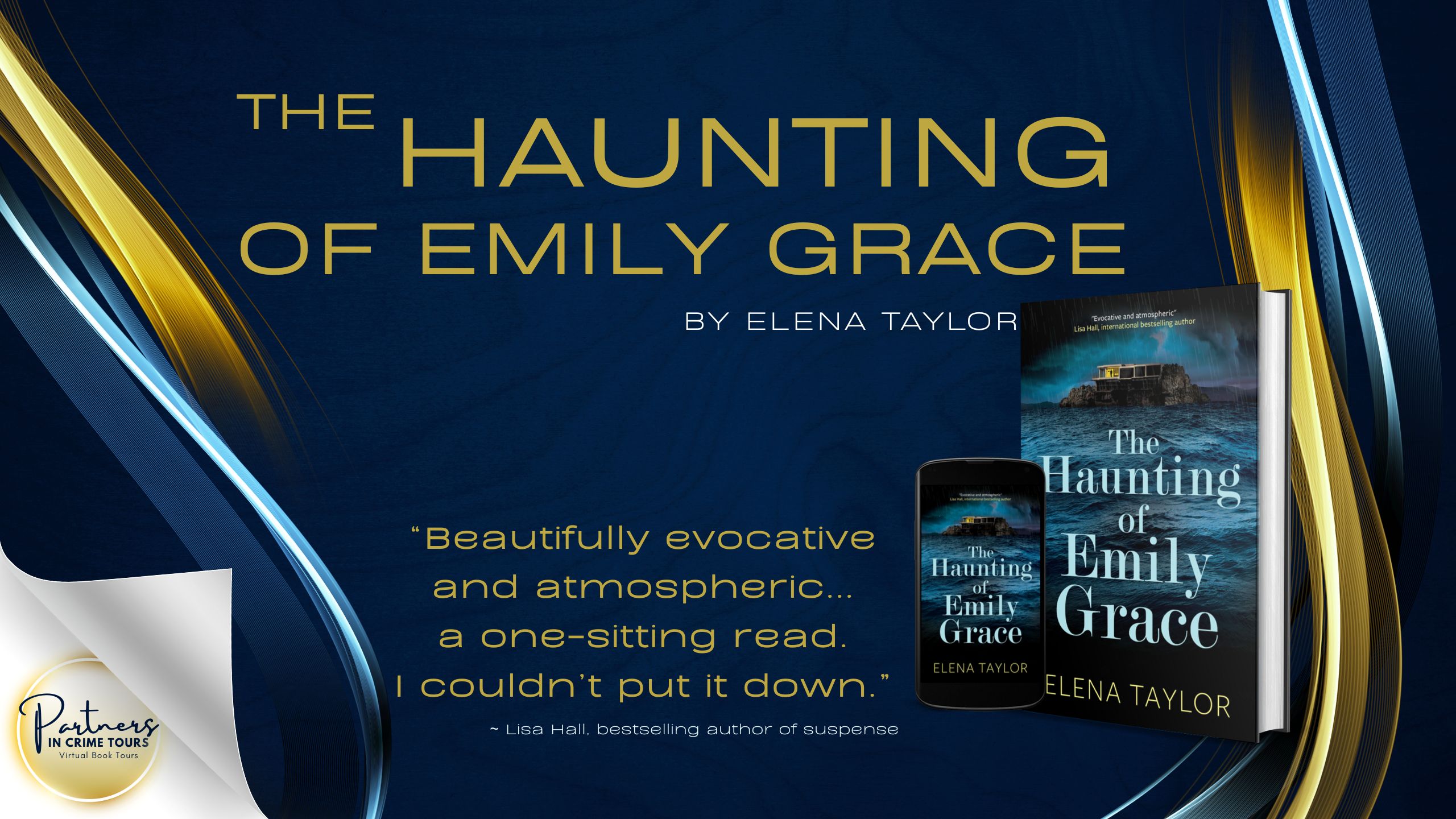
Emily Grace has endured the worst loss imaginable. But can she survive a remote manor haunted by more than just memories . . .? Drowning in grief, Emily Grace has lost everything: her home, her friends, her career. Only one lifeline remains—a job working for an eccentric millionaire. Along with his wife, he’s been building a mansion on a secluded island surrounded by a harsh and unforgiving sea. But when she disappears under mysterious circumstances, Emily Grace is hired to finish the project. Locals believe the house is cursed, but their warnings go unheeded as Emily Grace works to rebuild her life. After what she’s been through, nothing can scare her—except perhaps the attention of a handsome man offering more than friendship. And yet, there’s something strange about this solitary fortress. Accidents. Mishaps. Ghostly whispers through the surrounding forest, footsteps when she’s completely alone . . . Is there truly a curse or is the ethereal specter in the window an omen of something more sinister?
This spooky standalone from phenomenal crime author Elena Taylor will have readers sleeping with the light on for weeks! With vibes of Rebecca by Daphne du Maurier, fans of Riley Sager and thrillers with light horror elements will love The Haunting of Emily Grace!
.
Praise for The Haunting of Emily Grace:
“Taylor doesn’t just conjure suspense—she dissects it, peeling back the fragile layers of identity, memory, and trust until nothing feels safe. The Haunting of Emily Grace is deeply unsettling in all the best ways.” ~ Carter Wilson, bestselling author of Tell Me What You Did “Beautifully evocative and atmospheric, The Haunting of Emily Grace is a one-sitting read. I couldn’t put it down.” ~ Lisa Hall, bestselling author of suspense “gut-tightening suspense” ~ Edward J Leahy, author of the Dan Brady and Kim Brady mysteries
.
The Haunting of Emily Grace Trailer:
.
.
Book Details:
Genre: Suspense with a touch of light paranormal/horror
Published by: Severn House Publication Date: November 4, 2025 Number of Pages: 288 pages, Hardcover ISBN: 9781448317370 (ISBN10: 1448317371), Hardcover
Grief is a scab that I can’t stop picking at, no matter how hard I try. It pokes at me now as I sit in my truck on the deserted ferry dock, surrounded by dense morning fog and waiting for the boat to take me across an expanse of dark water to a house rumored to be cursed. My fingers trace a photograph taped to my dashboard. My hand trembles, likely from an empty stomach or sleeplessness, as both are constant companions. But I outline the beloved face, forever frozen, like a precious object in amber. Lost to me in the real world, calling to me from the next. The ferry slides into the dock in front of me with a bump against the pilings. A lone figure moves across the empty deck, while an old, grizzled seaman stays inside the tiny wheelhouse. One captain and one first mate. Tying the ferry off with ropes thicker than my arm, the mate’s actions are practiced and steady. He lowers a ramp and waves me forward. Ever so slowly, I roll across the water, fighting against holding my breath—the superstition I’ve clung to my entire life every time I cross a bridge. The thirty-minute sail to Salish Island, and tiny Monk’s Rock where my new job awaits, won’t allow me the indulgence, so I might as well continue to breathe despite my need to cling to anything, even a silly belief, to keep me safe. After parking the truck as the mate directs, I wait as he shoves bright orange chock blocks around all four wheels, as if, without a barrier, my vehicle might drive itself into the sea. I open my door a crack; our eyes meet. “Can I get out?” “Of course.” The first mate is rugged, with an air of confidence like he’d be good in a crisis. Smooth skin on his cheeks. Bright, inquisitive eyes. Broad shoulders visible under the bulky uniform of dark green waterproof overalls and a yellow slicker. He holds out his hand as I step out. “Careful. Parts of the deck can be slippery when it’s this wet.” Electricity flies between our fingers, and I pull away as if he poses a threat. I don’t want to feel desire. Intimacy is dangerous. But what does it mean that I’m looking at men again? He gives me an odd look. “We’ll be underway in a few minutes.” He walks back to the ramp, where two men unload a battered white cargo van. The three of them quickly stack boxes to one side, lashing them in place. No doubt provisions for an island that’s home to five hundred hearty souls—and me. At least for the time it takes to complete the finish carpentry in one enormous house. I’d once been a very good carpenter. Before my life exploded into hospitals and medical visits, overwhelming helplessness and all the endless paperwork connected to dying. Since then, I’ve done a poor job of putting myself back together. The rough pieces of grownup life refusing to fit a new pattern now that I’m alone. My mentor Bill Thomlinson had started this project less than a week ago but fell and broke his leg in multiple places. After he came through the surgery, metal pins in place, he convinced the homeowner to take a chance on me. “You need this,” he said to me over the phone, his voice surprisingly strong for someone coming out of anesthesia. “I’m done watching you flail. This job can save you. Don’t let me down.” Now I stand on the deck of a private ferry while the engines roar out a steady vibration under my feet, and wonder if I’ve made a terrible, terrible mistake. Crossing to the rail, I pin my eyes where the horizon must lie out beyond the mist. Clouds above and waves below. Indistinguishable from each other because of the heavy air, thick like smoke. My stomach lurches at the thought of everything that swims underneath my feet and the unknown depth of the sea. Breathe in . . . breathe out . . . focus on the future. Focus on the work. All I know about the job ahead of me is that the original carpenter vanished, forcing the owner, Cameron Lang, to bring in someone else, but then Bill ended up with pins in his leg. Given that I haven’t slept in so long that I shouldn’t be trusted with power tools, I hope that whatever the curse is, it doesn’t come in threes. When I feel like I’m losing my mind, it helps to ground myself with something physical, so I grip the hard, cold rail in my hands. No matter how much ending my life is a viable choice, some small part of me refuses to let death win again. The fog brightens, and we cross a physical line in space, plunging into a blue so pure it hurts my eyes. I gasp and grip even tighter as the sky separates from the water, which now spreads out below me in an endless black void. “Not quite got your sea legs?” The first mate watches me with barely disguised curiosity. Salt spray traces tears down my cheeks. I must look like I’m crying. “I didn’t expect to come out of the fog so abruptly.” “It does that sometimes. Now you see it, now you don’t. No matter how often we sail through a bank, it always feels like magic.” “I can imagine.” He lingers nearby. Maybe there’s little to do once the ferry is underway. Although small talk is beyond my ability, part of me longs to hear his voice again, even if I say things that sound insane. The temperature drops as we head further out to sea. We’re soon dodging between uninhabited land masses. “Some of these islands are so low they disappear in high tide.” He gestures to the slopes of land. Rocky outcroppings just under the surface. Dangerous, like unexploded mines in the sand. Panic rises. The water below us taunts me—my troubles will be over if I simply fall into a watery grave. The voice becomes louder and more insistent that I should do something I can’t take back. To keep my mind off the words in my head, my eyes search for the defiant piece of US rock thrusting out of Canadian waters. If I can make it back to dry land, I can get through another day. “That’s what you’re looking for.” The first mate’s breath tickles my ear as he comes closer, speaking over the hum of the engines, the slap of water on the hull, and the cry of seagulls. My gaze follows his arm to the far-off outline of Salish Island, where Monk’s Rock perches off the northern-most end, tethered to each other by the narrowest of bridges. “Take this.” He presses a business card into my hand. “Just in case.” Under his name is a single word, handyman, and a phone number. “Adrian Han?” I look up, his eyes capturing mine. “I thought you were the first mate.” “I’m a lot of things.” His words are casual, but something reflects in his expression, an emotion I can’t put my finger on. “You might realize at some point there’s a project you need help with. Nothing against your skills. Everyone needs another set of hands once in a while.” “I have a helper.” “Chuck, yeah. I’ve worked with him before.” His tone is carefully neutral. My new boss made the arrangements for Chuck to help me with anything that requires two people. Am I going to regret his choice? “How do you know why I’m here?” Adrian’s carefree expression returns. “Emily Grace Turner. Carpenter. Here to finish the End of the World.” It’s a jolt that he knows anything about me when I’ve worked so hard to become invisible. He reads me again, and his tone turns reassuring. “It’s a small town—people talk.” He gestures toward the wood rack that fits over my camper shell and the bumper sticker: Proud Member of the Carpenter’s Union. “Plus, your name was on your ferry registration.” I chuckle for thinking his words are sinister until a darker emotion, one that looks like fear, crosses his face. “That house—” His lips purse as if he holds something back. “Just call if you need help. Anytime.” The island takes clearer shape, and Adrian returns to the wheelhouse, his absence palpable, as if a physical hole remains in the air after he’s gone. He’s taken his fear with him, except for the small part he’s left behind with me. *** Excerpt from The Haunting of Emily Grace by Elena Taylor. Copyright 2025 by Elena Taylor. Reproduced with permission from Elena Taylor. All rights reserved.
.
About Author Elena Taylor:
.
Elena Taylor spent several years working in theater as a playwright, director, designer, and educator before turning her storytelling skills to novels. Her first series, the Eddie Shoes Mysteries, written under Elena Hartwell, introduced a quirky mother/daughter crime fighting duo. With the Sheriff Bet Rivers Mysteries, Elena returned to her dramatic roots to bring readers more serious and atmospheric novels. Located in her beloved Washington State, Elena uses her connection to the environment to produce tense and suspenseful investigations for a lone sheriff in an isolated community. The third in the series, Kill to Keep, launches summer 2026. The Haunting of Emily Grace is Elena’s first standalone suspense novel. Her favorite place to be is at Paradise, the property she lives on south of Spokane, Washington, with her equines, dogs, cats, and hubby.
Visit these other great hosts on this tour for more great reviews, interviews, guest posts, and opportunities to WIN in the giveaway! Click here to view the Tour Schedule
Don’t Miss Out! Enter Now for Your Chance to Win!
This giveaway is hosted by Partners in Crime Tours for Elena Taylor. See the widget for entry terms and conditions. Void where prohibited.
A high-profile homicide of a former ambassador’s son in the nightlife district of the nation’s capital gets connected to an assassination market on the dark web. When political elites panic upon finding their names listed on the online dead pool, entrepreneurial siblings Karen and Yemi Uzunma see a business opportunity for their DC area-based executive protection firm, RAPTOR. Their first major client becomes the ex-diplomat himself, Chiedu Attah, but to guarantee his safety, they realize they are going to have to go to war in the streets with an inventive contract killer who will not stop attacking until Attah suffers the same fate as his son.
Praise for Bazaar:
“Bazaar is not just about action; it unfolds layer by layer, offering more than just a high-stakes thriller.” ~ Priya Bhasin, The Bibliophilic World “Truly an interesting book with a perspective rarely seen in fiction” ~ Jeff Sexton, Head Librarian for Hardcover.app “A fast-paced book that caught me off guard more than once.” ~ The Mystery Review Crew “If you like complex, suspenseful, thrills, chills, hidden agenda type books, then I recommend giving Bazaar by Miles Joyner a try.” ~ Susan Blogs About Books “Saying that I was awestruck by Miles Joyner’s character development and knowledge of subject matter would be an understatement. I highly enjoyed this novel.” ~ J.M. Clark, Author of Palace Program series of novels.
.
BAZAAR Trailer:
.
.
Book Details:
Genre: Technothriller
Published by: World Castle Publishing Publication Date: March 24, 2025 Number of Pages: 355 ISBN: 9798305201901 (HC) 9798891263369 (PB)
A lifelong fiction writer, Miles turned to penning novels after nearly a decade of holding various producer/editor roles in the D.C. area media industry. He still pursues filmmaking in between books and finds that writing in the thriller genre only enhances that passion even more. Miles is an active member of International Thriller Writers where his novel, Bazaar, was selected for ITW’s Debut Authors Program. He also attends monthly meetings for Novels in Progress DC.
Visit these other great hosts on this tour for more great reviews, interviews, guest posts, and opportunities to WIN in the giveaway! Click here to view the Tour Schedule
ENTER FOR A CHANCE TO WIN:
This is a giveaway hosted by Partners in Crime Tours for Miles Joyner. See the widget for entry terms and conditions. Void where prohibited.
A devoted wife and mother faces the unimaginable as her life crumbles.
Crystal Rigler seems to have a perfect marriage. Derek, her handsome and charismatic husband, and their adult daughter, Cordelia, are her whole world. In addition to her already busy life, Crystal supports the volunteer organization she and Derek started: STOP (Stop Transplants of Organs from Prisoners). STOP aims to end a new government policy of harvesting organs from executed prisoners. They learn that these organs are not distributed by the national transplant list, established to allocate organs fairly. Instead, a shadowy figure known as Broker Al pulls the strings. He expedites the execution of young and healthy prisoners and sells their organs at a high price to the rich and well-connected. After Crystal learns a disturbing secret, events are set in motion that will potentially dismantle STOP, change her life, and cost her everything. Unless she is willing to do the unthinkable… .
.
Praise for The Organ Broker:
“The Organ Broker by Deven Greene was intricate and captivated my attention from the first page. The story was fast-paced with not a single dull moment.” ~ Readers’ Favorite
“If you enjoy moral dilemmas, complex characters, and a plot that feels uncomfortably plausible, this book will leave you thinking long after the ending.” ~ Literary Titan
“…electrifyingly intense… Introspective and entertaining, The Organ Broker navigates the delicate balance between principles and priorities.” ~ Indies Today
“The Organ Broker … teeters between thriller, novel, a story of medical and social challenge, and more. It stands out from others about organ harvesting simply because it evolves a complex plot that engages characters and readers in a moral and ethical dance spiced with intrigue and the unexpected.” ~ D. Donovan, Sr. Reviewer, Midwest Book Review
.
THE ORGAN BROKER Trailer:
.
.
Book Details:
Genre: Psychological Suspense
Published by: Panthera Publishing Publication Date: April 2025 Number of Pages: 321 ISBN: 9781964620060 (ISBN10: 1964620066)
The East Texas sun was hotter than usual for September, the few clouds high above providing no relief. A half-hour earlier, overcome by heat and exhaustion, Crystal had let her sign reading “Save Kwami” slip to the ground. Standing near the front of the crowd, Crystal pushed up the visor on her baseball cap to get a better look at her surroundings. She was pleased with the impressive turnout which she estimated to be close to one thousand people. It was the largest they’d ever had. Most of the other protestors continue to hold their placards high, displaying myriad slogans such as “Justice for Kwami,” “Let Kwami Live,” “Impeach Gov. Percy,” and the most popular, “STOP.” She took a deep breath and lifted her sign again, fighting the pain in her fingers as she held it as high as she could.
The crowd of protestors was comprised of a cross-section of the community— young, old, couples, families, Black, White, Hispanic, and Asian. A colorful array of baseball caps, bucket hats, visors, straw hats, and cowboy hats protected most of the heads from the constant flood of the sun’s rays. The makeshift podium and public address system were rudimentary, and there was the usual milling around often seen in large gatherings, but the audience, for the most part, was paying attention to the pudgy young man with a man bun speaking to them. At times, the crowd burst out in synchronous claps and hoots of approval. The assembly was peaceful, with only a few skirmishes breaking out at the edges where police stood watch. Still thirsty after having finished her bottle of water, Crystal let her mind wander as the speaker droned on about the immorality of what was about to take place. Her clothes clung to her sweaty body, and despite wearing sunglasses with polarized lenses, the bright sun hurt her eyes. Looking down, she swatted away a bug that landed on her arm. Uncomfortable and impatient, she was eagerly awaiting the next speaker. Finally, the man at the podium looked up and announced, “And now, the man you’ve all been waiting to hear, the leader of our organization, Mr. Derek Rigler.” The mood of the crowd changed, and participants started chanting “STOP” in unison as they raised and lowered their signs. A tall, muscular man with tan skin and wavy blond hair, took to the stage next to the previous speaker and scanned the crowd with his magnetic blue eyes. Crystal looked up and smiled. His handsome, chiseled features gave him the look of a confident leader. Although he was nearly fifty years old, he looked at least ten years younger. He hasn’t lost the ability to attract attention whenever he enters a room. Derek took his place on the podium and held out his arms as if to give a benediction. After almost a full minute of roaring applause, he raised and lowered his hands several times to quiet the crowd. Crystal looked around, energized by the enthusiasm bubbling over. She noted more press vans set up around the perimeter than in the previous protest. Their organization, STOP, was gaining traction. She wondered if Derek had picked her out of the crowd. If she were taller, he’d probably see her—she wasn’t far from the front—but she imagined her five-foot two-inch frame made her visage difficult to identify in the sea of people. From what she could glean, Derek hadn’t spotted her. After all, she was just another brunette under a baseball cap, surrounded by many others. Even so, Crystal smiled widely, wondering if anyone nearby recognized her. After all, she was notable as Derek’s wife and the mother of his child, Cordelia. As Derek started his familiar diatribe against the Texas death penalty laws, Crystal tried to lock eyes with him, but his eyes never found her. Instead, he focused on members of the audience near and far, concentrating his gaze on one person for several seconds before moving on to the next pair of waiting eyes. Crystal recognized the usual arguments against the event that was scheduled to take place momentarily—the uneven death penalty sentencing, the ugliness of exacting revenge, and the irreversibility of the punishment once meted out. The speech was powerful, and she agreed with everything Derek said. She could recite the words by heart, not only because she had heard them during Derek’s practice sessions, but because she had written them herself. Every time the crowd reacted with hollers and claps, she felt taller, each breath a bit more satisfying. She’d been to over six of these rallies in the past year, each protesting the execution of a prisoner found guilty of a crime deemed fitting for capital punishment. The death penalty had never sat well with Crystal, but over the past two years, the practice had escalated, with four more executions scheduled over the next six months in Texas alone. Not only was the ultimate punishment meted out more often, but the evidence leading to convictions was frequently less convincing. She’d made up her mind to do something to stop the injustice and had established STOP almost a year earlier. A small, grass-roots collection of like-minded people, it was taking hold, thanks to her speech writing, community outreach, and organizational skills, bolstered by her husband’s charisma. He was the face of the organization. Derek’s address was interrupted by a loud commotion as the officers stationed around the perimeter began to forcefully clear a path through the protestors to the entryway of the large building looming behind the speaker. Despite shouting and resistance from the crowd, with the most passionate demonstrators being handcuffed and dragged away, the police were able to open a wide berth. “We are nearing the time,” Derek shouted above the commotion, “the time when our brother Kwami will be taken from us in an act that can only be described as state-sponsored murder. Let all those who have participated in this mockery of justice one day pay for their crimes, and let all those who directly benefit from this violent act realize the wrong they have participated in.” A police transport moved through the clearing in the crowd as demonstrators chanted “Kwami, Kwami” in unison. Although the windows of the vehicle were covered, all knew who was inside—Kwami McKinney, sentenced to be executed that day. The van didn’t stop until it was a mere five feet from the door to the building. A massive construction of cement and glass six stories high, the structure dwarfed the trees and other buildings nearby. Derek was silent as he turned to watch the Black prisoner, his head shaved, exit the van’s side door. Dressed in an orange jumpsuit accessorized with ankle and wrist shackles, Kwami was escorted by two armed guards, each holding onto one of his arms. Two more prison officers took up the rear. As the party of five walked towards the glass doors of the building, a Black woman around fifty years old ran towards them screaming. She was forcibly stopped by police, who grabbed onto her arms long before she could interfere. Everyone there knew the woman was Sally McKinney, Kwami’s mother. She yelled and cried hysterically, flailing against those restraining her as her son was led through the automated doors that opened before him and the guards. They disappeared inside the structure as the glass doors shut. People in the crowd yelled and cried, drowning out Ms. McKinney’s wails. Frustrated tears filled Crystal’s eyes; their protest had done nothing to dissuade the authorities from carrying out their sentence. She hadn’t expected the proceedings to be halted, but held onto a glimmer of hope until now, irrational as it was. She looked to Derek for comfort, hoping they might finally lock gazes and convey their sadness to each other, but Crystal’s thoughts were interrupted by a female acquaintance. “Fantastic speech,” the woman said. “I can’t disagree,” Crystal answered, buoyed momentarily by the woman’s words. “You must be very proud, being his wife. He’s so handsome, and brilliant to boot. You two are the perfect couple. I’d sure like to be a fly on the wall at your dinner table to hear about all his great ideas.” The words stung slightly, as Crystal chuckled politely. She was accustomed to being thought of as a mere appendage of her charismatic husband, but, she’d tried to convince herself that a successful protest, with Derek delivering a resounding speech, was all that was important. She didn’t need the admiration of others like he did. “Our dinners aren’t as interesting as you might think. Mostly, we talk about how we’re going to pay our bills.” Members of the press, who until now had been scattered amongst the protestors while taking notes and silently recording videos, were now talking and interviewing people on camera. The crowd thinned, but Crystal didn’t want to leave. She’d have liked to remain until she knew Kwami had taken his last breath, but that moment was hours away. She listened as a nearby male telecaster spoke into a camera. “Emotions are again high as another execution is about to take place. While many people feel that the crimes Kwami McKinney was convicted of, armed robbery and hostage-taking, justify the death sentence, some feel the punishment is too severe for the crimes the prisoner was convicted of. Still others believe he is innocent of the charges against him.” The reporter turned to a middle-aged female bystander and asked, “What do you think of today’s events? Do you think justice is being carried out today?” After posing the question, he shoved the microphone close to the woman’s mouth. “This is a travesty of justice,” she answered. “The real criminal was wearing a ski mask during the robbery, and escaped capture immediately following the crime. That was made clear during the trial. We also learned that Mr. McKinney was picked out in a lineup by two unreliable witnesses days later. There was a boatload of evidence that the so-called witnesses had drug charges against them dropped shortly after identifying Mr. McKinney. What kind of justice is that?” The telecaster quickly turned to the camera and continued his reporting. “Despite the controversy, Kwami McKinney is still scheduled to be executed here and now at New Lake Hospital. While we are happy for the families of the six unnamed individuals who will be the recipients of much-needed organs, many are questioning the legality and morality of what is now becoming a common method of organ procurement. The objections are being led by the organization STOP, which stands for Stop Transplants of Organs from Prisoners.” *** Excerpt from The Organ Broker by Deven Greene. Copyright 2025 by Deven Greene. Reproduced with permission from Deven Greene. All rights reserved.
.
About Author Deven Greene:
Deven Greene lives in Northern California, where she enjoys writing fiction, most of which involves science or medicine. She has degrees in biochemistry (PhD) and medicine (MD), and practiced pathology for over twenty years.
She has previously published the The Erica Rosen MD Trilogy (Unnatural, Unwitting, and Unforeseen), and Ties That Kill, as well as several short stories.
Visit these other great hosts on this tour for more great reviews, interviews, guest posts, and opportunities to WIN in the giveaway! Click here to view the Tour Schedule
Don’t Miss Your Chance to Win! Enter Today!
This is a giveaway hosted by Partners in Crime Tours for Deven Greene. See the widget for entry terms and conditions. Void where prohibited.
Billy Tarwater thought he had left the troubled past behind, until a series of ominous incidents threaten to destroy everything he and his wife hold dear. Someone is out to get them, and he is determined to uncover the truth before it’s too late. But as he delves deeper into the mystery, he realizes that the dark forces at play may be connected to the events of seventeen years ago. And to the Atlanta Child Murders. Join him on a heart-pounding journey of suspense and intrigue as he navigates the dangerous waters of his past and fights to protect the ones he loves. In a race against an unknown enemy, Billy must confront his darkest fears. Will he be able to uncover the truth before it’s too late, or will he and his wife become victims of the sinister forces at play?
Praise for You Will Know Me by My Deeds:
“Mike Cobb’s You Will Know Me by My Deeds is a taut, propulsive tale set against the harrowing backdrop of the 1980’s Atlanta Child Murders. Entertainingly addictive and menacing.” ~ Robert Gwaltney, award-winning author of The Cicada Tree and Georgia Author of the Year “Mike Cobb’s Atlanta-based historical fiction easily holds its place on the bookshelf next to Caleb Carr’s Alienist novels.” ~ Joey Madia, author of Sherlock Holmes and the Mystery of M and the Stanton Chronicles historical fiction series “Mike Cobb’s enthralling and meticulously-researched mystery, You Will Know Me by My Deeds, sets a lofty standard for contemporary thrillers. Set in the heart of the ‘new’ south, Cobb’s vividly-wrought tale propels his readers through the tumult of an era and illuminates race relations at a difficult moment in Atlanta’s modern history. Grab this book for a satisfying and uplifting read.” ~ Steve Klein, Civil Rights Activist “I couldn’t put this book down and had to finish it in one sitting! Once again Mike Cobb has crafted a plausible story with strong characters, a sense of place, and rich historical detail regarding a tragic chapter of my beloved Atlanta’s history – the missing and murdered children from 1979 to 1981.” ~ Lisa Land Cooper, Author and Historian “Mike Cobb’s prose is powerful, and his plot is dark, complex and full of surprises. You will find a rich, earthy view of old Atlanta complete with all its beauty, weaknesses and the diverse attitudes of the Old South.” ~ Jeff Shaw, author of Who I Am; The Man Behind the Badge and Lieutenant Trufant “A bracing historical thriller that further enriches this top-notch series.” ~ Kirkus Reviews “This is an excellent book with an engaging mystery and an intriguing conclusion. It’s clear that research is paramount to Mike Cobb’s writing. I could really identify with how he wove true crimes into this fictional one. I look forward to reading more from him.” ~ Ed Begley Jr., Award-winning actor, producer, environmental activist, and author of To the Temple of Tranquility…and Step On It!: A Memoir
,
You Will Know Me by My Deeds Trailer:
.
.
Book Details:
Genre: Historical Crime Fiction
Published by: Waterside Production Publication Date: January 2025 Number of Pages: 444 ISBN: 978-1962984720 Series: Sequel to The Devil You Knew
Monday, December 14th, 1981 Two blurred headlights, ragged halos in the rearview, broke the Stygian pitch. Cynthia gripped the steering wheel so hard her knuckles blanched. The rain cascaded down the windshield in gelid sheets. The wiper blades thwacked the edge of the Suburban’s cowl like a metronome. For the past twenty-four hours, Atlanta had been beset by a heavy downfall and scant visibility. She struggled to make out the road ahead. For the first five minutes of the drive, Billy Jr. and Addie had jabbered away in the back seat like sugar-high Energizer Bunnies. Then they sank into oblivion. Just like that, she thought. Nothing like a weekend sleepover at Grandma Alice’s to wear the kids out. She stopped at the intersection of Flat Shoals and Glenwood. The barbershop to her left was long gone, a victim of white flight, its plate glass windows boarded up with fly-posted plywood. She could almost hear the snip snip of Mr. Batson’s clippers beckoning from yore. The snap of Sam Jepperson’s shoeshine cloth beseeching a generous tip. The redolence of Bay Rum and Kiwi polish. Not that she ever got her hair cut—or her shoes shined—there. But her father Cecil dragged her along on more than one occasion with the promise that they’d go next door for a vanilla shake if only she’d sit like a “good girl” and watch him get trimmed. She had often wondered whether he did things like that just to piss her off. His way of controlling. Or did he really want her company? The car that had been following her since she pulled out of Billy’s mother’s driveway lingered half a block behind. When the light changed, she turned left onto Glenwood. She looked in the mirror. The car turned left and kept its distance. Probably nothing. At the Gresham Avenue intersection, she glanced over at what had been Harry’s Army Surplus. Now, like the barbershop, just another padlocked casualty. A long-suppressed memory welled up. Saturday, September 28th, 1963. She was thirteen. So capricious and carefree, like most girls her age. She left the East Atlanta Pharmacy by the front door and headed west toward Moreland Avenue. Just past Harry’s, she looked back and saw a car following her. When she stopped, it stopped. When she went, it went. That had been her last recollection from before the erasure—what she later came to know by its medical name. Localized psychogenic amnesia. For seventeen years, the next thing she had remembered was waking up at Grady Hospital with an officer standing guard outside her door. The nurse had said You’re not Cynthia now. You’re Patti. With an i. Or something to that effect. She would later learn that the police had contrived the alias to protect her from her abductor. It wasn’t until October a year ago that everything began coming back to Cynthia in a torrent. What had been an eradication of five weeks of her past, leaving in its wake a deep, dark abyss, had begun to come back in a matter of days. This wouldn’t have happened without Billy’s help. And his dogged determination. Did she welcome the recovered memory? There were times when she wondered whether knowing was better than incognizance. Closure would feel right. But knowledge alone doesn’t bring closure. And could closure ever come for the families of the girls who didn’t survive? Why had she made it out alive, and the others hadn’t? She inched her way down Glenwood past Moreland Avenue. At the Boulevard intersection, she glanced across the street at Fire Station No. 10. A half dozen firemen were huddled under the overhang in front of the station. For a moment, she thought she saw Billy’s brother Chester standing there smoking a cigarette and chatting up the others. But Chester hadn’t lasted a year as a fireman before bugging out for the merchant marines, thinking he could avoid the draft. He ended up on the SS Mayaguez ferrying supplies through combat zones in Vietnam. Came home intact but with a chip on his shoulder. She turned right. She drove up Boulevard past Memorial Drive, hugging the eastern edge of Oakland Cemetery before assuming a northwesterly course past the shuttered Fulton Cotton Mill and through the railroad underpass. She looked back. The car continued to follow her. That’s when she realized that it wasn’t nothing. Perhaps she should have taken the expressway. But she had chosen not to. Visibility was bad enough on the surface roads. As she neared the intersection with Ponce de Leon, the light turned yellow. She accelerated and took a hard left, hoping the car would stop on red. It didn’t. When she turned right on Peachtree, then left on Fifth, the driver continued to dog her. Cynthia eased into The Belmont courtyard. The other car stopped briefly at the turn-in then crept down Fifth. She craned her neck, trying to get a good look at it. At the driver. But she could see little through the relentless downpour and the fogged windshield. She parked the Suburban at The Belmont entrance. She waited for the rain to abate enough for her to get the kids inside without a drenching. Then she hurried them into the lobby under her flimsy throwaway umbrella made for one. She closed the umbrella and hooked it on her wrist. She held Billy Jr. and Addie’s hands tight, lest they slip on the marble floor. They crossed the threshold into the elevator cab, leaving a trail of dripping water behind. She punched 4. When the doors opened, Billy was standing in the fourth-floor vestibule. He was in his light beige mackintosh and floppy yellow rain hat. “Clairvoyant, are we?” Cynthia said. “I saw you out the window and was on my way down to help. But you beat me to it.” He placed his hand on her upper arm. “Cynthia, you’re trembling.” “It’s just the biting cold. I’m fine. I need to get these rug rats out of their wet clothes and into their PJs. And then sit for a while. You can park the car if you don’t mind.” “Of course I don’t mind. That’s the least I can do.” She held out the umbrella. “Want this?” “No thanks.” He knelt in front of Billy Jr. and Addie. “How’s Grandma?” “Feisty as ever,” Cynthia answered. “She sure knows how to cut a look. But the kids adore her, and that’s what matters most. And compared to my mother…let’s just say you’re the lucky one and leave it at that.” When Billy returned, Cynthia was already curled up in her favorite overstuffed chair with a glass of Merlot. Her socks and Clarks slip-ons lay pell-mell on the floor about her. The open umbrella stood atilt in the corner of the room. “That was quick,” he said. She took a sip. Notes of black cherry, of vanilla and sandalwood, teased her throat. “I’m sure the kids are deep into sugar-plum dreams by now. Grab a pour and join me. There’s something you need to know.” Billy, glass in hand, plopped into the chair beside her. “What is it?” “I need to tell you about a flashback I had. And about a car.” He listened as Cynthia told him about the car that had followed her from his mother’s house. “Could you tell what kind it was?” he asked. “I couldn’t tell a thing, Billy.” She ran her finger along the chair’s piping, tracing in her mind the path she had taken. “All I know is it looked big. Maybe a sedan.” “I don’t think you should be out late at night by yourself, Cynthia. It seems like every day more shit happens. Carjackings. Murders.” “At least Wayne Williams is locked up.” She searched her thoughts. “Those poor children. And their grieving families.” Billy’s hesitation baffled her. He just sat there for a minute without saying a word. He finally spoke. “Tell me about the flashback.” “The whole thing with the kidnapping came rushing back tonight. It hit me hard, just as I passed the old army surplus. I guess it was my being right there where my thirteen-year-old self had been lured away.” She held her glass in the air. “More, please.” He refilled it and topped his off. He set the bottle on the side table, leaned over, and took her hand. “I’m so sorry, Cynthia.” “It wasn’t what I expected. I thought I had finally put it all behind me, with Kilgallon…excuse me, the Reverend Kilgallon…dead and Sam Jepperson exonerated and freed. But now I’m not so certain. Maybe it’ll haunt me forever.” “I hope not. I just wish there was something I could do to make things better.” “I’ll be okay.” “Are you sure?” “I’m sure. Life goes on, doesn’t it? And I don’t believe I have a choice in the matter.” *** Excerpt from You Will Know Me by My Deeds by Mike Cobb. Copyright 2025 by Mike Cobb. Reproduced with permission from Mike Cobb. All rights reserved.
About Author Mike Cobb:
.
Mike’s body of literary work includes both fiction and nonfiction, short-form and long-form, as well as articles and blogs. He is the author of three published novels, Dead Beckoning,The Devil You Knew, and its sequel You Will Know Me by My Deeds. His fourth novel, Muzzle the Black Dog, a novella, is scheduled for release in May 2025. He is also working on Kathleen, a fictionalized account of a cold case murder from 1970. While he is comfortable playing across a broad range of topics, much of his focus is on true crime, crime fiction, and historical fiction. Rigorous research is foundational to his writing. He gets that honestly, having spent much of his professional career as a scientist. A native of Atlanta, Mike splits his time between Midtown Atlanta and Blue Ridge, Georgia.
Visit these other great hosts on this tour for more great reviews, interviews, guest posts, and opportunities to WIN in the giveaway! Click here to view the Tour Schedule
ENTER FOR A CHANCE TO WIN:
This is a giveaway hosted by Partners in Crime Tours for Mike Cobb. See the widget for entry terms and conditions. Void where prohibited.
Avery Daniels’ NAILED: Resort To Murder II Book Trailer Blitz
July 2 – 27!
~~~~~
Title: NAILED: RESORT TO MURDER II Author: Avery Daniels Publisher: Blazing Sword Publishing, Ltd. Pages: 284 Genre: Cozy Mystery/Amateur Sleuth
BOOK BLURB:
Julienne is snow bound in the middle of the Rocky Mountains with a killer striking at will.
Julienne LaMere gets to attend a Resort Management conference at a prestigious ski resort in the Colorado Mountains. What should be an enjoyable getaway attending workshops by day and shopping and enjoying the resort by night comes to a screeching halt when a loud-mouthed guest is murdered plus the roads and town shut down for an epic blizzard.
In addition to attending the conference, dodging a smitten teen boy, and seeking clues among the gossiping – and increasingly tense – guests, her best friend’s heart has warmed to an unlikely man and may get broken. As if her mind isn’t already fully occupied, Julienne and her new boyfriend Mason are skiing down troubled slopes in their relationship. Will Julienne put the scant clues together and unveil the culprit before a murderer gets away?
Alpine Sun Resort had touches of the classic white exterior with alpine timber framing and balconies fitted with window boxes for flowers in spring and summer. Aspens and evergreens surrounded the sides and back where a stream meandered past. The research I’d compiled hadn’t done it justice. I felt like I’d been transported to a luxury version of a Brothers Grimm fairytale.
To the right of the entrance driveway stood a large snowman around six feet tall sporting a top hat, with a tree branch speared through its head, and a bright blood red scarf around its neck greeted me. It seemed gruesome to me and a feeling of dread washed over me.
“A slice of Germany. Feels quaint and cozy, don’t you think? Hope they have a German hunk available.” Porsche smiled.
“If there’s one on this entire mountain, I’m sure you’ll find him.” Porsche attracted men with her sense of assurance and she changed boyfriends as often as her nail polish.
“With any luck.” She winked. “You know me, I’ll find a diversion. Don’t worry about me entertaining myself.”
A uniformed valet was opening my car door before I could register his presence. At the entrance, I turned and drank in the view with a deep breath tinged with the scent of pine. The snow-draped ski slopes to the one side and the quaint town on the other were idyllic.
The ominous sky, roiling gunmetal and smoky gray clouds choking out the sun, was the only blemish in the lovely tableau stretched before me. This storm system was setting up to give us a good dump of powder and the skiers would be thrilled. I wasn’t too concerned. The roads were usually the main issue. Colorado is fortunate to only occasionally experience road closures.
~~~~~
Avery Daniels was born and raised in Colorado, graduated from college with a degree in business administration and has worked in fortune 500 companies and Department of Defense her entire life. Her most eventful job was apartment management for 352 units. She still resides in Colorado with two brother black cats as her spirited companions. She volunteers for a cat shelter, enjoys scrapbooking and card making, photography, and painting in watercolor and acrylic. She inherited a love for reading from her mother and grandmother and grew up talking about books at the dinner table.
Semele Cavnow appraises antiquities for an exclusive Manhattan auction house, deciphering ancient texts―and when she discovers a manuscript written in the time of Cleopatra, she knows it will be the find of her career. Its author tells the story of a priceless tarot deck, now lost to history, but as Semele delves further, she realizes the manuscript is more than it seems. Both a memoir and a prophecy, it appears to be the work of a powerful seer, describing devastating wars and natural disasters in detail thousands of years before they occurred.
The more she reads, the more the manuscript begins to affect Semele’s life. But what happened to the tarot deck? As the mystery of her connection to its story deepens, Semele can’t shake the feeling that she’s being followed. Only one person can help her make sense of it all: her client, Theo Bossard. Yet Theo is arrogant and elusive, concealing secrets of his own, and there’s more to Semele’s desire to speak with him than she would like to admit. Can Semele even trust him?
The auction date is swiftly approaching, and someone wants to interfere―someone who knows the cards exist, and that the Bossard manuscript is tied to her. Semele realizes it’s up to her to stop them: the manuscript holds the key to a two-thousand-year-old secret, a secret someone will do anything to possess.
~~~~~
Enjoy the excerpt
To my reader: I can see what time you live in, and I feel your eyes upon me. We are from different eras, you and I, and by the time you are reading these words, my ancient world will have long been buried. I am one you call a seer—someone who can divine the future and divine it well.
The power of intuition will have ebbed in your time, so you may not believe this story, or worse, think it a fable. But I assure you, my tale is true. I will begin by telling you about my life before, when I was a girl in Alexandria, Egypt.
In my youth, I did not know I had the sight. Only at certain times did the faintest glimpses of what was to come strike me like glimmers of light. Suddenly, I could see when the rains would come, whether my brother would marry, if my father would buy me the wesekh collar from the market. This kind of simple knowledge would present itself, but for the most part, I thought nothing of these inklings.
Gwendolyn Womack is the author of the RWA Prism award winning novel The Memory Painter. She writes metaphysical thrillers and love stories that travel history, exploring divination, reincarnation, magic, and time travel. She lives in Los Angeles with her family and is currently working on her third novel.
The Elf Max Dune
Publication date: October 18th 2016
Genres: Fairy Tales, Fantasy, Young Adult
This Christmas…it’s war. Grab your weapon and join the fight in this modern Santa Claus retelling with a dark twist. Fans of Guardians of the Galaxy and Avatar will be riveted by The Elf‘s action, humor and romance!
Elves are dying in the North Pole, and none of their scientists can find a cure. They believe it’s a virus, unleashed by a powerful enemy. All signs point to Jack Frost, who’s been biding his time from afar. Watching. Waiting. Plotting. One brave elf, to save his kind, will venture out to meet evil in the eye. But he uncovers a mystery more dangerous than he could have ever imagined. Now Lucian must join a group of warriors and fight. Fuego; a flame-wielding pyro. Tiktok; a brilliant bomb expert, Yuriko; a deadly ninja assassin. And Bullets; a hot-headed gun aficionado. These unlikely heroes must learn to work together and defeat the rising evil. Or Christmas will soon be lost…forever.
“Where are you going?” I taunt. “There’s nowhere to hide.”
Jack Frost doesn’t answer. Under the canopy of winter-crystallized trees, he crawls across the snow. His tall, muscular body leaves a trail of berry-red blood behind him. He looks desperate to put distance between us.
I begin to whistle softly and draw closer to admire my handiwork. Broken nose. Swollen eye. An arrow buried deep in his leg. Ah, such a beautiful sight to behold. I turn to Blitzen, my most loyal of companions, and smile. “Thank you, friend. Without you, I wouldn’t have made it.”
Blitzen gives an affirmative snort, staying close to our sleigh and supplies. His strong legs and zesty spirit had kept me alive for the last two weeks. The Artic is a cold house for the unwary. Nothing in it ever stirs. Nothing moves. Nothing sings. Yet he had guided me through it, his hooves detonating like muffled grenades as they crunched the powdery snow. We’d traveled over timeworn mountains, through tomblike valleys and flash-frozen rivers. I plan on rewarding Blitzen with his favorite food once we’re back in Santa’s Village. It’ll be agaric mushrooms for life. Breakfast, lunch, and dinner.
First things first though: I cock my crossbow.
Clink.
Upon hearing that sound, Frost forces his knees and elbows to move faster. He fights for his life like a desperate wild animal at death’s door. The expression of terror on his face is absolutely priceless. I wonder if he’ll start begging soon. Even if he does, it won’t do him any good. I won’t hesitate to pull the trigger and send one final bolt into his black heart.
For my friends…for my parents…
“Mmm,” I utter, savoring the moment. “This is even better than I imagined.” As I loom over him, a sudden wave of fury grips me. I violently plant my boot in his shoulder, prompting a muffled groan from him. Through gritted teeth I hiss, “And I’ve imagined this a lot.”
I remove my foot. Frost rolls over onto his back and gazes up at me in defeat. “Don’t do this, Lucian. Please.”
Ah, finally.
“Do you think begging is going to help? It didn’t help my parents or the other elves. They died just the same, all shaking, bleeding, and crying…and all because of you.” I point the loaded crossbow at his chest. “Now it’s your turn to die.”
“Wait!” He lifts up a trembling hand. “I can grant you great powers, unimaginable abilities, even immortality! Y-you could be the most powerful elf who’s ever lived!”
“Power?” I scoff. “I don’t want power. This is all I want.”
“Revenge won’t bring your parents back.”
I consider his words for a moment and do see the truth in them, but the rage inside pushes me on. “No, but it’s going to feel pretty good.” My finger slides the safety off.
Frost’s eyes widen.
Bzzz-bzzz-bzzz…
Suddenly a deep, loud sound echoes all about us, seemingly coming from every direction. They disturb the serene beauty of this frozen, crystal paradise where Frost is meant to meet his doom. Puzzled, I lower my crossbow and search for the source. My eyes scan through the tall, gray trees, their skeletal wooden arms knocking against one another in the slight breeze, but I catch nothing in my gaze except the clear, blue skies beyond. What the heck’s going on? Confused, I dart my eyes in every direction. And why is that annoying buzzing getting louder?
Beep! Beep! Beep!
A sense of déjà vu hits me.
Wait! That sound… Isn’t that…?
The beeping continues to assault my ears for several more moments, muddling my senses.
“No!” I wail when I finally remember. “No! Not yet!”
My desperate cries prove futile, though, as my crossbow melts in my hands. Its liquefied remnants splash at my feet. It doesn’t take long for the surrounding trees to follow suit, forming charcoal-gray puddles on the ground. Blitzen, too, begins to disintegrate where he stands. His fur, flesh, and bones dissolves into a paste and seep into the ground
“No!” Without wasting time, I jump on Frost, wrap my hands around his cold neck, and begin to viciously choke him. “I’ll kill you with my bare hands!”
Rather than panicking or pleading for mercy, he only laughs in my face, knowing full well it’s too late. His flesh quickly melts like hot wax until my fingers are kneading the remaining mess.
I punch the ground with my fists again and again, even as they start melting away. “Come on! I just needed another minute!”
As I beg for more time, I feel my bones softening, becoming more pliable, like iron morphing into licorice. Soon I am unable to hold my weight, and I topple over, falling to the icy ground.
Author Max Dune
Max Dune is a Southern writer who spent most his childhood watching TV, devouring comic books and weaving magical worlds in his head. In his mid-twenties, he decided to follow his true passion. He has since created a number of short stories, novels, screenplays and TV pilots. To be alerted to future books and giveaways, please sign up for his newsletter at http://eepurl.com/b5Is91