Soldier’s Joy: Book II of The Sentinel Heart Trilogy
By M.F. Jones
Category: Adult Fiction (18 yrs +) Genre: Romance: historical, supernatural, military Publisher: Fieldwood Books Release date: Sep 28, 2026 Content Rating: PG-13 + M: Soldier’s Joy contains wartime violence, the suicide of a minor character, two slightly explicit sex scenes though without gratuitous detail, and profanities like s**t, a**hole, and God damn it, though no f-words.
.
Book Description:
Avery Gowan is barely home from Iraq when a ghost appears to him—one that looks disturbingly like him. The apparition says that Jessie Gibbs, a woman he’s just met, can help him escape the guilt of the mission that killed three of his friends and maimed another.
A few days earlier, at a service honoring his family’s Civil War relative, Lemuel Sanders, Avery was drawn to Jessie’s quiet strength and calm presence. Jessie, a musician, had been camping with her Civil War-style band the previous year when she discovered Lemuel’s unmarked woodland grave, leading to his identification and proper burial after 145 years.
Jessie and Avery begin a relationship, but his anger, recklessness, and self-doubt threaten to tear them apart. When the ghost saves him from a deadly motorcycle crash, Avery hides the truth about his spectral guardian, afraid Jessie will see him as broken beyond repair.
But Jessie is hiding something too—a secret about her true connection to Lemuel Sanders that may cost her Avery’s love.
The sequel to the award-winning Stones River, Soldier’s Joy nonetheless stands alone as a haunting, emotionally charged story about how the past refuses to stay buried, how healing demands facing it, and how love gives the courage to do so.
Thanks so much for the chance to talk about my writing! I thought it might be helpful to share some things I wish I’d known as a beginning writer.
1. Just do it. It’s strange how reluctant we writers can be to actually sit down and do what we most want to do. I think it’s because the fear of doing it badly stops us. Try to produce something every day, even if it’s short.
I trick myself sometimes, telling myself, “Just write for 15 minutes and if it’s going nowhere you can stop.” Usually that carries me past the initial resistance and I get into the flow.
2. Don’t expect it to be any good at first. What kept me from pursuing my writing dream for far too long was how cringe-inducing my first attempts were. Believing that a real writer with real talent would never produce such junk, I quickly gave up.
But as I learned more about the writing process, I discovered that, for the great majority of writers, first drafts require suspension of all judgment as you hack your way through thickets of tangled ideas and slog through swamps of mucky language toward the goal of getting something—anything!—on paper or on screen. Because once you have that first draft, you’re on your way. You can cut it, add to it, shape it, polish it, and make something truly worthwhile of it.
Also, it’s virtually certain that, along the way in that messy first draft, you’ll produce sentences, paragraphs, scenes, maybe whole chapters, that give you chills of joy and may even make you think, did this really come from me?
Having realized all this, my self-made obstacles toppled and I was able to write my way through this trying first stage to produce five books – so far.
3. Block negative self-talk. If, as you write, your inner disparager says something to you that you’d never say to a friend, tell it to get lost in your most vivid language, and keep on writing!
4. Find a supportive writers’ group. We writers can only improve through criticism, but that criticism has to be, first, kind, and, second, insightful. A good writers’ group, whether in person or online, is an invaluable asset. Look for fellow writers to share work with, in local writers’ organizations, through colleges or the library, or on websites devoted to writing. (Writers Digest magazine publishes an annual guide to best websites for writers.)
5. Filter feedback. At the same time as you need to be open to criticism, you also need to be selective. With my first effort at a novel, now in a bureau drawer never to emerge, I was a member of a group of smart and opinionated writers. Being a newbie, I accepted each of their critiques as a necessary change I needed to make. As a result, I gave up my own voice and vision in trying to please others, and the result was what could be expected from creativity by committee.
You’re the authority on your work. Be open to criticism, but weigh it carefully against your vision and your individual style. Reject any outright negativity; it reflects more on the limitations of the critic than on the work. Remember that reading taste is highly subjective.
6. Read a lot. It will develop your inner ear for language and sense of pacing and form. You’ll discover what you love in a book or story or essay, and that love will find expression in your own work. If you have a particular genre you’re writing in, read widely in that genre and join online groups devoted to it.
Give yourself praise. No matter how a particular writing session may have gone, congratulate yourself for doing it. You wrote today. Tomorrow you’ll write again, a little or a lot better. You’re doing the work. You’re a writer.
.
.
.
.
Meet Author M. F. Jones:
M. F. JONES is a former editor for Viking Press book publishers, and Redbook, Family Circle, and Reader’s Digest magazines. When not writing, she can be found reading, knitting (while listening to audiobooks), singing in a choir, or hiking in the beautiful Tennessee woods near the home she shares with her husband, composer Douglas Hedwig.
Category: Adult Fiction (18 +) Genre: Mystery Publisher: Acorn Book Services Release date: Oct 13, 2026 Content Rating: PG-13 (Lauren Carr’s books are murder mysteries, so there are murders involved. Occasionally, a murder will happen on stage. There is sexual content, but always behind closed doors. Some mild swearing (a hell or a damn few and far between). No F-bombs!
“Pedigreed dogs, rich owners, cutthroat competition, enormous egos, several murders, a stolen diamond dog collar, a missing Irish Wolfhound show dog, a disgruntled cop, and a criminally inclined biker with a vicious poodle all come together in this tale. As each new element dropped in my lap, I was pulled in further until it was impossible to put the book down. I consumed it.” – Marilyn R. Wilson, Book Reviewer and Author
Book Description:
One Collar. Two Dead. Total Chaos.
When a priceless platinum-and-diamond collar vanishes at the Mid-Atlantic Classic Kennel Club Invitational—Best in Show at the Spencer Inn, it looks like the ultimate high-society theft. But when two women connected to the glittering event are murdered in quick succession, the case explodes into something far more deadly.
Mac Faraday and his troublemaking German Shepherd, Gnarly, dive headfirst into the glamorous, cutthroat world of championship dog shows. Amidst perfectly groomed champions worth small fortunes, ruthless competitors, and million-dollar egos, the trail leads to a missing Irish Wolfhound whose value goes well beyond his blue-blood pedigree.
As tensions rise between Spencer PD and the county sheriff’s office, Mac’s team races to untangle a web of greed, betrayal, and long-buried secrets—all while the elegant resort descends into delightful canine chaos. With show dogs of every shape and size turning the Spencer Inn into their personal playground, Gnarly does what he does best: stir up trouble and sniff out the truth.
Fast-paced, laugh-out-loud funny, and packed with four-legged mischief, Best in Murder proves that in the high-stakes world of Best in Show, the biggest prizes come with the deadliest risks.
I’ve read all of Lauren’s books. Every series. And it felt like Christmas when I got my hands on Best In Murder. I was going to be back with the gang. All of my beloved characters, human and otherwise.
When I read the synopsis I knew it was not going to be easy to figure out who the villain or villains would be. The Faraday household is large and bringing in all of the dog owners and staff made for a huge list of suspects. The canine show world is ultra competitive and shenanigans were sure to occur. An expensive jewel dog collar vanishes and soon after two women are found dead, things get serious.
Just like in her other books, Lauren drops you right in middle of things. It was nonstop reading after that. And when Mac and Gnarly are on the case, it becomes complete, delightful chaos. Imagine it. Gnarly, Mac’s german shepherd, is lord of the castle. He’s an expert at stirring up mischief and looking innocent himself. Now, all of his four legged friends are with him and so many new dogs running every which way wreaking havoc. I was invested in solving the theft and murders. But, I must confess, the animals and what they got up too stole the show more me.
Those of you new to Lauren’s books will quickly realize there is a large cast of characters in her books. That’s a lot to keep track of. Never fear. At the beginning of her books she provides a list of names and who they are, including the animals. I read it to refresh my memory. When I spy a name I’d not seen in a while my excitement increases, knowing I’ll get an update on what they’ve been up to. I saw a new one that made me chuckle. Tank. It’s not the name that tickled me so much as who it belonged to….. a toy poodle.
One question that I keep asking myself after finishing each book is, why hasn’t anyone made these into a television series or some movies. I’d be first to watch!
5 STARS
.
,
Interview with Author Lauren Carr:
.
Pitch Best in Murder to someone who has never heard of Mac Faraday.
Retired homicide detective inherits a fortune and a German shepherd with a résumé. Years later, Best in Show comes to his resort town. A priceless collar vanishes, a champion wolfhound vanishes, people start dying, and the dog treats the hotel like he owns the stock. You can start here. You will not be lost. You may be covered in hair.
Why a kennel-club invitational instead of another lakeside wedding or town festival?
Because a reader asked for more Gnarly, and I am petty enough to grant wishes at scale. A dog show gives you money, ego, animals, and an audience that is already judging everyone. It is a mystery writer’s buffet. Also, the Spencer Inn needed a new kind of disaster. Weddings we have done.
Mac still thinks like a cop. Does wealth ever make that harder to write?
Only if I let him get comfortable. Money buys the manor and the bad coffee at the Inn. It does not buy him patience. He notices what other people skip. That is the same man who walked into Spencer in book one. The bank account changed. The habit did not.
David’s promotion disappointed a few early readers. What do you want them to know?
He is not moving to another series. He is not being written out so I can import a new chief with a quirky hat. Acting sheriff opens cases beyond the town line, which Mac will exploit immediately. Spencer stays home base. Think of it as Jessica Fletcher buying a bigger suitcase, not selling the house.
How much of Gnarly is the real pack on your mountain?
The morals, the side-eye, and the belief that furniture is a suggestion. The war record and the mayoral campaign are fiction, though if one of mine could fill out paperwork, I would not put it past them. I do not write their thoughts. I write what it is like to live with a creature who is sure he is management.
You also run iRead Book Tours and Acorn Book Services. How does that change the way you launch a book?
It makes me polite to tour hosts, because I know what is in their inbox. It also makes me ruthless about copy. If a post cannot be pasted without a translator, it is not a post. Best in Murder is going out the way I ask my authors to go out: clean files, honest ARCs, and no begging in all caps.
Any scene in this book that made you laugh while you were supposed to be writing something grim?
Several, and I am not giving them away. I will say the Inn was not designed as a kennel, the staff knows it, and Gnarly does not care. If you need a visual, picture Best in Show colliding with a biker rally and then ask why I still have friends.
What is off-limits in a Lauren Carr mystery?
Writing from the dog’s head. Cliffhangers that are just unfinished books. Mean-spirited gore for decoration. And making the regulars talk like they are recapping a wiki for the new kids. They can say hello. They cannot give a TED Talk.
October 13 is close. What are you doing besides refreshing the Amazon page?
Walking dogs. Fixing one more sentence I swore I would not touch. Thanking the reviewers who already said they consumed the book and then could not explain the laughing to their mothers. That is a good problem. I recommend it.
Last word to the readers who have been here since It’s Murder, My Son.
Thank you for staying long enough that Gnarly needed a bigger stage. Best in Murder is for you, and for the person you loan it to who has never met Mac. Tell them the dog does not sit. Then tell them to sit down anyway.
One Locked Cottage. One Framed Dog. Two Four-Legged Detectives on the Case.
When beloved local Frieda Selleck is found mauled to death in her locked cottage, all evidence points to her gentle, arthritic Goldendoodle service dog, Michelangelo. But Mac Faraday refuses to believe the obvious. With help from his irrepressible German Shepherd, Gnarly, Mac must prove the loyal service dog was framed for murder.
Just days before the glamorous Mid-Atlantic Classic Kennel Club Invitational descends on the Spencer Inn, Frieda—a sharp-eyed woman with a reputation for “psychic” visions—had handed Mac a sealed envelope containing clues to her own killer. Now, with doors locked from the inside, no signs of forced entry, and a hidden wall safe emptied of cash and gold, Mac and Gnarly race against time to uncover the truth.
Joined by an unlikely four-legged partner in Michelangelo, the canine detective squad follows a trail of family secrets, phony smiles, suspicious alibis, and a desperate climb down a steep wooded hillside. As the pieces fall into place, Mac discovers that even the shiniest “golden child” can hide a dark heart.
A fast-paced, twist-filled cozy mystery packed with humor, heart, and plenty of doggy mischief. Perfect for fans of the Mac Faraday series!
“Who Framed Michelangelo?” is an exclusive prequel short story set at the Spencer Inn the week before the events of Best in Murder (Mac Faraday Mystery #15, coming October 13, 2026).
.
Meet Author Lauren Carr:
Lauren Carr is the author of over thirty acclaimed mystery novels, with more than half a million copies sold worldwide. Her fast-paced series—the Mac Faraday Mysteries, Chris Matheson Cold Case Mysteries, and more—blend twists, suspense, humor, and unforgettable characters (including clever German shepherds!).
It’s Murder, My Son organically hit #1 in Mystery on Amazon, and her books consistently rank in the Top 20 Police Procedurals in the US and international markets.
A popular speaker and publishing consultant, Lauren lives on a mountain in Harpers Ferry, WV, with her husband and three spoiled rotten German shepherds.
Category: Adult Fiction (18 +), 270 pages Genre: Psychological Thriller, Suspense Publisher: Rob Kaufman Release date: May 2023 Content Rating: PG-13 +M: ALTERED has a few profanities and alludes very subtly to abuse but never gets graphic or says the words. “Trauma” is used by Justin, the psychiatrist.
.
Book Description:
When Frank Devlin walks into Justin Wright’s office, the renowned New York City psychiatrist decides to take on one of the most challenging cases of his career.
Justin is determined to help Frank, a young man with multiple personalities (“alters”), live a happier, more fulfilling life. Little does he know that Frank and his alters are secretly weaving themselves into Justin’s life in ways that will affect the Wright family forever.
A suspense-filled story driven by emotion, angst, and the ultimate revenge, “Altered” takes readers down a twisted path of uncertainty and mind games—leaving them shocked, heartbroken, and questioning what could possibly come next…
Did the synopsis grab me? Sure did. Multiple personalities. A doctor who just wants to help their patient. And alters who have their own agendas. All the makings of an exciting psychological thriller.
.
This was a thriller. But it was also a ‘feeling’ story. I didn’t expect such an emotional empathy toward the patient’s alters. It was clear some very bad things occurred in the patients life that caused his mind to fracture in able to cope, to survive. The author did such a superb job of bringing the alters to life. To giving them such a presence. At times I pictured them as all standing in the same room, waiting for their chance to step forward.
.
I mentioned the alters had their own agendas. Boy did they ever. I couldn’t help but worry about the psychiatrists ability to handle such a charged endeavor. Danger and violence were palpable. It was mentioned that their were four personalities. I noticed that the doctor met three. It kept nagging at me. Was the fourth Justin, or was the fourth alter remaining hidden? If so, why?
.
To say I was invested in finding out how it all wrapped up is a sure thing. Did I see it clearly? Not at all. And I was set back on my heels by the epilogue.
Category: Adult Non-Fiction, 224 pages Genre: History Publisher: Dave Tabler Publication Date: June 1, 2026 Content Rating:G: no bad language, no sex scenes
Book Description:
Delaware Keepers is a bottom-up social history of the men and women who tended Delaware’s lighthouses from the colonial beacon at Cape Henlopen in 1769 through the automation era of the 1940s. Its central argument is a deliberate inversion of a familiar image. The popular lighthouse keeper—the bearded hermit slowly losing his sanity in storm-battered isolation—is, in Tabler’s words, “dead wrong.” Drawing on newspaper archives, government and inspection records, and family papers, the book reconstructs keeping not as a story of madness and solitude but of community, family life, civic engagement, and quiet professionalism.
The book opens on its thesis in miniature: keeper George W. Duncan celebrating his 37th wedding anniversary at the Port Penn Range Light in 1907, surrounded by forty guests and a brass band—a federal employee at the center of community life rather than its lonely edge. Delaware’s compact geography makes the case plausible: short coastline, numerous inland waterways, and stations often within walking distance of town, with even offshore posts like Fourteen Foot Bank deliberately crewed by three men to forestall the very isolation the myth romanticizes. Tabler doesn’t flatten the picture, though—remote, icebound posts like Mahon’s Light and Reedy Island could genuinely isolate, and the work carried real risk from storms, wrecks, and accidents.
Across sixteen chapters organized into five chronological parts, the narrative traces keeping as it emerged as an occupation, matured into a respected federal career, and then vanished under automation:
Founding the Lights (1769–1850s) — colonial origins, John and Elizabeth Dickerson at the first Cape Henlopen beacon, and Abraham Hargis writing desperate letters to Thomas Jefferson about inadequate pay.
Forging a Network (1850s–1880s) — the lights through the Civil War and the professionalization of keeping into a genuine career.
The Golden Age of Keeping (1880s–1940s) — the profession at its height, its costs, and its public visibility.
The End of an Era (1940s–1970s) — automation and the disappearance of the resident keeper.
Preserving the Legacy (1970s–present) — how families and communities carry the memory forward.
The human thread runs throughout: Hannah Hill dragging a boat across broken ice to fetch a doctor for her ailing husband; Irvin and Janie Lynch raising eight children at Mahon’s Light; the Spencer children at Liston Range, for whom a station with no plumbing or central heat was simply home. The closing chapters turn to memory itself—how granddaughter Penny Czerwinski turns Dorothy Lynch Morris’s recollections into classroom presentations (complete with Toby, the coal-chute-riding pig), and how preservation has shifted from maintaining structures to transmitting living culture.
Beyond maritime history, the book frames larger questions: how skilled occupations earn legitimacy and respect, what happens to experienced workers when technology renders them “unnecessary,” how communities lose institutional memory when federal employees vanish from daily life, and why we mythologize obsolete professions while forgetting the people who actually performed them. It positions itself not as a technical catalog of lighthouses—those exist—but as a recovery of the keepers as real, embedded, civic human beings.
Q: You’ve written six previous books on Delaware history. Why lighthouse keepers this time?
In a sense the keepers chose me. I kept meeting them in the margins while researching other books, and they never behaved the way the folklore said they should. The myth promises a solitary man in a wave-battered tower, slowly going mad from the isolation. What I kept finding instead were family men, churchgoers, and bandmates who happened to work in a lighthouse. But there was a bigger draw. Lighthouse keeping is a complete story you can hold in one book: a profession that came to Delaware in 1769, matured into a respected federal career, and then was made extinct by automation within a single generation. A skilled occupation rendered obsolete by technology is a subject with obvious echoes right now. The keepers lived through the version of it our own era is just starting to argue about, and their story shows what a community loses when a familiar profession simply vanishes from daily life.
,
Q: How did you research the book?
My training is in journalism, so the rule is primary sources first. Keeper logs and Lighthouse Board records at the National Archives, congressional testimony, family papers, cemetery records, and the archives of the U.S. Lighthouse Society all went into the file. My favorite find sits in the Founders Online database: an 1803 letter from Abraham Hargis, keeper at Cape Henlopen, written directly to President Thomas Jefferson to protest his pay, original spelling intact. He assured the president that “one active person in Deleware is worth a hundred in Pensylvania.” Hargis served thirty years and died at his post, and his salary was never raised. When a source like that survives, the historian’s job is mostly to get out of its way.
.
Q: Which keeper stayed with you after you finished writing?
The Lynch family of Mahon’s Light, on the marshy flats of the lower bay. Irvin and Janie Lynch raised eight children out there. Janie banged pots in the fog to guide lost boats to the landing, and for twenty-four years the station could be reached only by water or footpath. In 1926 Irvin was hauled before a Dover magistrate because his children’s school attendance was spotty; the judge dismissed the case after hearing what the road was like. When Kent County finally built a gravel road in 1934, Janie threw her hip boots aside and said, “Now I’ll be able to wear a woman’s clothes!” Somewhere in there is everything the book is about: hardship, humor, family, and a government job lived out in a marsh.
/
Q: If the lonely-hermit image is wrong, where did it come from?
It came from fiction, and from one genuinely horrific event: the 1801 Smalls Lighthouse tragedy off the Welsh coast, where a keeper died at his post and his surviving partner was found half mad beside the coffin. Writers took it from there. Edgar Allan Poe’s unfinished 1849 story “The Light-House” gave America a keeper unraveling on the page by his third day alone, and readers loved the haunted man in the tower ever after. Delaware’s stations mostly sat within sight of towns. The late Michael Morgan, the coastal columnist who chronicled this shoreline for decades and whom I quote in the book, put it plainly: “The loneliness of a lighthouse keeper is legendary,” he wrote, before showing that Delaware’s record tells another story. Morgan died this past December, mid-column at 82, and I like to think of Delaware Keepers as one more entry in the long argument he and Delaware’s historians have been winning against the myth.
.
Q: You came to book writing after other careers. When did you know you were a storyteller?
I didn’t decide to write. Writing found me, and it came from two directions at once. One was Hattie Rakestraw, a tobacco-voiced neighbor from my father’s boyhood in West Virginia. His parents’ kitchen door was always open to her, and she could pull tears and laughter out of the same room minutes apart. I heard her myself as a small boy. I was too young to catch what made the grown-ups roar, but old enough to sense that a plain-spoken farm woman holding a table spellbound was a kind of power. My father wrote a whole chapter about her in his memoir.
The other direction was my mother, a librarian, who kept Dickens, Eliot, and Dostoevsky within reach the way a mechanic keeps his tools. To her, novels were how a person understood the way the world actually works. Her college letters home survive, and mid-Les Misérables she complains that every book she’s been assigned shows people at their worst, then sighs, “Oh for a nice trite story where Goodness is rewarded with Happiness!” Notice who chose the word “trite.” She was in on her own joke.
Neither of my parents thought of themselves as writers. But between the woman who could turn that farmhouse kitchen electric, and the mother whose bookshelf explained the world, I grew up assuming stories were how you made sense of things. Years later I started mailing my father sketches of quirky characters I’d met in Brooklyn. “Another shaggy dog story!” he wrote back. He recognized the inheritance before I did.
.
Q: What does your writing routine look like?
I’m up at 4:30 every morning, which I’m told puts me in the company of about three percent of the country. The reason is simple: no interruptions. Nobody else in the house is up at that hour, the phone doesn’t ring, and no text is buzzing at me. Those early hours are the only ones the world hasn’t already claimed. I work to deadlines and I hit them; inspiration is welcome to join me at the desk, but the work starts either way. That discipline is how a self-published historian produces a book a year while keeping the research honest. Every named person in my books stands on a confirmed document, and that standard takes hours invested morning after morning.
;
Q: What’s next for you?
Two books are already in the pipeline. Delaware’s Forgotten Cavalry arrives January 1, 2027, built from the firsthand Civil War writings of three soldiers of Company C, First Delaware Cavalry, presented as they wrote them. And in mid-2027 comes a history of Delaware innkeeping, from colonial taverns to the corporate hotel brands of today. Different subjects, same project: telling the First State’s story through the people who did the work.
.
.
Meet Author Dave Tabler:
Ten year old Dave Tabler decided he was going to read the ‘R’ volume from the family’s World Book Encyclopedia set over summer vacation. He never made it from beginning to end. He did, however, become interested in Norman Rockwell, rare-earth elements, and Run for the Roses.
Tabler’s father encouraged him to try his hand at taking pictures with the family camera. With visions of Rockwell dancing in his head, Tabler press-ganged his younger brother into wearing a straw hat and sitting next to a stream barefoot with a homemade fishing pole in his hand. The resulting image was terrible.
Dave Tabler went on to earn degrees in art history and photojournalism despite being told he needed a ‘Plan B.’
Fresh out of college, Tabler contributed the photography for “The Illustrated History of American Civil War Relics,” which taught him how to work with museum curators, collectors, and white cotton gloves. He met a man in the Shenandoah Valley who played the musical saw, a Knoxville fellow who specialized in collecting barbed wire, and Tom Dickey, brother of the man who wrote ‘Deliverance.’
In 2006 Tabler circled back to these earlier encounters with Appalachian culture as an idea for a blog. AppalachianHistory.net today reaches 375,000 readers a year.
Dave Tabler moved to Delaware in 2010 and became smitten with its rich past. He no longer copies Norman Rockwell, but his experience working with curators and collectors came in handy when he got the urge to photograph a love letter to Delaware’s early heritage.
It turned out to be the start of something. Tabler has since written Delaware Before the Railroads, Delaware from Railways to Freeways, Delaware from Freeways to E-Ways, Delaware at Christmas, Delaware Behaving Badly, and Delaware Keepers.
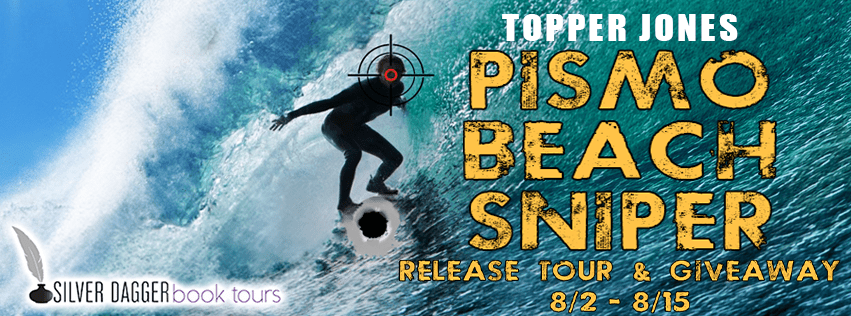
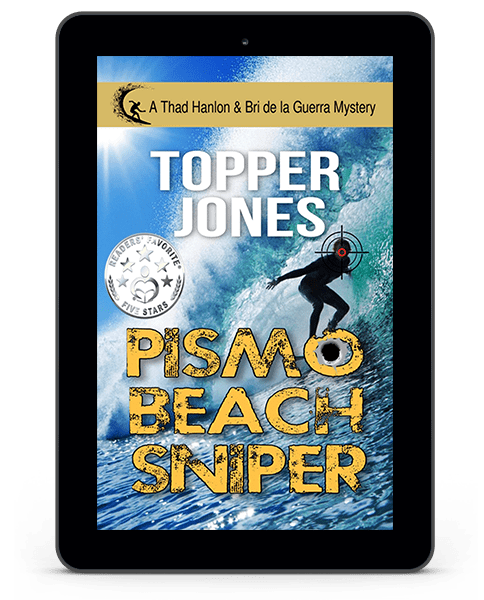
When sniper fire erupts at the Central Coast Surf Trials at
Pismo Beach, private investigator Thad Hanlon is thrust into every parent’s
worst nightmare. His eleven-year-old son and two teammates are shot while
surfing—one critically injured—plunging the contest into chaos and terrorizing
the tight-knit Five Cities beach community.
The shooter disappears, torching his hideout, leaving only questions in his
wake. Random attack—or the first move in a deadly game? Why target young
surfers? And is the marksman finished…or just getting started?
Urged by desperate parents, Hanlon and his sharp-witted partner, Bri de la
Guerra, race to protect the kids as they train for the upcoming West Coast
Championships. But as the detective duo close in on the sniper, they uncover a
chilling truth: the surf team isn’t his ultimate target—and the nightmare is
far from over.
This gripping thriller will keep you turning pages late into the night.
What Critics Are Saying
“Engaging characters, wit, and suspense elevate this rip-curling
page-turner.”
— Kirkus Reviews
“Pismo Beach Sniper is a tense and fast-moving mystery
with real emotional stakes. The target audience is readers who enjoy mystery,
private investigator fiction, crime thrillers, action suspense, coastal noir,
and family-driven detective series. Readers who like Robert Crais’s Elvis Cole
and Joe Pike novels may appreciate the same mix of banter, loyalty, and
wounded-hearted heroism, though Jones swaps Los Angeles grit for Central Coast
surf and spiritual undertow.”
— Literary Titan
“It felt like I was reading something akin to James Patterson: fast,
frighteningly imaginative, and furious with action. Pismo Beach
Sniper is a deftly plotted story of a man doing everything to keep his
child safe in a world where not only waves can kill.”
I was sitting under a beach canopy in the spectator
section of the California Central Coast Surf Trials, watching the first heat of
the semifinals, when I heard the sonic crack of a large firearm. Something
long-range like the scoped high-precision rifle my business partner, Bri, uses
to qualify at the Five Cities Shoot’n Center.
“What was that?” my son’s surf coach asked. Gev Burian
was sitting on my left. “Sounded like it came from behind us.”
Bri de la Guerra, on my right, stood to check things
out. “Cityside, yeah. I’m thinking .30 cal. Maybe three-oh-eight.”
I swiveled to scan the low-rise buildings of downtown
Pismo—the seafood cafes, souvenir shops, and beach rentals. Clumps of tourists
meandering down narrow Pomeroy Avenue stopped. Some gazed skyward, herd-like,
examining the highest roofline—the old Hotel Pier Vista. Others rushed indoors.
When a second blast didn’t happen soon after, I saw
pedestrians raise their palms in the classic “what’s up” shrug before
continuing their weekend saunter. Some, trailing well-groomed dogs on leashes,
took refuge in their smartphones.
I turned to face the Pacific as Bri sat in her folding
chair. Coach Gev got out his binocs and we rejoined the hundreds of other
parents, friends, and supporters along the beach to watch the tournament.
Three junior surfers, ages eleven to twelve—”grommets”
in surf jargon—were perched on their boards 100 yards offshore in the chilly
morning waters north of Pismo Pier. The contestants wore different colored
jerseys over their wetsuits. Red jersey had priority takeoff; the next wave was
his. As the kids waited for the sets to roll in, they bobbed in the mushy surf
like sitting ducks.
“Yellow’s down!” Coach Gev shouted. He handed me his
binoculars. “The kid’s slumped sideways off his board.”
“Cramp, maybe?” I pressed the field glasses to the
bridge of my nose, fiddling with the adjustments. “January water temps are
cold, fifty-three, fifty-four degrees. These temps? He should have worn a 5/4/3
mm instead. Maybe even a—”
There was a second sonic crack. I watched Yellow’s board
splinter into pieces. Chunks of the foam core ringed the downed contestant as
he struggled to keep his head above water.
Red jersey, closest to Yellow, dropped prone and paddled
with fury toward him. Just as he was about to grab Yellow’s arm, I heard shot
three. There was a splash near the tail of Red’s board.
Red turned turtle, flipping his tri-fin surfboard over
so the bottom faced the sky. Only his hands, gripping the sides of the
shortboard, were exposed.
Shot four took out Red’s middle fin. Shots five and six
took out the two outer fins. Red let go of his board and sank out of view.
That left the eleven-year-old in the light blue jersey
as the only contender sitting on the water. My son, Zael, was in full
competition mode, hyper-focused on The One Thing—a wave with his name on it. A
wave built by the sea gods just for him, for his performance, his tricks, the
ones he’d stick. The 10-rating he’d be awarded by all three judges. That
perfect ten.
Zael was in the zone, tunnel vision his ally. Chaos
bending to will. He had no clue what had happened to Red and Yellow.
I popped out of my beach chair, sprinted from our shade
canopy to the shoreline, and screamed as I waded in. “Duck and cover, Zael! Get
down! Now!” I waved my arms, zigzagging through the shallows.
My son wasn’t hearing me, wasn’t seeing me, wasn’t even
attuned to my panic despite his gift for sensing things unspoken. Zael paddled
hard for takeoff, slid into the three-foot wave breaking off the pier, and
dropped into the curl. He drove down the line, pumping his board to build
speed, then bottom turned, and angled toward the lip to launch into his
signature 360-degree air rotation and—
Blam.
Shot seven.
Zael’s right leg buckled. He lost balance and angled
into a dive as far away from his board as his leash would let him. When he didn’t
come up for air…
.
,
.
.
.
Are your characters based on real people or did they all come entirely from your imagination?
Mostly the latter. One of the two primary protagonists in PISMO BEACH SNIPER, Bri de la Guerra, is pure fiction. The other primary protagonist, Thad Hanlon, while also make-believe, was inspired by my nephew, who has competed internationally in surfing like Thad. But that’s where the similarity ends. Unlike Thad, who washed out of the pros, my nephew still competes. And my nephew’s a firefighter, not a private eye.
The ocean feels almost like a character in PISMO BEACH SNIPER. What role does the California Central Coast play in shaping the story’s mood?
The Pacific Ocean is a moody presence. At times, she provides solace from the daily grind. A chance to take a dip, cool off, and catch a few waves. And at other times, when big weather rolls in and the swells kick up, she can be a cruel monster, lashing out with rip tides and pounding surf. In Thad Hanlon’s world, the ocean is simultaneously a source of comfort, danger, and wisdom. When life becomes complicated, he paddles out beyond the break. The rhythm of the waves helps him untangle the Gordian knot of mysteries he’s facing and decide what to do next. In that sense, the Pacific isn’t just a setting—it’s a trusted companion in the story.
The novel blends PI procedural, action suspense, family drama, and coastal noir. How do you balance those elements while keeping the story moving?
By ensuring tension in every scene. That’s the secret to keeping the story moving when you’re juggling multiple elements.
For each scene, I work from a cinematic framework inspired by Blake Snyder’s Save the Cat!® approach to screenwriting. I start with a simple structure: where the scene takes place, what is happening, and—most importantly—the emotional arc of the point-of-view character.
From there, I focus on what really drives momentum: the conflict. Who wants what, what stands in their way, and what’s at stake if they fail. If I can clearly define Hero—Goal—Obstacles—Stakes, the tension takes care of itself, and the story keeps moving.
Thad’s fear for Zael gives the mystery a strong emotional charge. How did you approach writing him as both a father and an investigator?
For the father side of Thad, I simply tapped into my own experience raising two sons. While I had the good fortune of a supportive wife to share the journey, there were still plenty of nights spent worrying about our boys—especially during their tween years, when sports, adventure, and growing independence seemed to present a new reason to worry every week. No parent survives those years without a healthy concern for their children’s safety.
For the investigator side, I drew on my professional training as a CPA, software developer, and college professor. I’m analytical by nature. I like patterns, puzzles, and problem-solving. I can be methodical to a fault and have been known to spreadsheet just about everything.
The challenge—and the fun—was bringing those two sides together. When Thad is investigating a case, he wants to follow the facts wherever they lead. When his son is in danger, he’s a father first. The tension between those roles gave the story much of its emotional energy.
Who inspired you to write PISMO BEACH SNIPER?
I have an “idea catcher.” I bet you have one too.
Mine’s a little notebook on the nightstand where I jot down inspirations that arrive while I sleep, dream, or ponder. It’s chock-full of ideas for the next murder mystery—the howdunnits, the whodunnits, the whydunnits, even possible book titles.
But getting from a brilliant idea to a fully developed manuscript sometimes takes more than a notebook.
Sometimes it requires a mentor. A force majeure.
This is the story of the man who inspired me to finish PISMO BEACH SNIPER.
The year is 2022. Mid-January. I’m taking an eight-week novel writing class through the Institute for Continued Learning at Utah Tech University. Dr. Warren Stucki, author of the Dr. Cooper Mystery Series and six standalone novels, is teaching.
On day one, he tells us, “This is the year you write your novel,” and challenges us to complete Assignment #1—NOVEL IDEA SUMMARY SHEET—by the following week.
All we have to do is fill in the blanks:
(a) Working Title
(b) Genre
(c) Protagonist
(d) Antagonist
(e) Main Supporting Character
(f) Setting
(g) A one-line story idea describing the central problem the protagonist faces and the primary obstacles.
Piece of cake, right?
I had a possible title, but that was it.
Something I had come up with in 2016, years before I had even published the first two books in the Thad Hanlon & Bri de la Guerra Mystery Series.
For the assignment’s Working Title, I wrote down:
CowaBANGa!
A mashup of two exclamations that seemed incapable of belonging together.
Cowabunga!—surf slang for “Dude, that was Awwwwsome!”
BANG!—the sonic crack of a high-powered rifle.
It was high concept.
Excited surfers and unexpected gunplay.
But that was all I had.
Assignment #1 forced me to take the next step.
I scratched out the remaining fill-in-the-blanks, relying heavily on the backstories from my first two books. By the end of the eight-week course, I’d developed a working outline, key plot points, three sample chapters, and a draft query letter complete with a three-paragraph blurb.
I was well on my way to writing PISMO BEACH SNIPER, book three in the series.
My takeaway from Dr. Stucki’s class?
A force majeure can make all the difference between a middle-of-the-night inspiration scribbled into an idea catcher and a finished book on the shelf.
When all you have is the germ of an idea, sign up for a workshop. Let the instructor—and the energy of fellow writers—propel you from a mere notion to a fully realized story complete with character arcs, themes, and purpose.
Muse + Force Majeure = Your next masterpiece on the shelf!
What can we expect from you in the future?
Book Four, of course.
The next installment in the Thad Hanlon & Bri de la Guerra Mystery Series takes place two years after the events of PISMO BEACH SNIPER. Bri is out drumming up new business for the duo’s detecting agency when she stumbles upon a murder that will test both detectives in ways they never imagined.
Here’s the opening scene:
***
Even in the moonlight, Bri recognized the man floating face down in the cliffside pool as Dr. Yicheng Zhang. Potential client. The world-renowned fertility researcher was fully clothed in his signature charcoal wool-blend blazer with well-worn elbow patches, and he didn’t look so good. Pale, bluish skin, and that wild black hair of his fanned out like sea grass.
Bri sprinted to the rescue hook hanging on the cabana wall and used it to snag the good doctor, pulling him toward the pool steps. She strained to flip him over. His lips, forehead, and tip of his nose were a blotchy purple. There was a fine white froth around his nostrils. She checked for a pulse in a Good Samaritan move she knew didn’t have favorable odds. Still, she had to try.
The odds didn’t pan out.
Across the glass wall of the pool that faced the Pacific—brooding more than usual— someone had spray-painted in angry caps:
PERFECTION HAS A PRICE
***
True to cliché, the Five Cities Sheriff’s Department immediately suspects the spouse. But Mrs. Zhang insists she’s innocent, has an ironclad alibi, and hires Bri and Thad to find the real killer.
That’s when the case heats up.
As the investigation deepens, frozen embryos—including those intended for Thad’s future family—become a bargaining chip in a deadly game where science, ambition, and obsession collide.
Shell Beach Slayer (working title) is part mystery, part thriller, and brings back familiar faces, including Thad’s son Zael, now a teenager, and Naiya Ygnacio, his new bride. The stakes couldn’t be higher as Bri and Thad navigate a case that explores designer children, genetic engineering, and the meaning of perfection itself.
.
.
.
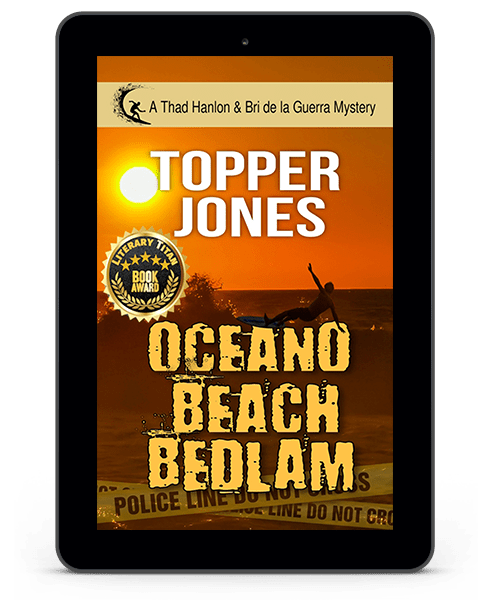
Oceano Beach Bedlam
A Thad Hanlon/ Bri de la Guerra Mystery Book 2
Hanlon & de la Guerra have gone full service. In this
second book in the surfing crime-fighter mystery series, Thad Hanlon and his
martial-arts-obsessed partner, Bri de la Guerra, hang out their shingle as
newly licensed private investigators. Now in addition to fraud-busting, the two
detectives do it all. Background checks. Surveillance. Even finding lost souls.
Just about anything that requires sleuthing or going undercover.
All they need is a client.
That’s when a former exotic dancer from Bakersfield CA shows up looking for her
surf prodigy son who’s gone missing in the wake of cult violence terrorizing
the California Central Coast.
What Critics
Are Saying
“A crunchy detective novel set in the world of California surfers.
Jones delivers a proper beach read, both in form and content.”
-Kirkus Reviews
“Honestly, I had a blast with this one. Oceano Beach
Bedlam is a smart and entertaining read. If you like your mysteries with
surfboards, sass, and just enough heart to keep you caring, this one’s for you.
It’s a great pick for fans of offbeat detectives, fast dialogue, and
sun-drenched noir with a brain and a soul. I’d recommend it to readers who
enjoy Janet Evanovich, Robert Crais, or the beachier edges of Elmore Leonard.”
When the facts don’t add up in his surf buddy’s bizarre
death, forensic consultant (and daddy-to-be) Thaddeus Hanlon investigates,
volunteering to go undercover to pick up where best friend Rafi Silva left off
in a secret probe of the U.S. gold stockpile—every last bullion bar.
Rafi’s spunky fiancée, Bri de la Guerra, has suspicions of her own and soon
joins Thad on the hunt for answers. Together, the two amateur sleuths delve
deep, stumbling onto a financial a-stock-alypse in the making, triggering a
brutal manhunt along the Eastern seaboard meant to silence anyone looking to
set the ledger straight.
What Critics
Are Saying
“Jones’ action-packed murder mystery…is
tension-fueled with plenty of twists and two appealing sleuths. In this
detective series opener, Thad Hanlon, a 27-year-old forensic accountant,
becomes the target of a murderous cadre when he accepts a new assignment that
takes him from Los Angeles to the East Coast center of power. Woven into the
gripping plot are sensual, detailed descriptions of Thad’s adventures riding
the waves, which should please the surfer crowd and afford others a visceral
sense of the experience.”
—Kirkus Reviews
“All That Glisters by Topper Jones is well-written with not a
single dull moment. I liked the way the author included elements of action,
mystery, and even some cyber investigating. Overall, I found this book to be an
amazing read.”
Writing
as Topper Jones, award-winning author Christopher G. Jones, Ph.D., delivers
detective fiction with a dash of romance, plenty of action, and memorable
characters. His Thad Hanlon & Bri de la Guerra Mystery Series has earned
Readers’ Favorite Five Stars and the Literary Titan Gold Book Awards.
Before
writing full-time, Jones taught financial reporting and business systems
development at the university level and worked in public accounting and
consulting. He is a member of The Private Eye Writers of America and
International Thriller Writers, and an affiliate of Mystery Writers of America.
To
stay close to family, Jones now lives in the southwestern desert rather than
his native California. But when the surf’s up, he’ll make the 450-mile trek to
the coast for a little “water therapy.”
Best Friends: The Orion Sessions by Cheryl DaVeiga
Category: Middle-Grade Fiction (Ages 9-13), 144 pages Genre: Contemporary Middle-Grade Fiction Publisher: Waterhole Productions LLC Release date: April 12, 2026 Content Rating: G. Written for middle-grade audience.
Book Description:
At thirteen, Orion Casey has stopped singing—and it’s not because she stopped loving it. After the girls everyone follows start talking about her instead of to her, she’s finished performing for anyone.
Then the messages start.
Anonymous. Encouraging. A little too perfectly timed.
Someone’s been watching her—really seeing her—and part of Orion can’t help hoping it’s the one person she wishes would notice her back. The texts give Orion confidence she didn’t know she had—enough to discover songwriting and a new way back to her music.
But as friendships shift and secrets surface, Orion begins to wonder: when the way you see yourself keeps changing based on who’s looking at you, how do you figure out who you really are?
Best Friends launches The Orion Sessions, a contemporary middle-grade series about friendship, self-confidence, and learning what it means to sing—and live—for yourself.
Category: Middle-Grade Fiction (Ages 9-13), Genre: Contemporary Middle-Grade Fiction Publisher: Waterhole Productions LLC Release date: July 15, 2026 Format available for review: ebook (PDF) Tour dates: June 22 to July 10, 2026 Content Rating: G. Written for middle-grade audience.
Book Description:
She finally found her voice. Now someone’s stolen it.
Thirteen-year-old Orion Casey arrives at songwriting camp ready to write, perform, and finally belong. Then she meets Ava Rae: TikTok-famous, confident, and exactly the kind of songwriter Orion hopes to be someday. When Ava Rae asks Orion to co-write a song for a real music producer, it feels like the universe finally has her back.
It doesn’t.
The morning after their late-night session under the stars, Orion wakes up to a post blowing up on social media. Ava Rae has uploaded their song — every chord, every lyric, every melody that was more Orion’s than hers — and claimed it as her own. Orion’s name? Nowhere. And the notebook with all the proof? Gone.
Now Orion is up against something she never saw coming. She’s been written out of her own story. And in a camp full of kids who worship Ava Rae, who’s going to believe her?
Stolen is Book 2 of The Orion Sessions — a fast-paced trilogy for music lovers and anyone who’s ever trusted the wrong person or had to fight to be believed.
The Orion Sessions has an original soundtrack that goes along with the books. How did that come about?
I’m a songwriter myself—that’s where much of my creative life began, before I wrote books. So, when I started writing about a girl finding her voice through music, it felt natural that the songs shouldn’t just be described; they should exist. I worked with my longtime collaborator Anthony Krizan to write original songs tied to key moments in the books, and with talented 14-year-old Quinn Carson to record vocals for many of them. Each book includes QR codes that link to the songs on YouTube, and they’re also available on Spotify in The Orion Sessions Playlist. Readers can hear the music Orion creates—not just read about her finding her voice but listen to it.
Because she just becomes a songwriter in Book 1, most of the actual songwriting occurs in Books 2 and 3. More songs are coming throughout the summer.
If a reader only takes away one thing from Best Friends, what do you hope it is?
That they’re not alone — and that who they are right now is enough. So much of middle school is spent comparing yourself to everyone else, wondering if you’re doing it “right.” If a kid closes this book feeling like it’s okay to take up space as themselves, without shrinking down or performing for anyone else, I’ll feel like it did its job.
Friendship is at the heart of Best Friends — including its title. How does that theme play out for Orion?
It has a double meaning, which I love. Orion’s best friend, Izzy, is a steady anchor for her—the kind of loyal, long-standing friendship that helps her through so much. Then Orion meets a boy named Jesse, who introduces her to songwriting, and together they write a song called “Best Friends.” Through that process, Jesse becomes a different kind of best friend: someone who helps Orion discover a part of herself she didn’t know was there.
So “Best Friends” works on two levels: it’s about the friendships that hold us up, and it’s also the title of the song that becomes a turning point for Orion. I liked that the title could carry both meanings at once — the people in our lives and the things those people help us find in ourselves.
You’ve talked about kids today being caught up in “following” rather than “doing.” How does Orion’s arc push back against that?
Orion starts the story very much focused on what other people think — fitting in, being accepted, not standing out in the wrong way. The shift happens when she starts creating something of her own through music, rather than just reacting to everyone around her. That’s the difference between following and doing. When you’re making something — even something small or imperfect — you start to find out who you are, instead of just managing how you’re perceived.
You mentioned sharing the book with a middle school class. Was there a moment from that experience that stuck with you?
Yes — watching how quickly kids connected with Izzy. She’s a supporting character, not the lead, but so many of them saw themselves in her. It reminded me that readers don’t always identify with the “main” struggle — sometimes it’s the character on the edges who feels most like them. That’s stayed with me, and it’s part of why I try to make sure every character in the series feels like a real person, not just a function of the plot.
What do you hope teachers, parents, or other adults take away from this book, even though it’s written for kids?
I hope adults remember how much weight middle schoolers are carrying — about belonging, identity, and self-worth — even when it doesn’t look that way from the outside. These books are fiction, but the feelings are very real. If reading Best Friends gives an adult a way into a conversation with a kid about what they’re going through, that’s just as valuable to me as the kid enjoying the story on its own.
.
.
,
Meet Author Cheryl DaVeiga:
Cheryl DaVeiga grew up loving music—singing, writing, and dreaming in melodies. Following that passion was never framed as a real option, so she chose a path that felt defined and practical, building a career in accounting and eventually becoming a partner at a national firm.
Years later, she found her way back to the music she had set aside, becoming an award-winning songwriter recognized by ASCAP and ultimately discovering the joy of writing children’s books. Across her seven picture books—stories infused with music, humor, and sing-along joy—her work has received award recognition from the Eric Hoffer Book Awards, Mom’s Choice Awards (Gold), Purple Dragonfly Book Awards, and Literary Titan.
But even as she wrote those playful stories, she knew there was another one waiting—one rooted in the girl she used to be and the voice she had tucked away. That story became The Orion Sessions, a middle-grade trilogy for kids growing up in the real world—with music, of course. The Orion Sessions is the series Cheryl wishes she’d had when she was twelve: full of music, friendship, mistakes, courage, and the journey of reclaiming the voice she’d hidden to fit in.
Cheryl lives in Tucson with her partner, Doug, and they spend summers in New Jersey. She still sings… like all the time.
💫 GRAND PRIZE (1 Winner):
📚 Signed copy of Best Friends
📚 Exclusive advance paperback copy of Stolen (Book Two — before its release!)
🎧 Audiobook access to Best Friends, narrated by award-winning voice actress Jesse Vilinsky
📓 Middle School Survival Kit (journal, friendship goodies, and fun surprises)✨ PLUS:
📚 10 winners will receive a signed copy of Best Friends + a bookmark
🎧 10 winners will receive audiobook access to Best Friends
Category: Adult Fiction (18 +), 316 pages Genre: Suspense Thriller Publisher: Ewephoric Publishing Release date: March 2026 Content Rating: PG because: There are a couple of references such as “hell” or “damn” in the dialog. No sex. Mild attraction. Mild description of dead bodies. Not too graphic. No strong language.
.
Book Description:
First they stole her trust. Now they want her life.
April Manning’s generous nature has always been a gift, and her greatest weakness. After being conned out of her life savings she’s left with an eviction notice and one last hope: reclaiming her old job at an architectural firm, even if it forces a showdown with head architect Hunter Ellis, her cheating ex-boyfriend.
There’s only one small hitch. The owner of the firm is dead, and the last thing April expects to find is the bloody murder weapon on her doorstep.
As the killer runs free, disturbing reminders arise from April’s troubled childhood, and suspicion flares at every turn…from the mysterious new handyman, to an estranged family member she’s tried to forget. Only one thing is certain. Death is stalking April, and she must unmask the killer before they land the fatal blow.
How would you describe your style of writing to someone who has never read your work?
I like building each scene where it has a life of its own—using the protagonist’s five senses, not just her visuals, but more emphasis on smells and tastes. Adding metaphors to give the reader a sensory ride brings realism into each chapter.
My books are easy to read with shorter sentences, utilizing words most of us use every day. My chapters always end on a cliffhanger. This assures the reader will want to turn pages to find the answers. Chapters are typically short and direct whenever possible. The Longest Chapter I’ve Written Award goes to A HUSH AT MIDNIGHT. Chapter one is 23 pages in order to introduce the history with the victim and my main character before the murder.
I write complicated mysteries to entice the reader to think about the twists in each book.
What mindset or routine do you feel the need to set when preparing to write (in general whether you are working on a project or just free writing)?
I’m too regimented to free write. One story at a time, one idea at a time, is my motto. From my thoughts onto 4 x 6 cards to detail out each scene, finally building the cards into complete chapters. I spend a great deal of time thinking about each scene, usually from the opening line, and making notations about what events will happen in the book. To weave a complicated mystery with numerous red herrings, I’ve found this practice works the best to ensure that all potential plot holes are covered. If you’ve read my mysteries, you’ll understand why this process leaves less room for errors.
Do you take your character prep to heart? Do you nurture the growth of each character all the way through to the page? Do you people watch to help with development? Or do you build upon your character during story creation?
Prior to starting a novel, I make a fictitious background and character profile for each individual who makes an appearance in the book. Each person gets a thorough family history and detailed personality including their political beliefs, habits, where they were raised, nationality, and vocation, among other things. I get to know each character a head of time and add more details as I write. Sometimes the characters speak to me if I’ve made a mistake in my calculations of how he/she should act in their roles. I like to layer on personality traits with every appearance they make in the book, but I refer to the Character Profiles often.
The hardest character to write is the villain, but they are my favorite to develop. Most of my characters have a frustrating side for the reader, which is part of the tension, but only one can truly be the ringleader bad guy in the end. I have to hold back tendencies to write the mustache-twisting guy or gal depicted best from old movies. My villains can be quirky yet likeable; that’s why they are harder to detect for the reader.
The tension between my series characters, Annalisse Drury and Alec Zavos is an ongoing adventure throughout four installments. My standalones, A HUSH AT MIDNIGHT AND LIES TO FOREVER show flawed female main characters who have to deal with the murder of a loved one in the first chapter. You’ll find me inside each of these women.
Do you have a character that you have been working on that you can’t wait to put to paper?
Yes! I find myself drawn to reading time travel fantasy that takes place in the 1800s or possibly the 1700s. (Before modern technology and the distractions we have in our time.) In a past life, I must have lived during this time because it calls to me. That may be why I wrote Annalisse as an antiquities valuator. History intrigues me as much as it does her. At some point, I’d like to write a time travel novel; a standalone perhaps, with the option to add series books. A woman protagonist will reside here too, since I can relate to women’s thoughts much better than getting into a man’s head.
Can you share your next creative project? If yes, can you give a few details?
My new release (March 2026) LIES TO FOREVER, is a suspense thriller that takes place in the Smoky Mountains of Tennessee. Here’s a short description of this book:
A stalker wants her. After being scammed out of her life savings by a friend, April Manning is left with an eviction notice, a dead boss, and gunshots flying at her. When the victim’s murder weapon appears on her doorstep and childhood horrors follow her, the monster from the snowy Tennessee Appalachian woods has April in the crosshairs.
**In addition, I’m currently outlining another standalone mystery from my past as a California resident. The Northern California Coastline is the focus, and a protagonist in a bad personal relationship in need of an escape rounds out the opening chapters. (Title and book details to be divulged at a later date.)
Thank you for sharing my thoughts with your readers!
.
.
Meet Author Marlene M. Bell:
Marlene M. Bell shares many traits with the bold protagonists she writes. Her Annalisse series stars a New York antiquities appraiser who chases dangerous criminals in far-flung locales. The series has won eight international literary awards and an avid fan base around the world. When Marlene’s not busy plotting her next novel, she’s exploring her wooded Texas ranch with camera in hand and thirty sheep faithfully in tow. As an accomplished painter and nature photographer, she’s always hunting for the next spark of inspiration – or the next adventure calling her name. connect with the author: website ~ X ~ facebook ~ instagram ~ goodreads
Category: Adult Fiction (18 +), 337 pages Genre: Historical Fiction Publisher: A Good Read Publishing Release date: February 2026 Content Rating: PG +M: Some non-explicit discussions of sex; one subtle yet explicit sex scene and a brief discussion of suicide
Book Description:
Born the bastard daughter of an aristocrat, Jane Avril became the most famous dancer at the most famous dance hall in the world during the “Gay 90’s” in Paris: the Moulin Rouge. Beautiful, intelligent, and fiercely independent, she earned a place among the most famous artists, writers, and entertainers of her day, including Henri Toulouse Lautrec, who immortalized her in his paintings and posters. Immerse yourself in the turbulent and fascinating life of a Belle Epoque legend as she struggles out of poverty into the limelight, learning how to live and love as Queen of La Danse.
It wasn’t a conscious decision. I wrote my first short story when I was six years old, about a rabbit who makes friends with a giraffe. Two years later my parents gave me a small pink, plastic typewriter, and I churned out story after story. I have a colossal, relentless imagination. Even today, stories appear like movies in my head and out comes the laptop. Writing has always been how I process the world. Getting paid for it was a dream come true.
You’ve worked as a journalist and a fiction writer. Which type of writing do you like best?
As a journalist, I loved uncovering facts and weaving them into stories that mattered to people. But my first love is fiction. Historical fiction, to be precise. My mother went back to school when she was thirty and already had four children. She earned her BA, her MA, and then was awarded her PHD the same week that I graduated from high school. She majored in history. Instead of fairy tales, she regaled us with stories about events like the American Revolution, Napoleon’s conquests, and the collapse of the Austrio-Hungarian Empire. She told us about the people involved, not just the “boring history” part. John and Abigail Adams. Napoleon and Josephine. Empress Elizabeth of Austria. The fascination of and love for stories grounded in historical events has never left me.
Where do you get the ideas for your stories?
I’m a history geek. I’ll discover some intriguing, little-known historical nugget, and dive into research mode to find out more about it. Eventually a story begins evolving in my head. My first book found life in Shanghai between the two World Words. It was the only place in the civilized world you could go to without a passport or a visa and just start over. Shanghai was a haven for businessmen, villains, and refugees of all kinds: a perfect setting for a historical thriller.
I usually create fictional characters and drop them somewhere in the riptide of history. They experience actual historical events and interact with real historical figures. My latest book, about Jane Avril, is a departure from that structure. This time I wrote in first person about a real historical character. I call it a “fictional autobiography.” The book is largely based on her memoirs.
What is the first book that made you cry?
Gone with the Wind. I was eleven when I read it and cried hysterically for days. Then I would put the movie soundtrack on my record player and cry some more.
What authors did you dislike at first but grow into?
Gabriel García Márquez. I hated One Hundred Years of Solitude when I first read it. I read it again five years later and loved it. I’ve read everything he’s written. We were all forced to read Of Human Bondage by Somerset Maugham in high school, which I detested, but years later I stumbled across The Painted Veil, loved it, and have enjoyed many of his other works.
.
.
Meet Author M.L. Malcolm:
M.L. Malcolm loves readers! She has visited with over a hundred book clubs all over the country, and is happy to use Zoom or whatever technology is available to connect when a personal visit isn’t possible. She’s also a history geek, so she loves reading and writing historical fiction.
She began her professional career as an attorney in Atlanta, Georgia. After practicing law for three years, M.L. determined that “she and the law were not meant for each other,” and is now a self-described “recovering attorney.”
As part of her recovery strategy, M.L. yielded to her entrepreneurial inclinations and took over a struggling travel agency. She ran the business successfully for several years before selling it to a larger company, then retired from the labor force to spend more time with her children and pursue her life-long ambition to become a writer. She has also amassed an impressive hat collection (and yes, she does wear them).
M.L. has won several awards, including recognition in the prestigious Lorian Hemingway International Short Story Competition, and a silver medal from ForeWord magazine for Best Historical Fiction Book of the Year. “Heart of Lies” was chosen by the American Booksellers Association as an “Indie Pick” and a “Recommended Book Club Read” selection, and M.L. was selected by Target Stores as an “Author to Watch”. She has also worked as a free-lance journalist for newspapers and magazines in Washington, DC and Los Angeles.
She and her family currently live in Washington, DC. M.L. is her nickname. Her full name is Mary Lee Malcolm
Category: Adult Fiction, 272 pages Genre: Mystery, Suspense, Thriller Publisher: SparkPress Publication Date: October 2024 Content Rating:PG -13 rating for: There are no f-words but there is some violence (attempted murder) and some non-explicit references to sex, alcohol and recreational drugs.
Book Description:
Gone Girl’s twists, The Social Network‘s scheming, and Agatha Christie’s sleuthing come together in this suspenseful novel, a bingeworthy mystery set in Toronto that spans corporate intrigue, murder, and marital mismatch. Who would want to harm a well-liked CEO at the top of his game, and why? In the summer of 2021, Canadian tech entrepreneur Tom Oliver is considering selling his company to a Silicon Valley buyer when he becomes the target of an unknown perpetrator. As his friend and homicide detective Jason Liu investigates a web of secrets and deceit, Tom’s inner circle of family and colleagues comes under scrutiny.
Devious Web brings you into the world of business, US politics, social media, and family drama. If you were enthralled watching Suits and Succession, you’ll enjoy the high suspense, fast pace, and unexpected plot twists of this compelling novel.
Your book has a mix of mystery, business issues, US politics, family dynamics, and even horses. What did you draw on to create the story of Devious Web?
My career has spanned journalism and tech sector communications/public relations with a focus on writing about fiber optic communications. I have also owned horses for many years, so it’s likely no surprise that the main character in Devious Web is a software company CEO and an equestrian. A keen interest in US politics is also reflected in the book. Overall, I’m fascinated by mysteries and interpersonal relationships, so the twisty plot with compelling characters comes from a place of innate intrigue.
What was your biggest challenge when writing the novel?
I found it challenging to ensure that the action launched early in the book while simultaneously introducing characters to readers. The beginning chapters of the book were the most daunting to write, knowing that readers determine their interest level in a book quickly based on the opening scenes. I’m delighted when readers tell me that they like the way the action unfolds early on and that they like the pace of the book.
Who has been your toughest critic?
I confess that I’m my own toughest critic! When asked how long it took me to write the book, I answer truthfully that the first draft took about three months. But the self-editing process was ongoing for longer because I tend to be a perfectionist and appreciate the use of the right word or phrase at the right time.
You published with hybrid publisher SparkPress. Why did you accept an offer to publish with them?
The short answer is that I’m an older author with a shorter publishing runway than a ‘twenty-something’ and working with SparkPress enabled getting my book into the market faster. To land a publishing deal with a traditional publisher, authors first need to enlist the help of an agent which is time-consuming. At the other end of the spectrum is self-publishing which requires no editorial vetting, given anyone can self-publish. Independent presses and hybrid publishers provide a middle ground where editorial rigor is applied but authors can submit manuscripts directly without an agent. I submitted my manuscript to SparkPress due to their reputation of quality publishing and distribution partnership with Simon & Schuster.
After creating a series of compelling characters, do they seem real to you?
My goal with the characters was to make them authentic for readers and to do that, I visualized each of them in detail including their physical and personality traits. My characters are well defined in my mind to the extent that I can picture going for a business lunch with Tom and his investor Lawrence, having a glass of wine with Tom’s wife Miriam, or going gambling with bad boy Patrick. They certainly seem as large as life to me.
Have you had good feedback about your book cover and what inspired it?
Feedback on the book cover has been amazing! People love the black and red color combination and have commented that the graphic of a man about to walk into a boardroom is mysterious. The Toronto designer worked from my concept of a Mad Men graphic style, and she created the compelling design. I love the fact that there is an icon of the man on the spine of the book, and that the boardroom chair icons reappear on the back cover.
Are you planning to write a sequel to Devious Web?
Yes, I’m halfway through writing the sequel which will be set primarily in California as opposed to the main setting of Toronto in Devious Web. Some of the characters from the first novel crop up again in the second, including popular character Detective Jason Liu. Because I typically wear black and red at signing events to match the cover of Devious Web, I’m looking forward to a different cover design for book #2 featuring new colors so I can wear something different!
.
.
Meet Author Shelley Grandy:
Shelley Grandy is a Canadian communications professional whose type-A personality and honors journalism degree from Ottawa’s Carleton University fueled a career that started in newspapers and progressed to twenty-five years at high-tech
company Nortel.
She subsequently founded Grandy Public Relations Inc. and has supported tech sector clients in Ontario and Quebec for the past sixteen years.
After writing countless press releases and technical articles for trade media, Devious
Web is Shelley’s debut fiction novel.
When not writing, Shelley enjoys intriguing Netflix-style productions and is known to frequently reference scenes from Grace and Frankie.
You can also find her at the boarding stable with her horse, Briosa. Shelley lives in Trenton, Ontario, Canada, with husband of thirty-plus years Roy, husky dog Luka, and cat Otto, within spoiling distance of her beautiful granddaughters, Emilia and Olivia Oulds.
Category: Adult Fiction (18 +), 296 pages Genre: Literary Fiction Publisher: Troubadour UK Release date: October 2024 Content Rating: PG -13 + M rating for: There is contextual sex, violence and abuse.
.
Book Description:
Being born into poverty and hardship in 1930s London, Matthew’s life was one of relentless struggle. One inadvertent act in defence of his mother would haunt his conscience forever.
Matthew’s journey takes him from the poverty of a cold stone granary to the opulence of Mayfair and Kensington Palace Gardens, where he starts a family of his own. Despite working his way to the top of the business world, he remains an outsider to London’s elite. He then realises that that same elite has an ugly underbelly. High society was a hot bed of depravity.
Will he correct society’s wrongs? Will the man who never succumbed to expectations be able to challenge his own destiny or will he simply accept the futility of it all?
I researched the book as I wrote. I decided that I would start the main character’s life in abject poverty in 1930s London and then I researched as and when the story developed. I had to do quite a bit of research on the shipping industry, which was not known to me at all. Plus, I had to do research on Cancer and the potential post treatment hazards that can be fatal.
Which was the hardest character to write?
The hardest character, by far, was Matthew Stephens. Developing a three dimensional emotionally conflicted tycoon, husband, son and father needed many rewrites.
There are many books out there about rags to riches. What makes yours different?
I have tried to keep the narrative simple, while delving into inner victories and defeats of a human being. I was not looking to entertain or titillate but to just relate a human story without idolising the main character. There are many authors who deal with the human condition, but I wanted to do it in a manner that reflects my own value set, beliefs and spirituality.
Your book is set in (name place). Have you ever been there?
Th main part of the book is in London, where I spent my adult life and formative years until I moved to the continent.
What is your next project?
I am working on a family story where the female protagonist, a well to do English family lady, makes an unusual compromise but eventually lives to regret it; she then looks for a purpose by travelling to India. Although I have Indian roots, I am having to research quite a bit on the area where she begins her journey. I intend it to be a complex story reflecting different levels of existence.
What genre do you write and why?
I write the only genre I read, literary fiction. I believe that my language skills are well suited to write in a sustained, deliberative manner while weaving the story.
.
.
Meet Author Arvind Wadhera:
Arvind is French and British with roots in India. He lives and works in Brussels.
Arvind has three adult children, who all live away from Belgium. He reads literary fiction and was motivated to write after reading three key books: The Portrait of Dorian Gray, Thérèse Raquin, 1984 and East of Eden. He is fascinated by the co-existence of good and evil. In his first book, Emma’s Equilibrium, he relates the story of an Olympic winner who suffers hurt along the way. Choppiness on High Seas charts the life of Matthew from his ignominious birth to his passing away in peace after having become one of the weathiest persons in the world.
Arvind loves languages and can speak French, Spanish, Dutch, German, Italian, Hindi, Punjabi and Gujarati. He is a stroke survivor and rides, jogs and does yoga.
He is a strong believer in the duality of fortune and misfortune. He is deeply spiritual.
Arvind finds writing challenging and frustrating and editing particularly painful. He, however, believes that writing can be therapeutic and gratifying.



.jpg)
%20(2).png)


.png)











.png)


